
 Whatsapp
Agricultural Diversification and Organic Farming Explained
Understand how agricultural diversification and organic farming support rural development, with examples, income calculations, limitations and practice answers.
- 12th
- Economics
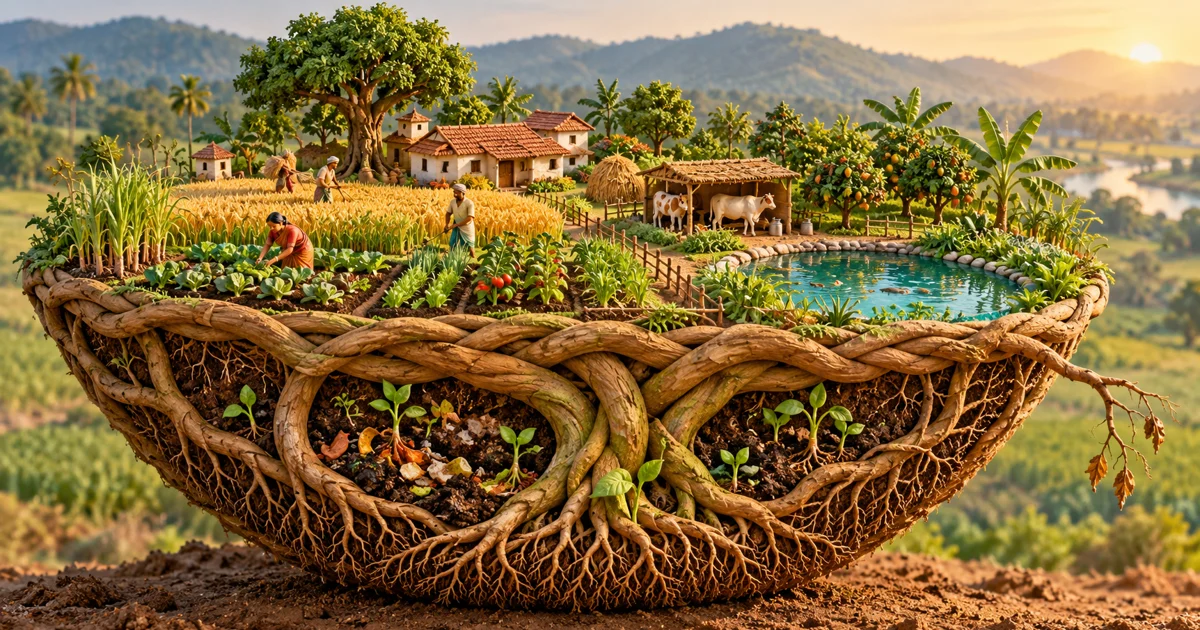
Imagine two village households. One waits for a single crop harvest to meet almost every expense. The other grows crops, sells a little milk and earns from repairing farm equipment. A disappointing harvest would hurt both, but their income would not necessarily fall by the same amount.
Now imagine that the first household starts using compost and a planned crop rotation. Has it diversified its sources of income? Perhaps, if it adds another crop. But changing its farming method alone does not prove that it has added a livelihood.
That distinction makes this whole topic easier.
Agricultural diversification concerns the mix of productive activities. Organic farming concerns how agricultural production is managed. Both can support rural development, but they solve different problems and need different kinds of support.
What is agricultural diversification?
Agricultural diversification includes changes in the cropping pattern and a movement into allied activities or non-farm work. The aim is to broaden productive opportunities instead of depending too heavily on one activity.
For revision, organise examples into three groups:
| Route | What changes? | Simple example |
|---|---|---|
| Crop diversification | The combination of crops | A cereal grower adds pulses and vegetables |
| Allied activities | The household adds another agricultural activity | A cultivator also keeps dairy animals |
| Non-farm activities | Work expands beyond agricultural production | A family member starts a repair workshop |
Livestock, poultry, fisheries and horticulture are important examples in this chapter. Food processing, handicrafts and services widen the rural employment picture. Rural development also requires education, health, credit and infrastructure; it cannot be measured by crop output alone. This framework follows NCERT’s Rural Development chapter.
Three similar cases with different answers
Case A: Meena continues growing wheat but increases the area under wheat. This is an expansion of the same crop, not evidence of crop diversification.
Case B: Meena uses part of her land for vegetables while retaining wheat. This changes her crop mix and is crop diversification.
Case C: Meena retains her original crop and her household opens a bicycle repair shop. The household has diversified into non-farm work even though its crop mix is unchanged.
Notice how little information you need for the classification. You do not need to invent a profit increase or assume the new activity succeeds.
How can diversification support rural development?
A useful way to explain the connection is to follow the household’s income through time.
1. Different income sources can soften a setback
Consider this fictional annual income comparison. Every figure is an assumed net contribution after the costs assigned to that activity. It is a teaching example, not a forecast of farm earnings.
| Household plan | Ordinary year | Year with a crop setback |
|---|---|---|
| Crop-only plan | Rs. 1,20,000 | Rs. 60,000 |
| Crops in diversified plan | Rs. 75,000 | Rs. 37,500 |
| Dairy in diversified plan | Rs. 30,000 | Rs. 30,000 |
| Repair work in diversified plan | Rs. 15,000 | Rs. 15,000 |
| Diversified plan total | Rs. 1,20,000 | Rs. 82,500 |
Both plans earn Rs. 1,20,000 in the ordinary year. In the setback year, crop income halves in both plans, while the example assumes that dairy and repair income remain unchanged.
The crop-only household loses Rs. 60,000, or 50%. The diversified household loses Rs. 37,500, or 31.25%. Its remaining income is Rs. 22,500 higher.
The lesson is about the distribution of risk, not a promise of higher income every year.
Now change the assumption. Suppose the same drought also raises feed costs and reduces customers’ spending on repairs. Dairy and repair earnings may fall too. The protection becomes weaker when several activities suffer together.
2. The timing of earnings matters
Suppose a household receives crop-sale money in April but pays food, transport and electricity bills every month. Even a profitable crop year can contain difficult months.
In a classroom example, regular milk receipts might help cover those bills between harvests. That does not mean all milk receipts are spare money: feed, transport and animal care still have to be paid for.
When explaining this benefit, use the phrase more regular cash receipts, then say why their timing helps the household. Avoid treating sales revenue and disposable income as the same thing.
3. A new activity can create work beyond the field
Imagine a village that begins processing its fruit into jam. Ask who might do the additional work: someone washes and grades fruit, someone cooks and packs it, and someone arranges deliveries.
This is a useful way to explain the connection between production and other local jobs. But ask a second question: will enough customers buy the jam at a price that covers its costs? A processing machine without buyers is not a complete development plan.
4. More employment must also mean worthwhile employment
Consider a family member who moves from occasional farm work into a workshop that offers paid work throughout the year. Compare that with a family member who simply adds long unpaid hours to an already full day.
Both cases may involve more activity. Only the first clearly demonstrates an improvement in paid employment from the information given. Strong answers consider earnings, working conditions and control over income, as well as the number of tasks performed.
What is organic farming?
Organic farming is a managed production system that builds soil fertility and uses ecological processes, while restricting or prohibiting specified inputs. It is not simply leaving a field alone.
Practices include crop rotations, green manures, composting, biological pest management and mechanical weed control. India’s National Programme for Organic Production sets requirements covering production plans, inputs, records and protection against contamination. Its standards prohibit synthetic nitrogenous fertilisers and specified synthetic pesticides; permitted inputs remain subject to conditions. These details are set out in APEDA’s NPOP standards, Chapter 3.
Calling organic farming “chemical-free” is an imprecise shortcut. Calling it “farming without any pest control” is also incorrect.
Think of the difference between adding one healthy habit and following a complete training programme. One practice may be helpful, but it does not tell you everything about the whole system.
Diversification and organic farming: keep the distinction clear
| Question to ask | Diversification | Organic farming |
|---|---|---|
| What is being examined? | The mix of activities or crops | The production system |
| What would you look for in a case? | An additional or different source of production or work | Evidence of organic management practices and requirements |
| Can they occur together? | Yes, a farmer can add crops within an organic system | Yes, organic management can include a varied crop plan |
| What should you avoid assuming? | More activities always mean more profit | An organic label guarantees higher profit |
Here is a quick classification exercise:
- A conventional farm adds a fish pond: diversification is described; organic production is not established.
- A rice farmer changes production practices while keeping rice as the sole crop: a method change is described; crop diversification is not established.
- A farm adds pulses and vegetables within an organic management plan: both ideas appear.
- A village starts a tailoring centre: non-farm diversification is described; organic farming is irrelevant to that activity.
How organic farming can help, and what can limit it
Organic management can support soil biological activity and biodiversity through rotations, organic matter and habitat management. Those environmental functions matter because farming depends on the productive condition of land over time. Outcomes still depend on local conditions and management. FAO discusses these relationships in its chapter on organic agriculture and the environment.
The economic balance is more complicated. Reduced purchases of some inputs may be offset by extra labour, organic material, machinery or marketing costs. Labour-intensive activities can create work where workers are available, but become a constraint where labour is scarce. FAO’s evaluation of organic agriculture therefore stresses examining the whole production system.
Transition is another consideration. Yields and costs can change when management changes, and results depend partly on the previous farming system and the farmer’s skills. A price premium can help only where suitable markets exist. These qualifications are discussed in FAO’s Committee on Agriculture paper.
Under NPOP, conversion has defined requirements, and produce in conversion is not automatically saleable as organic. For an economics answer, remember the implication: changing practices and receiving the full market benefit need not happen at the same time.
A worked example: why a premium does not guarantee profit
A fictional grower compares two annual plans. Assume that the cost figures include all relevant costs for this simplified exercise, including an allowance for family labour. There are no unsold stocks or other receipts.
| Item | Existing plan | Proposed organic plan |
|---|---|---|
| Quantity sold | 4,000 kg | 3,200 kg |
| Price received | Rs. 25 per kg | Rs. 32 per kg |
| Total revenue | Rs. 1,00,000 | Rs. 1,02,400 |
| Total cost | Rs. 65,000 | Rs. 70,000 |
| Surplus | Rs. 35,000 | Rs. 32,400 |
Step 1: Calculate revenue.
Existing plan: 4,000 x Rs. 25 = Rs. 1,00,000.
Proposed plan: 3,200 x Rs. 32 = Rs. 1,02,400.
Step 2: Subtract costs.
Existing surplus: Rs. 1,00,000 - Rs. 65,000 = Rs. 35,000.
Proposed surplus: Rs. 1,02,400 - Rs. 70,000 = Rs. 32,400.
The proposed price is 28% higher, but the surplus is Rs. 2,600 lower. In this example, a higher price does not fully compensate for lower quantity and higher total cost.
Step 3: Find the price needed to match the old surplus.
Required revenue = proposed cost + target surplus.
Required revenue = Rs. 70,000 + Rs. 35,000 = Rs. 1,05,000.
Required price = Rs. 1,05,000 / 3,200 = Rs. 32.8125 per kg, or about Rs. 32.82 when rounded up to the nearest paisa.
This is the price needed to match the old surplus, not merely to cover costs. The cost-covering price is Rs. 70,000 / 3,200 = Rs. 21.875 per kg.
The example does not predict that organic farming must be less profitable. Change the quantity, realised price or costs and the conclusion may change. Its purpose is to show what evidence a profit claim needs.
Turn a village case into a strong answer
Try this original case:
A village grows mainly one cereal crop. A producer group proposes vegetable plots, a milk collection centre and compost training. The nearest large market is far away, transport is irregular and several households cannot afford the initial investment.
A weak answer says, “These measures will increase income and solve rural poverty.”
A stronger answer separates the proposals and connects each obstacle to a practical need:
| Evidence in the case | Interpretation | Support to discuss |
|---|---|---|
| Vegetable plots | Change in crop mix | Buyers, timely transport and suitable storage |
| Milk collection centre | Support for an allied activity | Collection arrangements, animal care and reliable payments |
| Compost training | A production-management practice | Wider training and verification before claiming certified organic status |
| Initial investment is unaffordable | Entry is constrained | Suitable credit and realistic repayment planning |
You can then conclude: the proposals offer additional opportunities, but their success depends on whether households can finance production and sell what they produce.
That conclusion uses the facts given. It does not invent a guaranteed result.
Common mistakes to avoid
Treating all diversification as non-farm work. Adding pulses to a cereal farm also changes the production mix.
Calling every village activity agricultural. A repair shop may serve farmers while remaining a service activity.
Equating revenue with income after costs. The worked example shows why the distinction matters.
Assuming organic production has no costs. Compost preparation, labour and selling arrangements still use resources.
Promising that diversification removes all risk. Revisit what happens when several activities face the same shock.
Writing only advantages. For an evaluation question, explain a benefit, the mechanism behind it and a condition needed for it to occur.
Practise before you revise
1. A farmer grows more of the same crop on additional land. Is this diversification?
Not on the information given. The scale has increased, but no change in the mix of crops or activities is described.
2. A crop-growing household starts earning from tailoring. Classify the change.
It is diversification into non-farm work. The household does not have to stop farming for this classification to apply.
3. In the income example, what happens if dairy earnings also fall by Rs. 10,000?
The diversified household’s setback-year income becomes Rs. 72,500. That is Rs. 12,500 above the crop-only household’s Rs. 60,000. The protection is smaller than before.
4. At Rs. 35 per kg, what would the proposed organic plan earn after costs?
Revenue would be 3,200 x Rs. 35 = Rs. 1,12,000. Subtracting Rs. 70,000 gives Rs. 42,000, which exceeds the existing plan’s surplus by Rs. 7,000.
5. Does compost use prove that vegetables are certified organic?
No. It gives information about one practice, not compliance with the complete certification requirements.
6. What is missing from the statement “a new processing unit will help the village”?
Evidence about demand, costs, finance, skills and who receives the earnings. Add a clear explanation of how the proposed unit would turn local produce into saleable output and paid work.
Frequently asked questions
What does agricultural diversification mean in simple words?
It means broadening the mix of crops or productive activities instead of relying too narrowly on one source. It can include allied activities and non-farm work.
Is dairy farming a non-farm activity in this topic?
Dairy is normally discussed as an allied agricultural activity. Distinguish milk production from separate processing, transport or retail activities when a question requires detailed classification.
Must a farmer leave agriculture to diversify?
No. Adding another crop or an allied activity can be diversification. Moving into non-farm work is another possible route.
Are crop rotation and diversification the same thing?
Crop rotation describes a planned sequence of crops on land over time. Diversification is the broader idea of changing or widening the production and livelihood mix. A rotation involving different crops can contribute to diversification.
Can diversification and organic farming happen together?
Yes. A farm can have a varied crop plan while following organic production requirements. The two descriptions answer different questions about the farm.
Does organic farming mean doing nothing about pests?
No. Organic systems use management practices and permitted controls. Preventing and managing pest damage remains part of farming.
Does an organic price premium always increase profit?
No. Quantity sold and total costs matter too. In our example, the higher price produced slightly higher revenue but a lower surplus.
Why is market access important in a rural development answer?
Producing something is only part of earning from it. In a case involving distant buyers or irregular transport, explain how these obstacles affect the household’s ability to sell its output.
What is the best way to write a balanced evaluation?
Start with the proposed change, explain a possible benefit, and then identify a condition needed for that benefit. Use the facts of the case to support the conclusion instead of promising that one measure will solve every rural problem.
Looking for commerce tuitions?
Prachi is a gold-medalist commerce teacher with experience at Deloitte and KPMG. She focuses on fundamentals to build a strong foundation.