
 Whatsapp
Agricultural Marketing in India: Defects and Government Measures
Understand agricultural marketing in India, its main defects, and the government measures used to protect farmers and improve price realization.
- 11th
- Economics
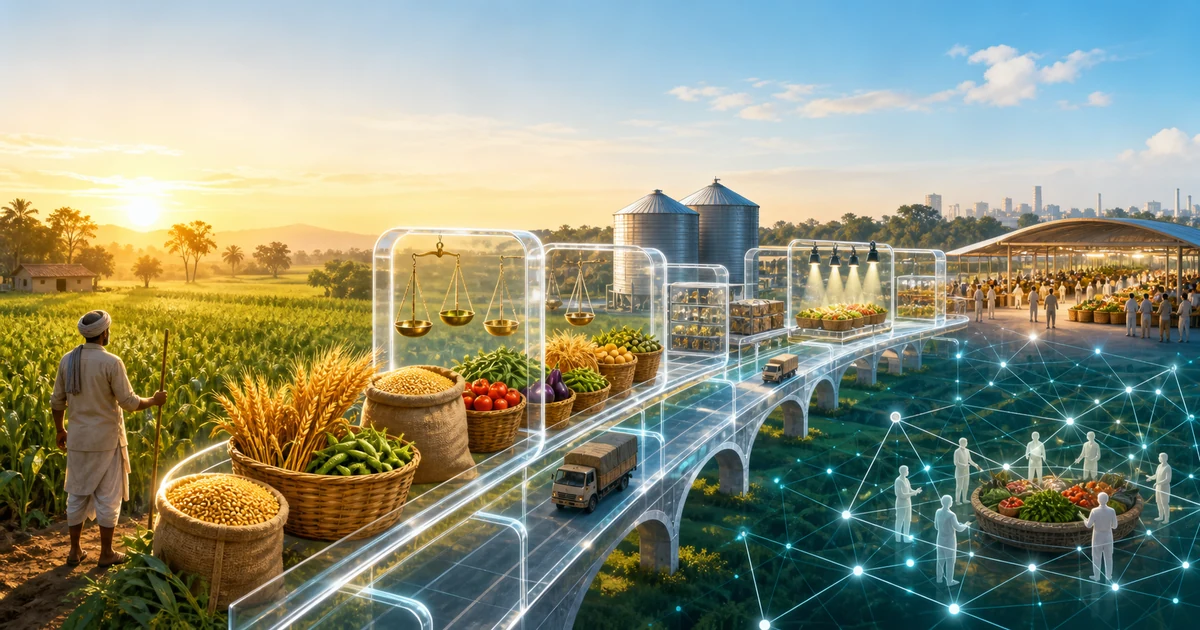
Agricultural marketing sounds like a simple phrase at first.
A farmer grows a crop and sells it. A buyer purchases it. The crop reaches consumers. Done.
But real life is not that simple.
Between the field and the final consumer, a crop may pass through collection, cleaning, grading, storage, transport, auction, wholesale trade, processing, packaging, retail sale, and payment. At each step, someone adds a service, a cost, a margin, or sometimes an unfair practice.
This is why agricultural marketing is so important in the Indian economy.
If this system works well, farmers get a better price, consumers get better quality, wastage falls, and rural income improves. If it works badly, farmers may produce enough but still remain poor because the reward from production is lost after harvest.
That is the heart of this topic.
What Agricultural Marketing Really Includes
Do not think of agricultural marketing as only “selling crops in a mandi.”
It includes the whole journey of farm produce after harvest.
Agricultural marketing includes:
- assembling produce from different farms
- cleaning and sorting
- grading according to quality
- weighing and measuring
- packing
- storage in godowns, warehouses, or cold storage
- transport from villages to markets
- sale through mandis, traders, cooperatives, FPOs, or direct channels
- processing when required
- sharing price and arrival information
- payment to farmers
- movement of goods to wholesalers, retailers, and consumers
For example, wheat may be harvested in a village, packed in sacks, taken to a mandi, weighed, sold through bidding, stored, milled into flour, packed, transported again, and finally sold to a family.
So when we study agricultural marketing, we are not studying only one sale. We are studying the entire path from harvest to value.
Why Agricultural Marketing Matters So Much
Agriculture has one special problem: most crops are produced in villages, but most large markets, processing units, and consumers are spread across towns, cities, and distant regions.
This creates a gap between the place of production and the place of sale.
Marketing fills this gap.
A good agricultural marketing system helps in four big ways.
| Area | How good marketing helps |
|---|---|
| Farmer income | Farmers can compare prices and sell at a better time or place |
| Consumer welfare | Consumers get better quality, safer goods, and more regular supply |
| Rural development | Storage, transport, processing, and trading create rural employment |
| National economy | Less wastage and better distribution improve food security |
The point is simple: production gives the crop, but marketing gives the crop its economic value.
The Farmer’s Problem After Harvest
A farmer’s difficulty does not end when the crop is harvested.
In fact, a new set of problems begins.
The farmer may need money urgently to repay a loan, pay wages, buy inputs for the next season, or manage household expenses. If the farmer has no proper storage, no transport, no price information, and no bargaining strength, the crop has to be sold quickly.
That quick sale is often called a distress sale.
A distress sale happens when a farmer sells produce at an unfavourable price because there is pressure to sell immediately.
This pressure is stronger for small and marginal farmers because they usually have smaller marketable surplus, weaker storage access, and less ability to wait for a better price.
This is why marketing defects are not small inconveniences. They can directly reduce farm income.
Main Defects of Agricultural Marketing in India
The defects of agricultural marketing are the weaknesses that prevent farmers from getting a fair and stable return.
Let us understand them one by one.
1. Inadequate Storage Facilities
Many agricultural products cannot be kept safely without proper storage.
Food grains need dry and secure godowns. Fruits, vegetables, flowers, dairy, fish, and other perishable products often need cold chains, quick transport, and careful handling.
When storage is poor:
- produce may get damaged by moisture, pests, heat, or mishandling
- farmers may be forced to sell immediately after harvest
- market arrivals may suddenly rise, pushing prices down
- wastage may increase
- quality may fall before the produce reaches consumers
This defect is especially serious for perishable goods.
If tomatoes, milk, or leafy vegetables are not moved or stored properly, the loss happens quickly. A farmer may not only lose price, but also lose part of the actual product.
2. Poor Transport and Connectivity
A farmer may know that a better price is available in a nearby town, but that knowledge is not enough.
The farmer still needs roads, vehicles, loading facilities, and affordable transport.
Poor transport creates many problems:
- produce reaches the market late
- perishable goods lose freshness
- transport cost becomes too high
- farmers depend on local traders
- distant buyers cannot easily reach village produce
When transport is weak, the market becomes small. The farmer may technically be free to sell, but practically limited to whoever can buy nearby.
Good roads, rural logistics, collection centres, and cold-chain movement widen the market. They turn a local crop into a product that can reach many buyers.
3. Too Many Intermediaries
Intermediaries are people or firms who stand between the farmer and the final consumer.
Not every intermediary is bad. Some provide useful services such as transport, storage, credit, grading, wholesale distribution, and retail sale.
The problem begins when the chain becomes too long or when some middlemen use the farmer’s weak position unfairly.
If produce passes through many hands, the consumer may pay a high price, but the farmer may receive only a small share.
This creates a gap between:
- price paid by the consumer
- price received by the farmer
This gap is called the marketing margin.
A reasonable margin is needed because marketing services cost money. But an excessive margin shows inefficiency or unfairness in the system.
4. Malpractices in Unregulated Markets
In an unregulated market, farmers may face unfair practices because rules are weak or not properly enforced.
Common malpractices may include:
- wrong weighing
- hidden deductions
- excessive commission
- delayed payment
- forced sale through a particular agent
- lack of open auction
- unfair quality rejection
- manipulation of prices
These practices may look small individually, but together they can reduce the farmer’s income sharply.
For example, if the weighing is slightly wrong, commission is high, quality is undervalued, and payment is delayed, the farmer loses at every step.
This is why regulation became an important government measure in agricultural marketing.
5. Lack of Grading and Standardisation
Grading means sorting produce according to quality.
Standardisation means using accepted quality standards so that buyers and sellers understand what each grade means.
Without grading:
- good quality and poor quality produce may be mixed
- better farmers may not get a better price for better produce
- buyers may distrust quality
- disputes may arise
- export and processing opportunities may reduce
Imagine two farmers selling pulses.
One farmer cleans, dries, and sorts the pulses carefully. Another farmer brings mixed quality. If both receive the same price, the careful farmer has no reward for better quality.
Grading solves this problem by linking price with quality.
6. Lack of Market Information
A farmer needs to know:
- what price is running in nearby markets
- which crop has high arrivals
- which market has better demand
- what quality buyers prefer
- whether prices are rising or falling
- what government procurement or support is available
Without this information, the farmer may sell at a lower price simply because the better option is not visible.
Earlier, many farmers depended mainly on local traders for price information. That made bargaining difficult.
Today, digital platforms, mobile apps, market information networks, and price dashboards can reduce this information gap. But access and understanding still matter. Information is useful only when the farmer can actually use it.
7. Inadequate Credit Facilities
Credit and marketing are closely connected.
If farmers cannot get timely institutional credit, they may borrow from local moneylenders or traders. Then they may be forced to sell their produce to the same lender or trader, sometimes at a lower price.
This is called interlocked credit and product market dependence.
In simple words, the farmer’s loan and sale become tied together.
The result may be:
- weak bargaining power
- early sale at low prices
- dependence on non-institutional lenders
- inability to store produce
- difficulty in using better inputs for the next crop
This is why rural banking, cooperative credit, Kisan Credit Cards, self-help groups, and FPO-linked credit are connected with better marketing outcomes.
8. Small Marketable Surplus
Marketable surplus means the part of total produce that is available for sale after the farmer keeps some for family consumption, seed, animal feed, or other needs.
Many small farmers have limited surplus to sell. A small quantity makes it harder to:
- hire transport separately
- bargain strongly
- attract large buyers
- use storage profitably
- sell directly in distant markets
When farmers sell individually in small lots, their bargaining position remains weak.
This is where cooperatives and Farmer Producer Organizations become important. They help farmers pool produce, reduce cost, and negotiate better.
9. Weak Processing and Value Addition
Raw produce often earns less than processed or value-added produce.
For example:
- tomatoes can become puree or sauce
- milk can become paneer, butter, ghee, or packaged dairy products
- wheat can become flour
- fruits can become juice, jam, or dried products
- spices can be cleaned, graded, packed, and branded
If processing facilities are weak, farmers may remain stuck at the lowest stage of the value chain.
Value addition does not mean every farmer must open a factory. It means the marketing system should create links with processing, packaging, storage, branding, and organized sale.
10. Seasonal Price Fluctuations
Agricultural production is seasonal.
At harvest time, market arrivals often rise. When supply suddenly increases, prices may fall. Later, when stocks reduce, prices may rise.
This creates uncertainty for farmers.
The farmer who sells immediately after harvest may get a low price. The trader or stockist with storage may gain later if prices rise.
Better storage, market information, price support, processing, and warehouse receipts can reduce the pressure of seasonal price movements.
A Simple Defect and Measure Map
This table helps you connect the problem with the solution.
| Defect | Why it hurts farmers | Measure that can help |
|---|---|---|
| Poor storage | Forces quick sale and causes wastage | Warehouses, cold storage, warehouse receipts |
| Poor transport | Limits access to better markets | Rural roads, logistics, collection centres |
| Too many intermediaries | Reduces farmer’s share in consumer price | Cooperatives, FPOs, direct marketing |
| Unfair practices | Causes wrong weighing, high charges, delayed payment | Regulated markets and open auction |
| No grading | Better quality does not get better price | AGMARK, assaying, quality standards |
| Poor price information | Farmers sell without comparing markets | Market information systems and digital platforms |
| Lack of credit | Farmers sell early to repay loans | Institutional credit and Kisan Credit Cards |
| Small surplus | Weak bargaining power | Pooling through cooperatives and FPOs |
Keep this map in mind. It makes long answers much easier to write.
Government Measures to Improve Agricultural Marketing
The government has taken several steps over time to improve agricultural marketing in India.
The aim is not only to create markets. The deeper aim is to make those markets fairer, more transparent, and more useful for farmers.
1. Regulated Markets
Regulated markets were created to protect farmers from unfair practices in traditional markets.
In these markets, sale and purchase are supervised under rules. Market committees usually include representatives connected with farmers, traders, and administration.
Regulated markets try to ensure:
- open auction or transparent bidding
- fair weighing
- standard weights and measures
- proper market charges
- licensing of traders and commission agents
- settlement of disputes
- basic facilities such as yards, sheds, and godowns
- market information
The logic is simple. If farmers are selling in a market where rules are clear, they are less likely to be cheated through hidden charges or wrong measurement.
2. Warehousing and Storage Facilities
Storage is one of the most practical measures for improving agricultural marketing.
Warehouses help farmers and traders store produce safely. Cold storage helps perishable goods such as fruits, vegetables, dairy products, meat, fish, and flowers.
Storage helps because it:
- reduces wastage
- prevents immediate distress sale
- keeps quality safe
- allows sale when market conditions are better
- supports processing and distribution
- improves food supply management
Modern storage is not only about building godowns. It also includes scientific handling, quality testing, receipts, finance, and digital linkage with markets.
Recent government initiatives have also focused on farm-gate storage, cold chains, warehouses, sorting, grading, and primary processing facilities. These measures matter because a farmer’s bargaining power improves when the crop does not have to be sold in panic.
3. Grading and Standardisation
Government support for grading and standardisation helps create trust in agricultural markets.
When produce is graded, buyers can bid according to quality. Farmers who produce better quality can receive a better price.
AGMARK is one well-known quality mark connected with agricultural produce in India. The broader purpose of grading and standardisation is to make quality visible and reliable.
Grading helps in:
- fair pricing
- reducing disputes
- encouraging quality improvement
- supporting processing industries
- improving consumer confidence
- helping exports where quality standards are important
4. Cooperative Marketing and FPOs
A single small farmer may have limited bargaining power. Many farmers together can become a stronger seller.
This is the basic idea behind cooperative marketing and Farmer Producer Organizations.
Through collective marketing, farmers can:
- pool produce
- reduce transport cost per unit
- store larger quantities
- negotiate with buyers
- purchase inputs more efficiently
- access credit and advisory services
- build direct links with processors or retailers
FPOs are especially important because they can help small and marginal farmers act like a larger organized unit without losing their individual farms.
For example, a vegetable FPO may collect produce from many farmers, grade it, pack it, and sell directly to a buyer who needs a reliable daily supply.
That can improve both price and stability.
5. Market Information Services
A fair market needs information.
Farmers should not have to enter the market blindly.
Market information services provide details about:
- prices
- arrivals
- demand
- nearby markets
- commodity trends
- quality requirements
Information helps farmers decide where, when, and how to sell.
Digital market information has made this more powerful. A farmer can compare prices and arrivals across markets before making a sale decision. But digital access must be supported by awareness, language support, training, and local help.
6. National Agriculture Market, or e-NAM
The National Agriculture Market, commonly called e-NAM, is a digital platform that links physical wholesale mandis through online trading.
Its purpose is to improve transparency, competition, and price discovery.
Through e-NAM, farmers and traders can use a wider market network instead of depending only on one local market. The platform supports online bidding, quality assaying, lot tracking, digital payments, and price information.
Official updates in 2026 reported that e-NAM had integrated 1,656 mandis, with 1.89 crore farmers and 2.78 lakh traders registered by June 2026.
This is important because agricultural marketing improves when farmers can reach more buyers and compare prices more transparently.
But e-NAM also teaches us a balanced lesson: technology helps only when physical market support is also strong. Internet, assaying, grading, storage, transport, training, and timely payment all matter.
7. Alternative Marketing Channels
Alternative marketing channels try to reduce the distance between farmers and consumers or between farmers and bulk buyers.
Examples include:
- farmers’ markets
- direct sale to consumers
- sale through cooperatives
- sale through FPOs
- contract links with processors or retailers
- collection centres
- digital platforms
The main benefit is that farmers may receive a higher share of the final consumer price when unnecessary layers are reduced.
But direct marketing also needs organization. A farmer still needs sorting, transport, quality control, payment systems, and a reliable buyer base.
So the answer is not “remove every intermediary.” The answer is “build efficient channels where each service adds real value.”
8. Price Support and Procurement
Price support measures are also connected with agricultural marketing.
Minimum Support Price and procurement operations help provide a price signal for selected crops. They can protect farmers from very low prices in certain situations.
Procurement also supports buffer stocks and food distribution.
However, price support is not a complete solution for all marketing problems. It cannot replace storage, transport, grading, competition, processing, and market information.
It is better to understand it as one part of the larger agricultural marketing system.
9. Better Rural Infrastructure
Marketing cannot improve only inside the mandi.
It also needs:
- village roads
- electricity
- internet connectivity
- storage centres
- cold chains
- weighing facilities
- quality-testing facilities
- processing units
- banking access
- transport services
Think of agricultural marketing as a chain. If one link is weak, the whole chain suffers.
For example, an online platform cannot fully help a farmer if the village road is poor, the produce cannot be graded, and the buyer cannot trust the quality.
That is why infrastructure is a long-term measure, not just a background facility.
10. Training and Awareness
Farmers need practical awareness about:
- grading
- market prices
- storage options
- digital payments
- warehouse receipts
- FPO membership
- government procurement rules
- crop quality requirements
- safe packaging and handling
Without awareness, even a good scheme may remain underused.
Training helps farmers understand how to use market facilities and avoid unfair practices.
This is especially important when digital systems are introduced. A farmer who has never used online bidding or digital payment needs support, not just an app.
Are These Measures Enough?
This is a very important question.
Government measures have improved agricultural marketing in many ways. Regulated markets reduced some unfair practices. Warehousing and cold storage reduced some distress sales and losses. Grading improved quality recognition. Cooperatives and FPOs gave farmers more collective strength. e-NAM has expanded digital market access and price discovery.
But problems remain.
Some farmers still lack storage. Some still sell to local traders because transport is expensive. Some do not receive reliable price information in time. Some markets still suffer from weak infrastructure. Small farmers may still find it difficult to use modern systems without guidance.
So the best answer is balanced.
This balanced view is better than saying either “everything has failed” or “everything has been solved.”
How to Write This Answer in Exams
If the question asks for the meaning, write the full process.
If the question asks for defects, organize the answer point by point.
If the question asks for government measures, match each measure with the problem it solves.
A strong answer can follow this order:
- Start with the meaning of agricultural marketing.
- Mention that it includes assembling, storage, transport, grading, processing, and sale.
- Explain the main defects.
- Explain government measures.
- Add a balanced concluding line.
Here is a compact structure you can remember:
| Part of answer | What to write |
|---|---|
| Meaning | Movement of farm produce from farmer to consumer |
| Functions | Storage, transport, grading, processing, sale, information |
| Defects | Storage, transport, intermediaries, malpractices, grading, credit |
| Measures | Regulated markets, warehouses, grading, cooperatives, e-NAM, infrastructure |
| Conclusion | Better marketing raises farmer income and reduces wastage |
A Short Example to Understand the Whole Topic
Imagine a farmer who grows tomatoes.
If there is no cold storage, the tomatoes must be sold quickly. If the village road is poor, transport becomes costly. If the farmer does not know prices in nearby markets, the local trader has more bargaining power. If there is no grading, good tomatoes and average tomatoes may receive the same price. If the farmer has borrowed from the trader, there may be pressure to sell to that trader only.
Now imagine a better system.
The farmer joins an FPO. The tomatoes are collected, sorted, graded, packed, and stored briefly in a cold chain. The FPO checks prices in different markets, sells to a buyer through a transparent channel, and receives payment digitally.
The crop is the same.
The difference is marketing.
That is why agricultural marketing is not a side topic. It is the bridge between production and income.
Final Takeaway
Agricultural marketing in India is about much more than selling farm produce.
It is about making sure that the farmer’s hard work is not lost after harvest.
The main defects are poor storage, poor transport, too many intermediaries, unfair market practices, lack of grading, weak information, inadequate credit, small surplus, weak processing, and seasonal price fluctuations.
The main government measures include regulated markets, warehousing, cold storage, grading and standardisation, cooperative marketing, FPOs, market information services, e-NAM, alternative marketing channels, price support, infrastructure development, and farmer training.
When these measures work well together, farmers get better access, buyers get better quality, wastage falls, and the rural economy becomes stronger.
FAQs
What is agricultural marketing?
Agricultural marketing is the process through which farm produce moves from farmers to consumers. It includes assembling, storage, transport, grading, processing, packaging, sale, price information, and payment.
Why is agricultural marketing important in India?
It is important because many farmers depend on agriculture for income. A good marketing system helps farmers get better prices, reduces wastage, improves consumer supply, and supports rural development.
What are the main defects of agricultural marketing in India?
The main defects include inadequate storage, poor transport, too many intermediaries, unfair market practices, lack of grading, poor price information, inadequate credit, small marketable surplus, weak processing, and seasonal price fluctuations.
What is a distress sale?
A distress sale happens when a farmer sells produce at a low or unfavourable price because there is urgent pressure to sell, often due to lack of storage, credit, or bargaining power.
How do regulated markets help farmers?
Regulated markets help by supervising buying and selling, encouraging open bidding, checking weights and measures, regulating market charges, licensing traders, and reducing unfair practices.
How does grading help agricultural marketing?
Grading sorts produce according to quality. It helps better quality produce receive a better price and gives buyers more confidence about what they are purchasing.
What is e-NAM?
e-NAM is the National Agriculture Market. It is a digital platform that links physical mandis and supports transparent online trading, price discovery, quality assaying, and digital payment.
Are intermediaries always harmful?
No. Some intermediaries provide useful services such as transport, storage, finance, processing, and distribution. The problem is an unnecessarily long or unfair chain where the farmer receives a low share of the final price.
How do FPOs improve agricultural marketing?
FPOs help farmers pool produce, reduce costs, bargain better, access larger buyers, use storage and grading facilities, and sell in a more organized way.
What is the best way to remember government measures for agricultural marketing?
Remember the main measures as regulation, storage, grading, collective marketing, information, digital markets, price support, infrastructure, and training.
Looking for commerce tuitions?
Prachi is a gold-medalist commerce teacher with experience at Deloitte and KPMG. She focuses on fundamentals to build a strong foundation.