
 Whatsapp
Area Between Two Curves: Sketch, Limits and Solved Examples
Find the area between two curves with clear graphs, six worked examples, top-minus-bottom and right-minus-left methods, practice questions and FAQs.
- 12th
- Study Advice
You can integrate every term correctly and still get an area question wrong. Usually, the trouble starts before the integration: the wrong limits, the wrong curve on top, or a crossing point that went unnoticed.
Imagine stretching a thin thread between two curved edges. One thread measures a gap. Many closely packed threads fill the whole region. That is the idea behind finding the area between two curves: add up the lengths of tiny strips across the space you want to measure.
Once you can describe one strip correctly, the integral becomes much easier to set up.
This guide works through six examples, including a change of upper curve, a region below the x-axis, and a sideways parabola. Keep a pencil nearby. The most useful practice is to predict the limits and subtraction order before reading each solution.
The Area Between Two Curves Formula
For vertical strips, use:
Area = integral from a to b of
       [upper curve - lower curve] dx
Here, a and b are x-coordinates. The two boundary equations must give y-values in terms of x.
For horizontal strips, use:
Area = integral from c to d of
       [right curve - left curve] dy
Here, c and d are y-coordinates. The boundary equations must give x-values in terms of y.
These formulas apply directly when the named boundaries keep their order throughout the interval. If they exchange positions, divide the region into suitable pieces. OpenStax’s lesson on areas between curves develops both versions and the crossing-curve case.
In the working below, integral[a,b] means a definite integral with lower limit a and upper limit b. Also, [F(x)] from a to b means F(b) - F(a).
A Five-Step Setup You Can Reuse
1. Read every boundary in the question
Underline the curve equations and any extra lines such as x = 0, x = 2, or y = 3. Also notice phrases such as “first quadrant” or “between the given ordinates”.
Two curves may enclose a complete region by themselves. In another question, extra straight lines close the region. Do not assume that every limit must come from the intersection of the two curves.
2. Find the relevant intersections
For equations y = f(x) and y = g(x), solve f(x) = g(x). Substitute each answer back to obtain the full coordinates for your sketch.
For equations already written as x = p(y) and x = q(y), solve p(y) = q(y) instead. This gives candidate y-limits directly.
If you square an equation while solving it, check the resulting solutions in the original equation. Squaring can introduce a point that is not actually on both required branches.
3. Draw a useful sketch
You do not need a perfect artistic drawing. Mark the intersections, any extra boundary lines, and the shaded region. Add a typical strip inside it.
For a parabola, show its opening direction and vertex. For a circle, be clear about whether the question uses the whole circle or one arc. A sketch should answer a question: where does my strip begin and end?
4. Confirm the boundary order
Choose an interior point in each interval between successive intersections. Compare the boundary values there.
Testing once is enough on such an interval when the functions are continuous and you have found every crossing within it. Testing once across several crossings is not enough.
5. Integrate and check the answer
Keep the subtraction inside brackets until you have simplified it. Evaluate the antiderivative at the upper limit and subtract its value at the lower limit.
Finish with square units, unless the question specifies units such as square centimetres. A non-empty region should have positive area.
Example 1: A Line Above a Parabola
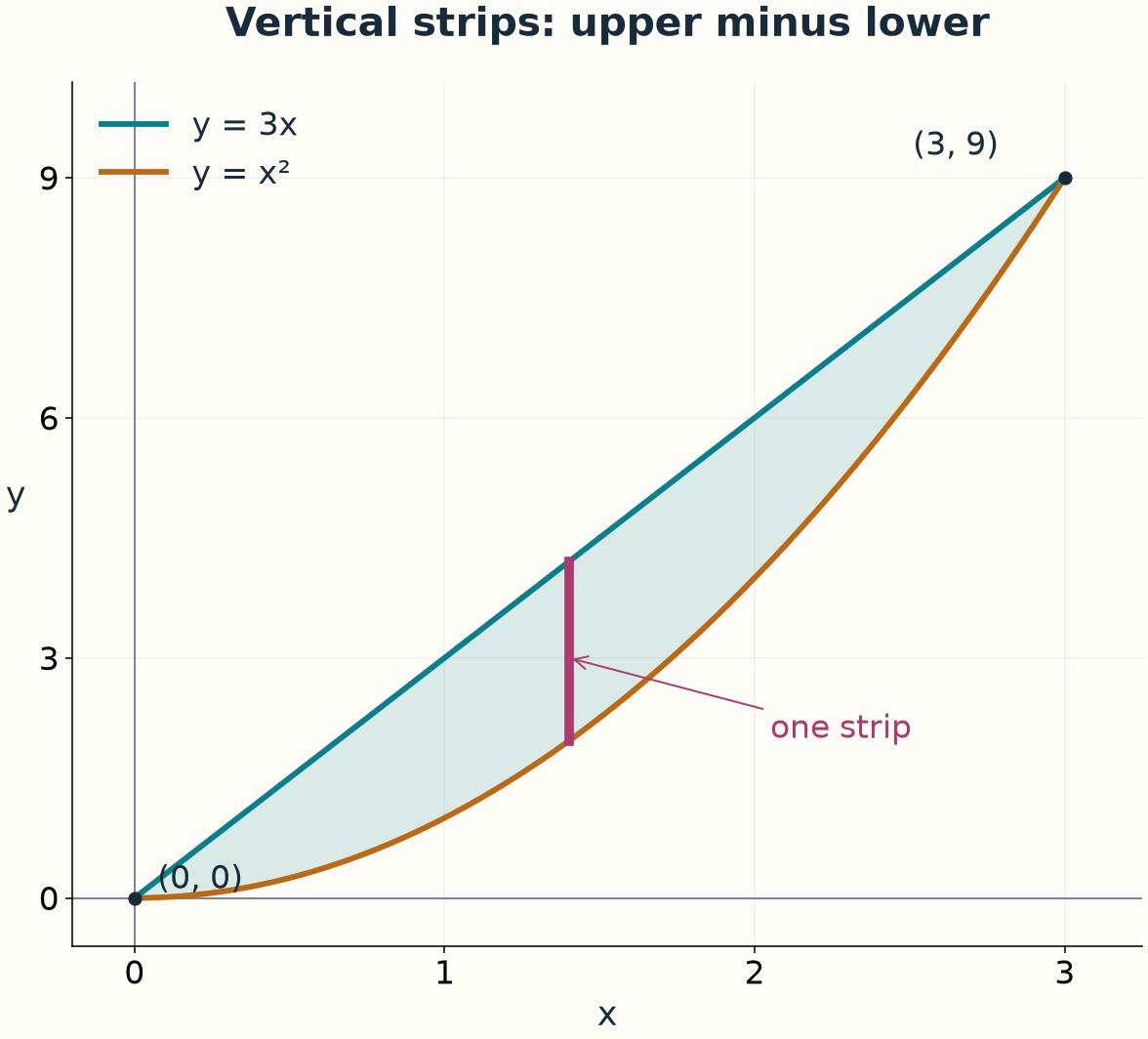
Find the area enclosed by y = 3x and y = x^2.
Start with the intersections:
x^2 = 3x
x(x - 3) = 0
x = 0 or x = 3
The curves meet at (0, 0) and (3, 9).
At x = 1, the line gives y = 3, while the parabola gives y = 1. The line is above the parabola between the intersection points.
Therefore:
A = integral[0,3] (3x - x^2) dx
  = [3x^2/2 - x^3/3] from 0 to 3
  = 27/2 - 9
  = 9/2 square units
A quick size check helps. The gap 3x - x^2 reaches its maximum of 9/4 at x = 3/2. A rectangle of width 3 and height 9/4 has area 27/4, so the region must be smaller than that rectangle. Our answer, 9/2, passes this check.
Notice that the y-coordinate 9 is not an integration limit here. We chose vertical strips and dx, so the limits are x-coordinates.
Example 2: Use the Limits the Question Actually Gives
Find the area between y = x + 2 and y = x^2, bounded by x = 0 and x = 1.
The line and parabola intersect where:
x^2 = x + 2
(x - 2)(x + 1) = 0
x = -1 or x = 2
However, neither of these values is a limit for the region asked for. The question explicitly closes the region with x = 0 and x = 1.
On this interval, the line is above the parabola. For instance, at x = 1/2, their heights are 5/2 and 1/4.
A = integral[0,1] (x + 2 - x^2) dx
  = [x^2/2 + 2x - x^3/3] from 0 to 1
  = 1/2 + 2 - 1/3
  = 13/6 square units
If you used -1 and 2, you would calculate the entire region enclosed by the two curves. That is a different question.
Example 3: The Curves Exchange Positions
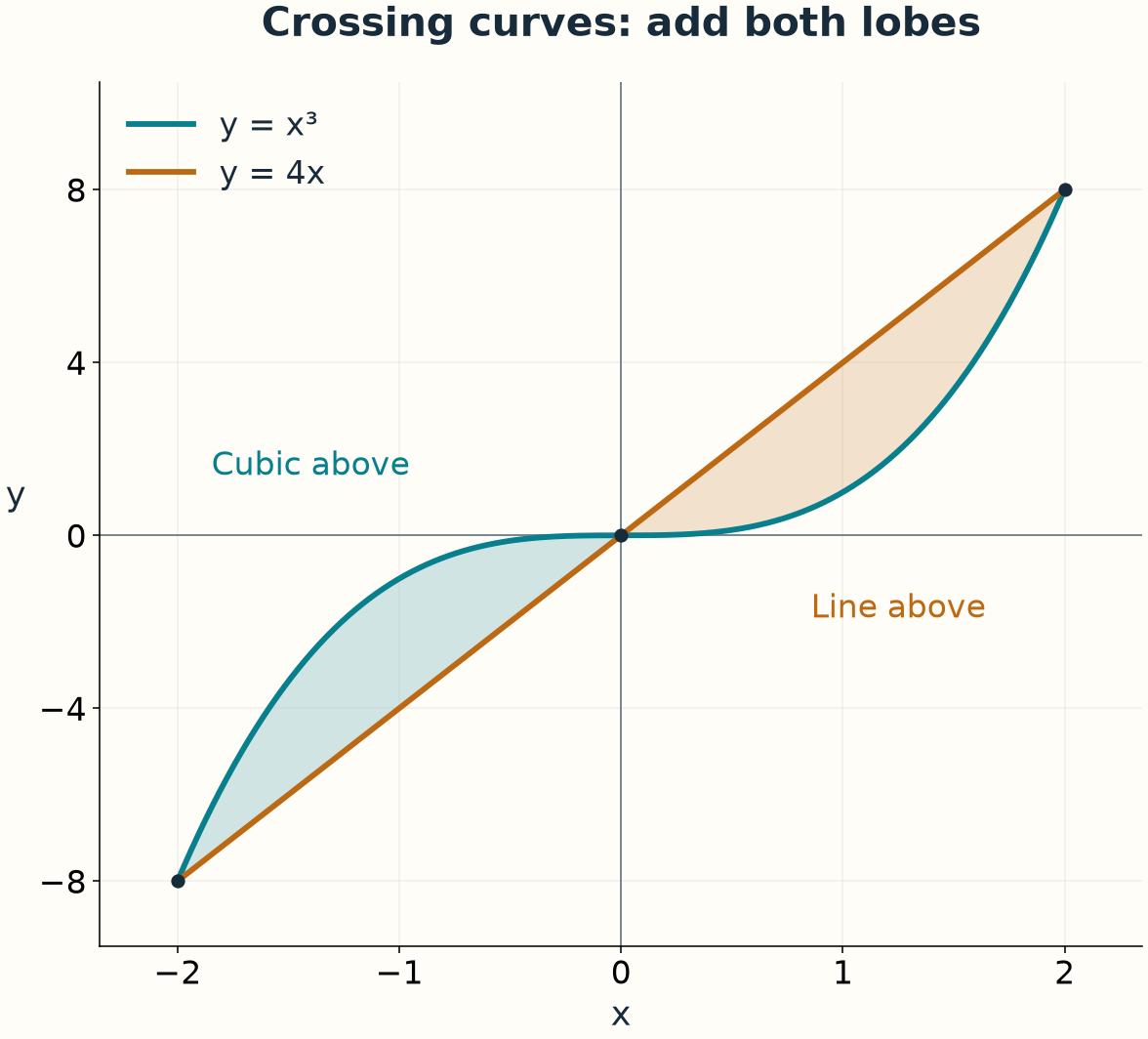
Find the total area enclosed by y = x^3 and y = 4x.
The intersections satisfy:
x^3 = 4x
x(x - 2)(x + 2) = 0
x = -2, 0, 2
There are two enclosed pieces, one between -2 and 0, and one between 0 and 2.
Test one point in each piece:
| Test point | Cubic value | Line value | Upper curve |
|---|---|---|---|
| x = -1 | -1 | -4 | y = x^3 |
| x = 1 | 1 | 4 | y = 4x |
The subtraction order changes at x = 0.
Write one integral for each piece:
A1 = integral[-2,0] (x^3 - 4x) dx
   = [x^4/4 - 2x^2] from -2 to 0
   = 0 - (4 - 8)
   = 4

A2 = integral[0,2] (4x - x^3) dx
   = [2x^2 - x^4/4] from 0 to 2
   = 8 - 4
   = 4

Total area = A1 + A2 = 8 square units
Now look at a tempting wrong approach:
integral[-2,2] (4x - x^3) dx = 0The negative contribution on the left cancels the positive contribution on the right. Taking the absolute value of that final zero does not recover the missing area.
The general expression is the integral of |f(x) - g(x)|, not necessarily the absolute value of the integral of f(x) - g(x).
For this particular example, symmetry also gives a shorter correct solution: calculate the right-hand area and double it. The two lobes are related by a half-turn about the origin. That shortcut works because the regions match, not merely because the outer limits are opposites.
Example 4: Both Curves Are Below the x-Axis
Find the area enclosed by y = x^2 - 6 and y = -2.
The intersections come from:
x^2 - 6 = -2
x^2 = 4
x = -2 or x = 2
Between these values, the parabola lies below the line. At x = 0, its height is -6, while the line has height -2.
The upper height is the larger number, even when both numbers are negative. So the strip length is:
(-2) - (x^2 - 6) = 4 - x^2Hence:
A = integral[-2,2] (4 - x^2) dx
  = [4x - x^3/3] from -2 to 2
  = (8 - 8/3) - (-8 + 8/3)
  = 32/3 square units
At the centre, the gap is 4 units. It narrows to zero at both ends. Since the whole region fits inside a rectangle of width 4 and height 4, an area smaller than 16 is reasonable.
Do not replace each negative y-value by its absolute value before subtracting. The ordered difference already measures the distance correctly.
Example 5: Horizontal Strips Avoid an Awkward Split
Find the area enclosed by x = y^2 and x = y + 2.
The first curve is a parabola opening to the right. The second is a line. Both are already expressed as x in terms of y, so try a horizontal strip.
Find the intersections:
y^2 = y + 2
(y - 2)(y + 1) = 0
y = -1 or y = 2
The points are (1, -1) and (4, 2). At y = 0, the parabola has x = 0 and the line has x = 2. Thus, the line is the right boundary and the parabola is the left boundary.
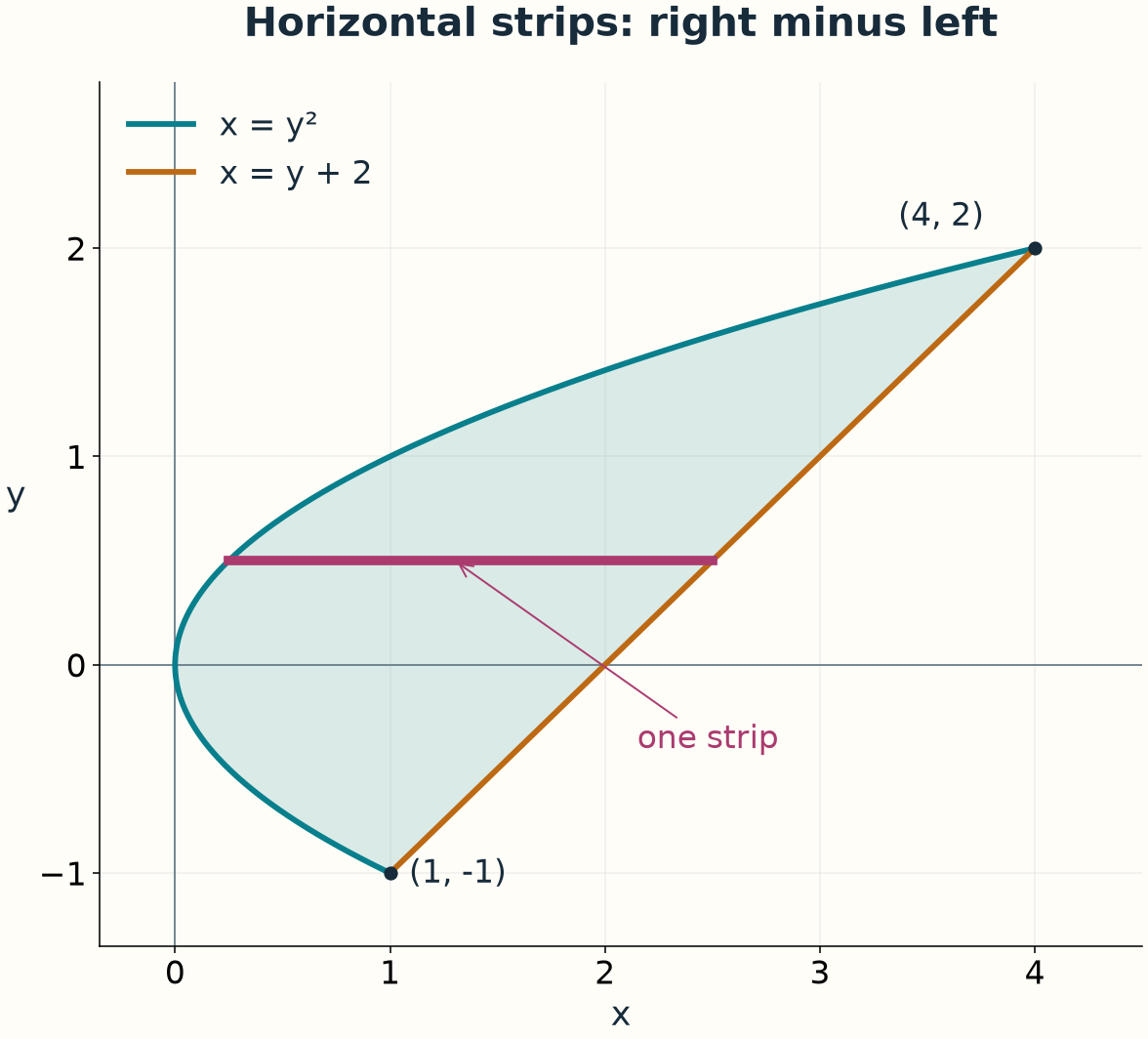
A = integral[-1,2] (y + 2 - y^2) dy
  = [y^2/2 + 2y - y^3/3] from -1 to 2
  = (2 + 4 - 8/3) - (1/2 - 2 + 1/3)
  = 10/3 - (-7/6)
  = 9/2 square units
Could you use vertical strips instead?
Yes, but now the parabola has two branches: y = sqrt(x) and y = -sqrt(x).
From x = 0 to x = 1, the strip runs between the two parabola branches. From x = 1 to x = 4, it runs from the line y = x - 2 to the upper branch.
The equivalent setup is:
A1 = integral[0,1] 2sqrt(x) dx
   = 4/3

A2 = integral[1,4] (sqrt(x) - x + 2) dx
   = [2x^(3/2)/3 - x^2/2 + 2x] from 1 to 4
   = 16/3 - 13/6
   = 19/6

A = 4/3 + 19/6 = 9/2 square units
Both methods measure the same region. Horizontal strips simply keep one pair of boundary formulas for the whole journey.
The APEX Calculus discussion of area also shows how changing the strip direction can simplify a region whose boundary changes partway across.
Example 6: A Modulus Curve With a Corner
Find the area enclosed by y = |x - 1| and y = 3.
The modulus graph is a V with vertex (1, 0). Its intersections with the horizontal line satisfy:
|x - 1| = 3
x = -2 or x = 4
The line is above the V throughout the enclosed region. However, the formula for the lower boundary changes at x = 1:
|x - 1| = 1 - x, when x < 1
|x - 1| = x - 1, when x >= 1
So:
A1 = integral[-2,1] [3 - (1 - x)] dx
   = [2x + x^2/2] from -2 to 1
   = 9/2

A2 = integral[1,4] [3 - (x - 1)] dx
   = [4x - x^2/2] from 1 to 4
   = 9/2

Total area = 9 square units
A geometry check is available: the enclosed region is a triangle with base 6 and perpendicular height 3. Its area is (1/2) x 6 x 3 = 9.
Here we split because a boundary has a piecewise formula, even though the upper and lower curves do not exchange positions.
When Should You Split the Integral?
Use a new piece whenever your description of the strip needs to change. Common triggers are:
- The curves cross and exchange upper and lower positions.
- A different curve becomes part of the boundary.
- A modulus or another piecewise expression changes formula.
- One strip would pass through separated pieces of the region and include unwanted space.
An intersection does not always mean an exchange of order. For example, y = x^2 touches y = 0 at the origin, but the parabola remains above the axis on both sides. Test the ordering instead of automatically reversing the subtraction at every meeting point.
Likewise, crossing the x-axis does not by itself force a split for the area between two curves. What matters is their order relative to each other.
For area between a single curve and the x-axis, the axis is the other boundary, with equation y = 0. The NCERT Application of Integrals chapter explains why portions on opposite sides of the axis must contribute positive amounts to total geometric area.
Small Mistakes That Change the Whole Answer
Using a root as a limit without checking the region. A first-quadrant restriction or an extra vertical line can exclude part of the complete enclosure. Shade only what is asked for.
Mixing x-limits with dy. Read the differential before substituting bounds. In Example 5, -1 and 2 are y-limits; 1 and 4 are the x-coordinates of the intersections. They are not interchangeable.
Losing brackets around the lower curve. If the lower curve is x^2 - 6, subtract the entire expression. Writing -x^2 - 6 changes the gap.
Assuming two curves always enclose a finite region. The lines y = x and y = x + 2 do not close a region by themselves. Extra boundaries would be needed for an ordinary finite-area question.
Using symmetry without checking the boundaries. A symmetric curve can be cut by an asymmetric line or interval. The complete shaded region must have the symmetry you intend to use.
Adding a constant to the final area. A definite integral produces a number. An arbitrary C does not belong in the final answer.
Turning a negative answer positive without checking the setup. A negative result may reveal reversed order on one interval or a missing split. Diagnose it before correcting it.
A Short Practice Set
For each question, write the boundaries and integral before calculating. Try to predict whether you need one piece or more.
- Find the area enclosed by
y = 5xandy = x^2. - Find the area between
y = x + 4andy = x^2on0 <= x <= 1. - Find the total area enclosed by
y = x^3andy = 9x. - Find the area enclosed by
x = y^2andx = 2y + 3. - Find the area enclosed by
y = x^2 - 9andy = -5. - Find the area enclosed by
y = |x + 2|andy = 2.
Answers With Setups
1. The intersections are at x = 0 and x = 5. Integrate 5x - x^2 from 0 to 5. The area is 125/6 square units.
2. Use the supplied limits, 0 and 1. Integrate x + 4 - x^2. The result is 1/2 + 4 - 1/3, or 25/6 square units.
3. The intersections are at x = -3, 0, 3. Integrate x^3 - 9x from -3 to 0, then 9x - x^3 from 0 to 3. Each piece is 81/4, giving 81/2 square units.
4. Horizontal strips run from x = y^2 to x = 2y + 3, with y-limits -1 and 3. Integrating 2y + 3 - y^2 gives 32/3 square units.
5. The intersections have x-coordinates -2 and 2. The strip length is -5 - (x^2 - 9) = 4 - x^2. The area is 32/3 square units. It matches Example 4 because both boundaries have moved down by the same amount.
6. Split at the vertex x = -2. Integrate x + 4 from -4 to -2, then -x from -2 to 0. The total is 4 square units, also the area of a triangle of base 4 and height 2.
If the integration itself is slowing you down, revisit how to choose an integration method. For the examples here, careful setup and the power rule do most of the work.
Frequently Asked Questions
What is the formula for area between two curves?
With vertical strips, integrate the upper y-value minus the lower y-value with respect to x. With horizontal strips, integrate the right x-value minus the left x-value with respect to y. If the boundaries change order or formula, split the calculation into suitable pieces.
How do I decide which curve is on top?
Find the intersections first. Then substitute an interior x-value into both equations on each interval between crossings. The larger y-value belongs to the upper curve there. Confirm the choice against your sketch.
Are the limits always the intersection points?
No. Intersections often give the limits of a region enclosed only by two curves. If the question specifies lines such as x = 0 and x = 1, those lines may supply the limits instead. Read all the boundaries before integrating.
Why can a definite integral be zero when the area is positive?
A definite integral of a difference can contain positive and negative contributions that cancel. Geometric area adds the sizes of the pieces. Split where the curves exchange order and use a positive strip length in each piece.
Can I take the absolute value only after integration?
Only if the difference keeps one sign throughout the interval. When its sign changes, taking the absolute value of the final integral can hide cancellation and give the wrong total area.
When is integration with respect to y easier?
It is often easier when a horizontal strip has one clear left boundary and one clear right boundary across the entire region, while vertical strips would require multiple formulas. Sideways parabolas are good candidates, but the sketch should decide.
What happens if both curves are below the x-axis?
Use upper minus lower as usual. For instance, the vertical distance from y = -6 to y = -2 is -2 - (-6) = 4. Negative coordinates do not make the geometric area negative.
Does every intersection require a split?
No. Curves can touch without exchanging positions. Check the sign of their difference on either side. You need a split when the strip’s boundary description changes, not simply because two curves meet.
Can I double the area on one side of the y-axis?
Yes, if the full region has the required symmetry and both halves have equal area. Symmetric limits alone do not prove this. Check the curves and every extra boundary line.
Do I need an exact answer or a decimal?
Keep fractions and constants such as pi exact unless the question asks for an approximation. State the final answer in square units and use a decimal only when it serves the question.
Looking for commerce tuitions?
Prachi is a gold-medalist commerce teacher with experience at Deloitte and KPMG. She focuses on fundamentals to build a strong foundation.