
 Whatsapp
Bill of Exchange vs Promissory Note vs Cheque
Understand the difference between a bill of exchange, promissory note, and cheque with simple meanings, examples, parties, and exam-friendly comparison points.
- 11th
- Accounts
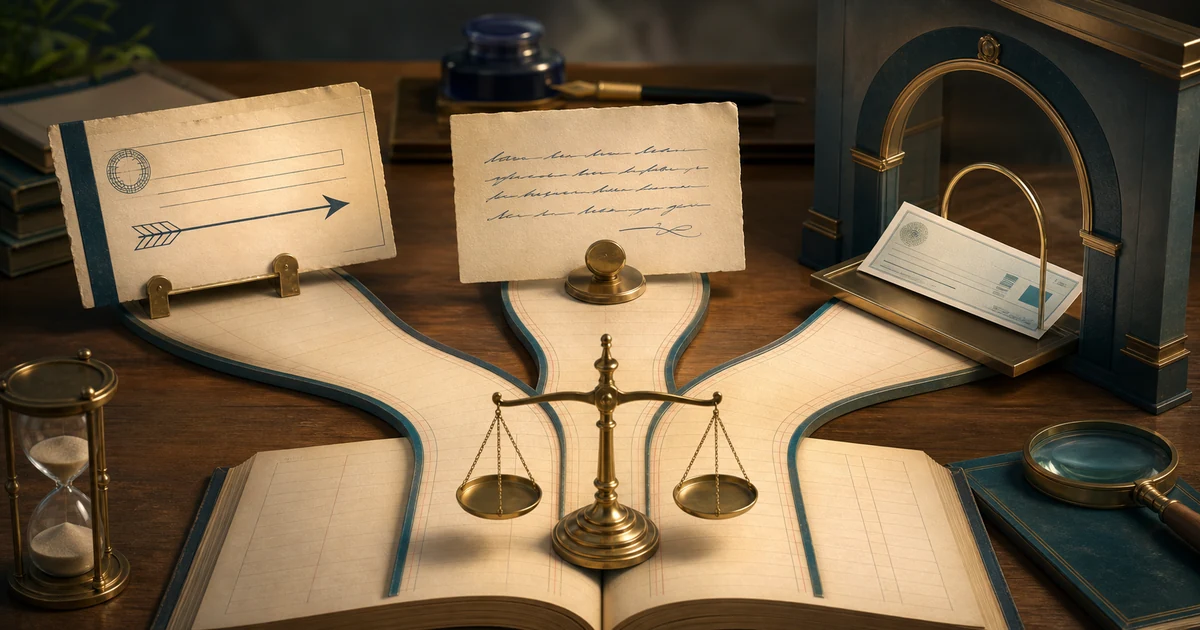
Bill of exchange, promissory note, and cheque look similar at first because all three are written instruments used for payment.
That is exactly why students mix them up.
One says, “Please pay this person.”
One says, “I promise to pay this person.”
One says, “Bank, pay this person from my account.”
Once you understand this small difference, the whole topic becomes much easier.
This guide will help you understand the meaning, parties, acceptance, due date, and practical use of all three instruments without memorising the comparison blindly.
First, Why Do These Instruments Exist?
In business, many transactions happen on credit.
For example, Amit sells goods to Bhavna today, but Bhavna will pay after two months. Amit does not want the amount to remain only as a verbal promise. He wants written proof of the amount, the party who must pay, and the time of payment.
That is where written payment instruments become useful.
They make the payment obligation clearer. They also help the parties record the transaction properly in the books of accounts.
In Accountancy, the real question is not only “What is the definition?” The better question is:
Who is asking whom to pay, and when?
If you answer that correctly, the difference becomes simple.
What Is a Bill of Exchange?
A bill of exchange is a written order made by one person directing another person to pay a certain amount to a certain person.
In simple language, the creditor prepares the bill and asks the debtor to accept it.
Suppose Amit sells goods to Bhavna on credit. Amit is the creditor because he has to receive money. Bhavna is the debtor because she has to pay.
Amit may draw a bill on Bhavna saying that Bhavna should pay the amount after a fixed period. When Bhavna accepts the bill by signing it, the bill becomes a clear written commitment.
The important word here is order.
A bill of exchange does not say, “I promise to pay you.” It says, in effect, “You are directed to pay this amount.”
Parties to a Bill of Exchange
There are usually three parties:
| Party | Meaning |
|---|---|
| Drawer | The person who makes the bill. Usually the creditor or seller. |
| Drawee | The person on whom the bill is drawn. Usually the debtor or buyer. |
| Payee | The person who will receive the money. Often the drawer, but it can be another person. |
After the drawee accepts the bill, the drawee is also called the acceptor.
This is why students should not treat “drawee” and “acceptor” as two completely different people in every question. In most school-level questions, the drawee becomes the acceptor after signing the bill.
What Is a Promissory Note?
A promissory note is a written promise made by one person to pay a certain amount to another person.
Here, the debtor prepares the instrument.
Suppose Bhavna owes Amit money. Instead of Amit drawing a bill on Bhavna, Bhavna herself writes a note promising to pay Amit after two months. That written promise is a promissory note.
The important word here is promise.
The debtor is not being ordered by someone else. The debtor is saying, “I will pay.”
Parties to a Promissory Note
There are usually two main parties:
| Party | Meaning |
|---|---|
| Maker or promisor | The person who makes the promise to pay. Usually the debtor. |
| Payee | The person who will receive the money. Usually the creditor. |
Some books use the word “drawer” for the person making the promissory note, but it is clearer to remember this person as the maker or promisor.
What Is a Cheque?
A cheque is a written order given by an account holder to a bank, asking the bank to pay a certain amount to a person.
For example, Bhavna may issue a cheque to Amit. In that case, Bhavna is telling her bank to pay Amit from her bank account.
A cheque is connected to a bank account. That is the easiest way to separate it from the other two.
In legal terms, a cheque is a special type of bill of exchange because it is also an order to pay. But for Accountancy students, the special point is this:
That means the cheque is not normally treated like a three-month credit instrument in the way a bill of exchange or promissory note may be. It is meant to be presented to the bank for payment.
Parties to a Cheque
There are three parties:
| Party | Meaning |
|---|---|
| Drawer | The bank account holder who writes the cheque. |
| Drawee | The bank on which the cheque is drawn. |
| Payee | The person who receives the payment. |
This is a common exam trap.
In a bill of exchange, the drawee is usually the debtor. In a cheque, the drawee is the bank.
The Simplest Story to Compare All Three
Let us use one situation.
Amit sells goods worth Rs. 20,000 to Bhavna on credit.
If Amit draws a bill of exchange
Amit, the creditor, prepares a bill and directs Bhavna to pay Rs. 20,000 after two months. Bhavna accepts it.
This is a bill of exchange.
Why? Because the creditor is ordering the debtor to pay.
If Bhavna writes a promissory note
Bhavna, the debtor, writes that she promises to pay Amit Rs. 20,000 after two months.
This is a promissory note.
Why? Because the debtor is promising to pay.
If Bhavna issues a cheque
Bhavna writes a cheque in favour of Amit for Rs. 20,000. Amit presents it to the bank for payment.
This is a cheque.
Why? Because the account holder is ordering the bank to pay.
Bill of Exchange vs Promissory Note vs Cheque: Main Differences
| Basis | Bill of Exchange | Promissory Note | Cheque |
|---|---|---|---|
| Basic nature | Order to pay | Promise to pay | Order to bank to pay |
| Who usually prepares it? | Creditor | Debtor | Bank account holder |
| Main paying party | Drawee or acceptor | Maker or promisor | Bank, from drawer’s account |
| Number of main parties | Usually three | Usually two | Three |
| Acceptance | Required by drawee | Not required separately | Not accepted like a bill |
| Bank involvement | Not necessary | Not necessary | Necessary |
| Payment timing | On demand or after a fixed period | On demand or after a fixed period | On demand |
| Days of grace | Usually apply if payable after a fixed period | Usually apply if payable after a fixed period | Do not apply |
| Common use in Accountancy | Credit sales and bills receivable or payable | Written promise for debt | Bank payment through cash book |
| Memory line | ”You pay." | "I will pay." | "Bank, pay.” |
Do not try to memorise this table as separate lines. Read the first three rows carefully, and the rest will begin to make sense.
Why Acceptance Matters in a Bill of Exchange
Acceptance is one of the biggest differences between a bill of exchange and a promissory note.
In a bill of exchange, the drawer is directing the drawee to pay. But the drawee must accept the bill before the bill becomes a proper accepted obligation.
This is why many questions say:
“A drew a bill on B, which B accepted.”
That acceptance is not a decorative detail. It is the debtor agreeing to the order.
In a promissory note, the debtor has already signed the promise. So there is no separate acceptance by another person.
In a cheque, the bank does not accept it in the same way a drawee accepts a bill. The bank pays when the cheque is presented, provided the cheque is valid and the account has enough balance.
Due Date and Days of Grace
A bill of exchange and a promissory note may be payable after a certain period, such as one month, two months, or three months after date or after sight.
When they are payable after a fixed period, days of grace are usually added to find the maturity date.
For example, if a bill is drawn on 1 July for two months, the basic due date is 1 September. After adding three days of grace, the maturity date becomes 4 September, unless that day is affected by a holiday rule in the question.
A cheque is different.
A cheque is payable on demand. It is not treated as a credit instrument with days of grace.
This one point saves many marks in practical questions.
How to Identify the Instrument in a Question
When a question is long, do not panic. Look for the action word.
| If the question says | Think of |
|---|---|
| ”Drew a bill on…” | Bill of exchange |
| ”Accepted the bill” | Bill of exchange |
| ”Promised to pay…” | Promissory note |
| ”Made a promissory note” | Promissory note |
| ”Issued a cheque” | Cheque |
| ”Paid by cheque” | Bank or cash book entry |
| ”Cheque dishonoured” | Bank reconciliation or cheque-related treatment, depending on the chapter |
The words in the question usually give the answer. Students lose marks when they ignore those words and jump straight into entries.
Common Mistakes Students Make
Mistake 1: Calling Every Written Payment a Cheque
A cheque involves a bank. If there is no bank account holder ordering a bank to pay, do not call it a cheque.
A bill of exchange and promissory note can exist between business parties without the bank being the drawee.
Mistake 2: Forgetting That a Bill Needs Acceptance
If A draws a bill on B, B must accept it. Until B accepts, it is only a draft from the practical accounting point of view.
This matters because the acceptor is the person who must pay on maturity.
Mistake 3: Mixing Up Drawer and Drawee
This happens because the same word can behave differently in different instruments.
In a bill of exchange, the drawer is usually the creditor.
In a cheque, the drawer is the account holder.
The drawee in a bill is usually the debtor.
The drawee in a cheque is the bank.
Mistake 4: Applying Days of Grace to Cheques
Cheques are payable on demand. They do not have a maturity date like a term bill.
If you see a cheque in a question, think of bank payment, presentation, collection, dishonour, or bank reconciliation. Do not start adding three days.
Mistake 5: Thinking a Promissory Note Has Three Main Parties
A promissory note is simpler. The maker promises to pay the payee.
There may be endorsement later, but at the basic level, remember two main parties: maker and payee.
A Quick Memory Trick
Use this three-line method:
| Instrument | Student memory line |
|---|---|
| Bill of exchange | The creditor tells the debtor to pay. |
| Promissory note | The debtor promises the creditor to pay. |
| Cheque | The account holder tells the bank to pay. |
If you can remember only this much, you can rebuild the full comparison during revision.
How This Helps in Journal Entries
This comparison is not only theory. It affects entries too.
In bill of exchange questions, you often see terms like bills receivable, bills payable, acceptance, discounting, endorsement, retirement, renewal, and dishonour.
In promissory note questions, the logic is similar to a written promise to pay, but the starting point is different because the debtor makes the promise.
In cheque questions, the bank account is involved. So the entry usually affects Bank Account or appears in bank reconciliation, depending on the chapter.
This is why a student should first identify the instrument before writing the entry.
If you identify a cheque as a bill, you may wrongly look for acceptance or maturity. If you identify a bill as a cheque, you may ignore acceptance and days of grace. The first decision controls the rest of the answer.
Final Summary
A bill of exchange, promissory note, and cheque are all written payment instruments, but they are not the same.
A bill of exchange is an order made by the creditor to the debtor. It usually needs acceptance.
A promissory note is a promise made by the debtor to the creditor. It does not need separate acceptance.
A cheque is an order made by an account holder to a bank. It is payable on demand and does not have days of grace.
Once you remember order, promise, and bank, the topic becomes much less confusing.
Frequently Asked Questions
1. Is a cheque a bill of exchange?
Yes, a cheque is legally treated as a special type of bill of exchange because it is an order to pay. But for Accountancy comparison, remember its special features: it is drawn on a bank and payable on demand.
2. What is the main difference between a bill of exchange and a promissory note?
A bill of exchange contains an order to pay, while a promissory note contains a promise to pay. In a bill, the creditor usually draws the instrument. In a promissory note, the debtor usually makes the promise.
3. Who accepts a bill of exchange?
The drawee accepts the bill of exchange. In most Accountancy questions, the drawee is the debtor who agrees to pay the amount on the due date.
4. Does a promissory note require acceptance?
No. A promissory note does not require separate acceptance because the maker has already signed the promise to pay.
5. Are days of grace added to a cheque?
No. Days of grace are not added to a cheque because a cheque is payable on demand.
6. How many parties are there in a bill of exchange?
There are usually three parties: drawer, drawee, and payee. After acceptance, the drawee is also called the acceptor.
7. How many parties are there in a promissory note?
There are usually two main parties: maker or promisor, and payee.
8. Who is the drawee in a cheque?
The drawee in a cheque is the bank. This is different from a bill of exchange, where the drawee is usually the debtor.
9. Which instrument is easiest to identify in a question?
A cheque is usually easiest because the question mentions bank payment, cheque issued, cheque deposited, or cheque dishonoured. If there is no bank involved, check whether the sentence is an order to pay or a promise to pay.
10. What is the fastest way to remember the difference?
Remember these three lines: bill of exchange means “you pay”, promissory note means “I will pay”, and cheque means “bank, pay”.
Looking for commerce tuitions?
Prachi is a gold-medalist commerce teacher with experience at Deloitte and KPMG. She focuses on fundamentals to build a strong foundation.