
 Whatsapp
Budget Line Shift vs Rotation: Income and Price Changes
Learn when a budget line shifts or rotates using intercepts, labelled graphs, solved examples, simultaneous changes and practice questions with answers.
- 12th
- Economics

You have Rs 240 to spend on notebooks and juice. Next week, one of two things happens: your spending allowance rises, or notebooks become cheaper. Both changes let you buy more notebooks. Should you draw the same new budget line?
No. A larger allowance also lets you buy more juice if you spend everything on juice. Cheaper notebooks do not change that maximum juice quantity. That unchanged endpoint is the clue to a rotation.
An income change shifts the budget line parallel when both prices stay fixed. A change in only one price rotates it when income and the other price stay fixed. The qualifications matter as much as the rule.
Let’s turn that rule into something you can calculate, draw and explain without guessing which way the line moves.
Start with what the line actually measures
A budget line joins combinations of two goods that use the consumer’s entire available budget. The budget set includes combinations that cost less than or equal to that budget. Points on the line exhaust it, points inside leave some money unspent, and points beyond it are unaffordable.
This distinction follows the budget-constraint framework in OpenStax’s introduction to consumer choices.
Use these symbols:
- M: money available to spend on the two goods.
- Px: price per unit of good X, on the horizontal axis.
- Py: price per unit of good Y, on the vertical axis.
- x and y: quantities purchased.
The budget-line equation is:
Px × x + Py × y = M
Rearrange it to make y the subject:
y = M/Py - (Px/Py)x
This gives you three pieces of information immediately.
| Feature | Formula | Meaning |
|---|---|---|
| Horizontal intercept | M/Px | Maximum X if no Y is bought |
| Vertical intercept | M/Py | Maximum Y if no X is bought |
| Slope | -Px/Py | Change in Y available for one extra unit of X |
Assume positive prices, a positive budget and non-negative quantities. The usual straight-line diagram also assumes constant unit prices. Quantity discounts, rationing or restrictions on particular purchases can require a different shape.
Build one original budget line
Let X be notebooks costing Rs 30 each and Y be juice bottles costing Rs 20 each. M is Rs 240.
The equation is:
30x + 20y = 240, or y = 12 - 1.5x.
The horizontal intercept is 240/30 = 8 notebooks. The vertical intercept is 240/20 = 12 bottles. Plot (8, 0) and (0, 12), then join them.
Three affordable bundles on this line are:
| Notebooks, x | Juice bottles, y | Total cost |
|---|---|---|
| 0 | 12 | Rs 240 |
| 4 | 6 | Rs 240 |
| 8 | 0 | Rs 240 |
The slope is -30/20 = -1.5. At these prices, one extra notebook requires giving up 1.5 bottles in the continuous model. For a whole-number exchange, two extra notebooks require giving up three bottles.
Notice that moving from (4, 6) to (8, 0) does not shift the line. The prices and available money have not changed. Only the chosen bundle has changed.
Income changes: both intercepts move together
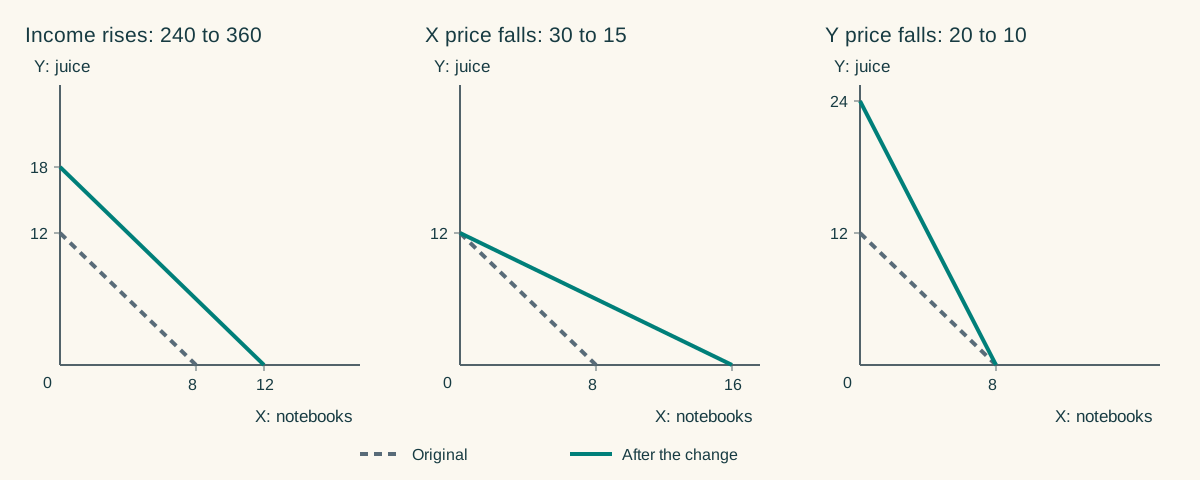
Keep both prices fixed, but raise M from Rs 240 to Rs 360.
The new equation is 30x + 20y = 360.
- Maximum notebooks: 360/30 = 12.
- Maximum bottles: 360/20 = 18.
- Slope: -30/20 = -1.5, unchanged.
Join (0, 18) and (12, 0). The new line is parallel to the original and farther from the origin. The consumer can afford every previously affordable bundle, plus additional bundles.
If income instead falls to Rs 120, the intercepts become (4, 0) and (0, 6). The line shifts inward, again with slope -1.5.
“Both intercepts move together” means they change by the same proportion, not by the same number of units. Here a 50% income rise increases the notebook intercept by 4 and the bottle intercept by 6. Both increases are 50% of their original values.
A change in Px: pivot around the Y-intercept
Return to the original Rs 240 budget. Keep juice at Rs 20, but reduce the notebook price from Rs 30 to Rs 15.
The new equation is 15x + 20y = 240.
Maximum notebooks becomes 240/15 = 16. Maximum juice remains 240/20 = 12. The slope becomes -15/20 = -0.75.
The new line joins (0, 12) and (16, 0). It rotates outward around the unchanged Y-intercept and becomes flatter.
Why does the Y-intercept stay put? At that endpoint you buy no notebooks. Their price therefore makes no difference to the cost of the all-juice bundle.
If notebooks instead rise to Rs 60, their maximum quantity falls to 4. The new line joins (0, 12) and (4, 0). It rotates inward and becomes steeper, with slope -3.
A change in Py: pivot around the X-intercept
Now keep M = Rs 240 and Px = Rs 30, but reduce the juice price from Rs 20 to Rs 10.
Maximum notebooks stays 8. Maximum juice rises to 24. The new equation is 30x + 10y = 240, with slope -3.
The line rotates outward around (8, 0) and becomes steeper. This sometimes surprises students: an outward rotation does not always make the line flatter. It depends on which axis carries the good becoming cheaper.
If the juice price rises to Rs 40 instead, the intercepts are (8, 0) and (0, 6), and the slope is -0.75. This is an inward rotation that makes the line flatter.
The six standard cases at a glance
Read this table with X on the horizontal axis and Y on the vertical axis. Each row assumes all other variables stay fixed.
| Change | X-intercept | Y-intercept | Result |
|---|---|---|---|
| Income rises | Rises | Rises | Parallel outward shift |
| Income falls | Falls | Falls | Parallel inward shift |
| Px falls | Rises | Unchanged | Outward rotation, flatter |
| Px rises | Falls | Unchanged | Inward rotation, steeper |
| Py falls | Unchanged | Rises | Outward rotation, steeper |
| Py rises | Unchanged | Falls | Inward rotation, flatter |
For negative slopes, “steeper” means a larger absolute value. A slope of -3 is steeper than -1.5 even though -3 is the smaller signed number.
The distinction between income shifts and single-price rotations is also illustrated in OpenStax’s discussion of changes in income and prices. The calculations here use our own notebook-and-juice example.
When both prices or several variables change
The shortcut “income means shift, price means rotation” is useful only for the standard single-change questions. For a more complicated question, calculate both intercepts again.
Example 1: both prices fall by the same percentage
Start from M = 240, Px = 30 and Py = 20. Both prices fall by 20%, becoming 24 and 16.
New X-intercept = 240/24 = 10.
New Y-intercept = 240/16 = 15.
New slope = -24/16 = -1.5.
The line shifts parallel outward even though money income has not changed. The price ratio is unchanged, while the budget buys more of either good. Both intercepts rise by 25%, not 20%: dividing by 0.8 multiplies purchasing power by 1.25.
So a parallel shift alone does not prove that money income changed.
Example 2: income and both prices rise proportionately
Let income rise by 25% to 300 and prices rise by 25% to 37.50 and 25.
New intercepts are 300/37.50 = 8 and 300/25 = 12.
The budget line is unchanged. The larger money amount buys exactly the same combinations because prices have risen in the same proportion.
This is a useful reminder to distinguish money income from purchasing power.
Example 3: income and only one price rise
Let income rise from 240 to 360 while Px rises from 30 to 45. Py stays 20.
New X-intercept = 360/45 = 8.
New Y-intercept = 360/20 = 18.
The new line rotates outward around the unchanged X-intercept, with slope -45/20 = -2.25.
Two variables changed, yet one endpoint stayed fixed. That happened because income and Px rose in the same proportion. Do not label the picture from the words “income increased” alone.
Example 4: one price rises and the other falls
Keep M = 240. Let Px rise to 40 while Py falls to 15.
New intercepts are 6 notebooks and 16 bottles, compared with the original 8 and 12. One endpoint moves inward and the other outward, so the lines cross within the positive quadrant.
Find their intersection:
30x + 20y = 240
40x + 15y = 240
Multiply the first equation by 3 and the second by 4. Subtract to get 70x = 240, so x = 24/7. Substituting gives y = 48/7.
The crossing bundle is affordable at full cost under both sets of prices. Some other bundles become affordable, while some previously affordable bundles are lost. You cannot describe this as an unqualified expansion or contraction of the budget set.
Reading changes backward from a diagram
Suppose a line originally has intercepts (10, 0) and (0, 15). Its new intercepts are (15, 0) and (0, 15).
You can conclude that M/Px rose and M/Py stayed unchanged. If the question also says income and Py stayed fixed, you can conclude that Px fell.
Without those extra assumptions, the graph does not identify a unique cause. Income and Py might both have increased proportionately while Px changed differently.
Here is a numerical reverse question with enough information:
Old Px = 600/20 = Rs 30.
Py = 600/30 = Rs 20.
New Px = 600/25 = Rs 24.
Px fell by (30 - 24)/30 × 100 = 20%. The X-intercept rose by (25 - 20)/20 × 100 = 25%. The percentage changes need not match because price is in the denominator.
Does an outward change mean the consumer buys more of both goods?
It means more combinations are affordable. The actual purchase also depends on preferences.
After an income rise, a consumer might choose less of an inferior good. After a price change, the choice reflects both the changed relative price and changed purchasing power. A budget line alone cannot identify the final bundle.
To analyse that choice, combine the budget constraint with indifference curves. The usual interior equilibrium has a tangency condition, but a corner choice may occur. OpenStax’s indifference-curve appendix develops that distinction between preferences and affordability. Our guide to indifference curve properties and MRS explains the preference side in more detail.
For this topic, keep your conclusion precise: “The affordable set expands” is justified by an outward shift. “The consumer definitely buys more of both goods” needs information the diagram does not supply.
How to present a diagram answer clearly
Use a short, repeatable sequence:
- Label X and Y, including which good is on each axis.
- Write the original intercepts M/Px and M/Py.
- State which variable changes and which variables remain constant.
- Calculate the new intercepts and join them with a straight line.
- Label the original and new lines, identify any fixed endpoint, and state the slope change.
For the notebook price fall, a complete explanation could be:
“With income fixed at Rs 240 and the price of Y fixed at Rs 20, the Y-intercept remains 12. A fall in Px from Rs 30 to Rs 15 increases the X-intercept from 8 to 16. The budget line rotates outward about the Y-intercept and becomes flatter, as the absolute price ratio falls from 1.5 to 0.75.”
That answer connects the assumption, calculation, graph and economic meaning. Every sentence earns its place.
Common mistakes and quick repairs
Moving both endpoints after only Px changes. Recalculate M/Py. Neither part changed, so that intercept must stay fixed.
Calling every outward movement a parallel shift. Compare slopes. Parallel lines have the same slope; a rotation changes it.
Saying cheaper Y makes the line flatter. With Y on the vertical axis, a fall in Py increases Px/Py and makes the line steeper.
Using -Py/Px for the slope. That is the reversed ratio for the stated axes. Solve the equation for the vertical-axis quantity first.
Confusing movement along a line with movement of the line. A different bundle at the same income and prices is a movement along the existing line.
Treating the intercept as the predicted purchase. It is the maximum possible quantity if all available money is spent on that good.
Try these questions before reading the answers
For Questions 1 to 5, start from M = Rs 300, Px = Rs 25 and Py = Rs 15. The original intercepts are 12 and 20, and the slope is -5/3. Treat each change independently.
- Income rises to Rs 450. Find the intercepts and describe the change.
- Px falls to Rs 20. Which endpoint stays fixed?
- Py rises to Rs 30. Does the line become steeper or flatter?
- Both prices double while income stays unchanged. Describe the new line.
- Income and both prices all double. What happens to the affordable set?
- A budget of Rs 480 buys at most 12 units of X or 24 units of Y. Income and Py stay fixed, but the new maximum X purchase is 16. Find the original prices and the new Px.
- In our original notebook example, income falls to Rs 120 and both prices fall by half. Does the budget line move?
- A student changes from (2, 9) to (4, 6) at M = 240, Px = 30 and Py = 20. Is this a shift, a rotation, or movement along a line?
Answers with the deciding step
- Intercepts 18 and 30; parallel outward shift. The slope remains -5/3.
- Intercepts 15 and 20; outward rotation about the Y-intercept. Slope becomes -4/3.
- Intercepts 12 and 10; inward rotation about the X-intercept. Slope becomes -5/6, so the line is flatter.
- Intercepts 6 and 10; parallel inward shift. Doubling both prices leaves their ratio unchanged.
- Intercepts remain 12 and 20. The line and affordable set are unchanged.
- Original Px = 480/12 = Rs 40; Py = 480/24 = Rs 20. New Px = 480/16 = Rs 30. The line rotates outward about (0, 24).
- No. The new intercepts are 120/15 = 8 and 120/10 = 12, exactly as before.
- Movement along the same line. Both bundles cost Rs 240, and neither prices nor income changed.
Frequently asked questions
What is the difference between a budget line shift and a rotation?
A parallel shift changes both intercepts proportionately while preserving the slope. A rotation changes the slope and turns the line around a fixed point. In the standard one-price-change case, that point is the intercept for the unchanged-price good.
Why does an income increase shift the budget line parallel?
With both prices fixed, M/Px and M/Py rise in the same proportion. The slope -Px/Py does not contain income, so it stays unchanged.
Why does a fall in Px leave the Y-intercept unchanged?
The Y-intercept is M/Py. If neither income nor Py changes, the maximum amount of Y remains the same. No X is purchased at that endpoint.
Does a price fall always make the budget line flatter?
No. With X horizontal and Y vertical, a fall in Px makes it flatter, but a fall in Py makes it steeper. In both cases, with other variables fixed, the affordable set expands.
Can a price change cause a parallel shift?
Yes. If both prices change by the same proportion while income stays fixed, their ratio stays constant. Both intercepts change proportionately, producing a parallel shift.
What if income and both prices rise by the same percentage?
The budget line remains unchanged. Dividing the new income by either new price gives the original intercept, so purchasing power over these two goods is unchanged.
Is the slope positive or negative?
For positive prices and the usual axes, the signed slope is -Px/Py. Its absolute value, Px/Py, measures units of Y sacrificed for one additional unit of X along the line.
Can I infer an income rise from a parallel outward shift?
Only with additional information, such as both prices being fixed. A proportionate fall in both prices could produce the same picture without any rise in money income.
Does a point inside the budget line mean the consumer cannot afford it?
No. It costs less than the available budget and is affordable. A point outside the budget set costs more than the budget and is unaffordable under the stated conditions.
What is the quickest way to avoid a wrong diagram?
Calculate M/Px and M/Py before and after the change. Plot the two endpoints each time, then compare the slopes. The arithmetic tells you whether the line shifts, rotates, crosses the original, or stays unchanged.
Looking for commerce tuitions?
Prachi is a gold-medalist commerce teacher with experience at Deloitte and KPMG. She focuses on fundamentals to build a strong foundation.