
 Whatsapp
Conic Equation From Focus, Directrix and Eccentricity
Find a conic equation from its focus, directrix and eccentricity using one distance rule, with worked examples, sign checks and practice answers.
- 11th
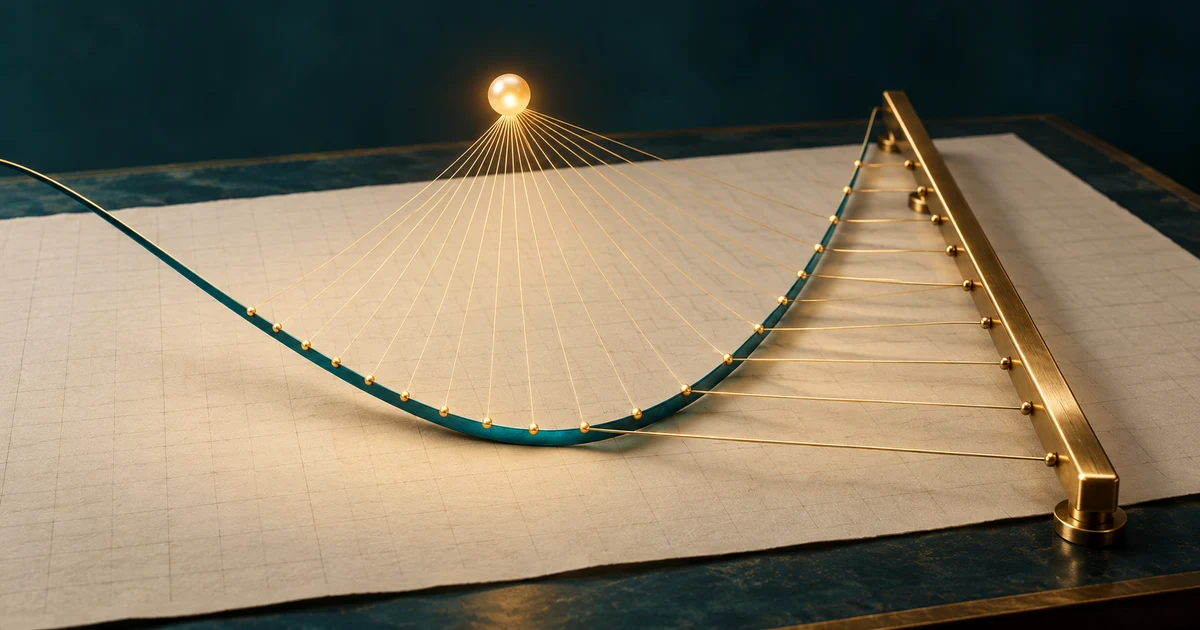
A question gives you a focus, a directrix and an eccentricity. You recognise all three words, but the equation still feels a long way away. Should you start with an ellipse formula? Find the centre? Draw a parabola first?
Start with a moving point.
Call it P(x, y). Measure its distance from the focus and its perpendicular distance from the directrix. The question is telling you the ratio of those two distances. Once you write that relationship, the equation follows through ordinary algebra.
Think of the focus as a small lighthouse and the directrix as a straight shoreline. A moving boat follows a rule comparing its distance from the lighthouse with its shortest distance from the shore. Different ratios trace different curves. The shore is a line, so measuring along a sloping path to it would change the rule.
This guide uses sqrt(...) for a square root and |...| for absolute value. The examples are worked from the distance rule so that you can reuse the method even when the focus is away from the origin.
The one rule behind the calculation
Let the focus be F(h, k), and let M be the foot of the perpendicular from P(x, y) to the directrix. Then:
PF / PM = e
PF = e PM
Here e is the eccentricity, a positive constant. The focus is assumed not to lie on the directrix.
The focus distance is always:
PF = sqrt((x - h)^2 + (y - k)^2)The directrix distance depends on how its equation is written:
| Directrix | Perpendicular distance PM |
|---|---|
| x = d | |x - d| |
| y = d | |y - d| |
| Ax + By + C = 0 | |Ax + By + C| / sqrt(A^2 + B^2) |
In the last row, A and B cannot both be zero.
The classification follows from the eccentricity:
| Eccentricity | Nondegenerate conic |
|---|---|
| 0 < e < 1 | Ellipse |
| e = 1 | Parabola |
| e > 1 | Hyperbola |
The focus-directrix definition and this classification are covered in OpenStax’s Conic Sections lesson. The calculations below apply that definition to original examples.
Do not insert e = 0 into this finite-directrix construction and expect a circle. It would give PF = 0, just the focus. A circle has eccentricity zero in the usual classification, but its directrix is understood as a limiting idea, not an ordinary finite line supplied in this type of question.
A reliable six-step method
- Write the focus coordinates, directrix equation and value of
eseparately. - Let
P(x, y)be an arbitrary point on the required curve. - Calculate
PFand the perpendicular distancePM. - Write
PF = e PM, then square both sides. - Clear denominators, expand and collect terms carefully.
- Identify the curve and check a simple point using the original distances.
The fourth step gives a useful master equation. For focus (h, k) and directrix Ax + By + C = 0:
(x - h)^2 + (y - k)^2
    = e^2 (Ax + By + C)^2 / (A^2 + B^2)
Or, without a fraction:
(A^2 + B^2)[(x - h)^2 + (y - k)^2]
    = e^2(Ax + By + C)^2
This is already a valid equation of the conic. Expansion makes it easier to compare answers; completing squares makes its geometry easier to read.
Squaring is safe here because PF and e PM are nonnegative. The resulting equality of squares is equivalent to the distance equality. This would not be true if you had silently replaced a distance by a signed expression before checking its sign.
Example 1: a parabola with a vertical directrix
Find the conic with focus (3, 0), directrix x = -3 and eccentricity 1.
For a point P(x, y):
PF = sqrt((x - 3)^2 + y^2)
PM = |x + 3|
Since e = 1:
sqrt((x - 3)^2 + y^2) = |x + 3|

(x - 3)^2 + y^2 = (x + 3)^2
x^2 - 6x + 9 + y^2 = x^2 + 6x + 9

y^2 = 12x
This is a parabola opening to the right. Comparing with y^2 = 4ax gives a = 3, exactly the focus coordinate.
The vertex is (0, 0). Its distance from the focus is 3, and its distance from the directrix is also 3. That checks the required ratio of 1.
Notice the directrix sign: x = -3 gives |x - (-3)| = |x + 3|. Copying the minus sign directly into the distance is a common source of a wrong answer.
Example 2: a shifted parabola opening downwards
Now take focus (2, -1), directrix y = 3 and eccentricity 1.
The directrix is horizontal, so the perpendicular distance uses the y-coordinate:
PF = sqrt((x - 2)^2 + (y + 1)^2)
PM = |y - 3|
Apply the distance rule:
(x - 2)^2 + (y + 1)^2 = (y - 3)^2
(x - 2)^2 + y^2 + 2y + 1 = y^2 - 6y + 9

(x - 2)^2 = -8y + 8
(x - 2)^2 = -8(y - 1)
The vertex is (2, 1) and the parabola opens downwards. Its axis is x = 2.
Why is the vertex at (2, 1)? On the perpendicular axis, the focus has y-coordinate -1 and the directrix is at 3. The midpoint has y-coordinate 1.
Check the vertex: the distance to (2, -1) is 2, and the perpendicular distance to y = 3 is also 2.
The standard parabola forms and focus-vertex geometry are explained in the NCERT chapter on Conic Sections and OpenStax’s lesson on the parabola.
Example 3: an ellipse from a focus and its matching directrix
Find the equation when the focus is (2, 0), the directrix is x = 8, and e = 1/2.
Before calculating, predict an ellipse because 0 < e < 1.
sqrt((x - 2)^2 + y^2) = (1/2)|x - 8|

(x - 2)^2 + y^2 = (1/4)(x - 8)^2
Multiply the whole equation by 4:
4(x - 2)^2 + 4y^2 = (x - 8)^2
4x^2 - 16x + 16 + 4y^2 = x^2 - 16x + 64

3x^2 + 4y^2 = 48
x^2/16 + y^2/12 = 1
The final equation is an ellipse centred at the origin, with its longer axis horizontal.
Read off a^2 = 16 and b^2 = 12. Then:
a = 4
c^2 = a^2 - b^2 = 16 - 12 = 4
c = 2
e = c/a = 2/4 = 1/2
Everything agrees with the supplied data. The right-hand focus is (2, 0) and its corresponding directrix is x = a/e = 8.
Check the vertex (4, 0): PF = 2, PM = 4, so PF/PM = 1/2.
Check the other vertex (-4, 0) too: PF = 6 and PM = 12. The same focus-directrix pair gives the same ratio on the far side of the ellipse.
That second check helps dispel an easy misconception: a focus and directrix do not describe only the nearby end of an ellipse. They describe the whole curve.
Example 4: a hyperbola, including its second branch
Take focus (5, 0), directrix x = 9/5, and eccentricity 5/3.
Because e > 1, expect a hyperbola.
(x - 5)^2 + y^2 = (25/9)(x - 9/5)^2Clear the denominator before expanding:
9[(x - 5)^2 + y^2] = (5x - 9)^2

9x^2 - 90x + 225 + 9y^2 = 25x^2 - 90x + 81
16x^2 - 9y^2 = 144

x^2/9 - y^2/16 = 1
Here a = 3, b = 4, and:
c^2 = a^2 + b^2 = 9 + 16 = 25
c = 5
e = c/a = 5/3
At the right vertex (3, 0):
PF = 2
PM = |3 - 9/5| = 6/5
PF/PM = 2 / (6/5) = 5/3
At the left vertex (-3, 0):
PF = 8
PM = |-3 - 9/5| = 24/5
PF/PM = 8 / (24/5) = 5/3
Both branches satisfy the same focus-directrix distance rule. If you had started with (5/3)(x - 9/5) without the absolute value, you would wrongly reject the left branch because that expression is negative there.
Example 5: a sloping directrix
Suppose the focus is (0, 0), the directrix is 3x + 4y - 10 = 0, and e = 1.
The line is neither horizontal nor vertical. Use the full point-to-line distance formula:
PM = |3x + 4y - 10| / sqrt(3^2 + 4^2)
   = |3x + 4y - 10| / 5
Therefore:
sqrt(x^2 + y^2) = |3x + 4y - 10| / 5
25(x^2 + y^2) = (3x + 4y - 10)^2
This compact equation is correct. If an expanded equation is wanted:
25x^2 + 25y^2
    = 9x^2 + 24xy + 16y^2 - 60x - 80y + 100

16x^2 - 24xy + 9y^2 + 60x + 80y - 100 = 0
The xy term is expected: the parabola’s axis is tilted relative to the coordinate axes. You do not need to rotate the axes merely to find its equation.
For a geometric check, the perpendicular from the origin meets the directrix at (6/5, 8/5). The vertex is halfway between this foot and the focus:
Vertex = (3/5, 4/5)
PF = sqrt(9/25 + 16/25) = 1
PM = |9/5 + 16/5 - 10| / 5 = 1
The vertex satisfies the required equality.
Example 6: completing squares after a shifted ellipse calculation
Let the focus be (3, -2), the directrix be x = 6, and e = 1/2.
(x - 3)^2 + (y + 2)^2 = (1/4)(x - 6)^2
4(x - 3)^2 + 4(y + 2)^2 = (x - 6)^2
Keep the y-bracket intact while simplifying the x-terms:
4x^2 - 24x + 36 + 4(y + 2)^2 = x^2 - 12x + 36
3x^2 - 12x + 4(y + 2)^2 = 0
3(x^2 - 4x) + 4(y + 2)^2 = 0
Since x^2 - 4x = (x - 2)^2 - 4:
3(x - 2)^2 - 12 + 4(y + 2)^2 = 0
3(x - 2)^2 + 4(y + 2)^2 = 12

(x - 2)^2/4 + (y + 2)^2/3 = 1
The centre is (2, -2), not the focus (3, -2). We have a = 2, b = sqrt(3), and c = 1. The right focus is one unit to the right of the centre, as required.
The corresponding directrix is x = 2 + a/e = 2 + 4 = 6.
At the right vertex (4, -2), the focus distance is 1 and the directrix distance is 2. Their ratio is 1/2.
If translating a curve feels unfamiliar, OpenStax’s ellipse lesson explains how the centre appears in standard form.
How much simplification does an answer need?
If the instruction is simply to find the equation, a correctly formed squared-distance equation is mathematically sufficient. Still, an expanded or standard form makes your answer easier to check and shows that you have completed the algebra.
Use the requested form when the question specifies one:
| Task | Useful final form |
|---|---|
| Find the equation | A simplified equation with no unnecessary fractions |
| Identify the conic | Equation plus the classification from e |
| Find centre, vertices or axis lengths | Standard form after completing squares |
| Sloping directrix with no further instructions | Compact squared-distance form or expanded quadratic |
For more practice recognising standard forms, use our guide to identifying a parabola, ellipse or hyperbola.
One important caution: for a standard ellipse or hyperbola, match the focus with its corresponding directrix. For example, the ellipse in Example 3 pairs (2, 0) with x = 8, and (-2, 0) with x = -8. Mixing the focus from one pair with the directrix from the other does not preserve that ellipse.
Mistakes worth catching before you submit
Reversing the ratio. The definition is PF/PM = e. Writing PM/PF = e uses the reciprocal and can turn an intended ellipse into a hyperbola.
Forgetting to square e. In Example 3, the coefficient becomes 1/4. The focus distance is squared, the line distance is squared, and the multiplier is squared too.
Using distance from the focus to the line. That is a fixed number. The required denominator is the distance from the moving point P(x, y) to the line.
Losing a sign in a coordinate. Focus (2, -1) gives (y + 1)^2; directrix x = -3 gives |x + 3|.
Calling the focus the centre. Example 6 deliberately separates them. The centre comes from the completed-square form.
Treating every curve as axis-aligned. A sloping directrix usually produces a rotated conic. An xy term is not evidence that the calculation failed.
Assuming a standard conic when the focus lies on the directrix. The ordinary classification above assumes the focus is off the line. If a question puts it on the line, the distance equation can degenerate. For instance, focus (0, 0), directrix x = 0 and e = 1 give y^2 = 0, a line rather than a nondegenerate parabola.
Try these six questions
For each, write the two distances before looking at the answer. All coordinates use the same units.
- Focus
(-2, 0), directrixx = 2, eccentricity1. - Focus
(0, 3), directrixy = 12, eccentricity1/2. - Focus
(4, 0), directrixx = 1, eccentricity2. - Focus
(1, 2), directrixy = -2, eccentricity1. - Focus
(0, 0), directrixx + y - 4 = 0, eccentricity1. - Focus
(0, 2), directrixy = 8, eccentricity1/2.
Answers with a working checkpoint
1. Start with (x + 2)^2 + y^2 = (x - 2)^2. The result is y^2 = -8x, a left-opening parabola.
2. Start with 4[x^2 + (y - 3)^2] = (y - 12)^2. Simplifying gives 4x^2 + 3y^2 = 108, or x^2/27 + y^2/36 = 1. The longer axis is vertical.
3. Start with (x - 4)^2 + y^2 = 4(x - 1)^2. This gives 3x^2 - y^2 = 12, or x^2/4 - y^2/12 = 1.
4. Start with (x - 1)^2 + (y - 2)^2 = (y + 2)^2. The result is (x - 1)^2 = 8y, with vertex (1, 0).
5. The distance to the line is |x + y - 4|/sqrt(2). Thus 2(x^2 + y^2) = (x + y - 4)^2. Expanded, this is x^2 - 2xy + y^2 + 8x + 8y - 16 = 0.
6. Start with 4[x^2 + (y - 2)^2] = (y - 8)^2. The result is x^2/12 + y^2/16 = 1.
Frequently asked questions
1. What is the formula for a conic from focus, directrix and eccentricity?
For focus (h, k) and directrix Ax + By + C = 0, use (A^2 + B^2)[(x - h)^2 + (y - k)^2] = e^2(Ax + By + C)^2. It comes directly from PF = e PM.
2. How do I know whether the answer is an ellipse, parabola or hyperbola?
With the focus off the directrix, 0 < e < 1 gives an ellipse, e = 1 gives a parabola, and e > 1 gives a hyperbola. Predict the type before expanding, then use it as a check.
3. Why is the distance to x = d an absolute value?
The signed difference x - d can be negative, but distance cannot. The perpendicular distance is |x - d|. After squaring, its square becomes (x - d)^2.
4. Can I always square the focus-directrix equation?
Yes, for PF = e PM with positive e and genuine distances. Both sides are nonnegative, so squaring preserves equivalence. Keep absolute values when first writing the line distance.
5. Do I need to find the centre before writing the equation?
No. Start with the given focus and directrix. For an ellipse or hyperbola, completing squares later reveals the centre. A parabola has a vertex but no centre of symmetry.
6. What changes when the directrix is sloping?
Use the general perpendicular-distance formula, including its denominator. The final equation may contain an xy term because the axis is tilted. The basic rule PF = e PM stays the same.
7. Does one focus and one directrix describe both branches of a hyperbola?
Yes, when they are a corresponding pair and perpendicular distance is treated as nonnegative. Example 4 checks both vertices using the same pair.
8. Is the vertex always halfway between the focus and directrix?
For a parabola, its vertex is the midpoint of the focus and the foot of the perpendicular from the focus to the directrix. This shortcut does not generally apply to an ellipse or hyperbola.
9. Can I obtain a circle by setting e equal to zero here?
Not with an ordinary finite directrix. The equation would reduce to a single point. The circle’s eccentricity of zero belongs to the broader classification and a limiting interpretation of the focus-directrix relationship.
10. What is the quickest way to check my final equation?
Check that the conic type agrees with e, then substitute an easy point into the original distance ratio. If standard form is available, recover the focus and corresponding directrix as a second check.
Looking for commerce tuitions?
Prachi is a gold-medalist commerce teacher with experience at Deloitte and KPMG. She focuses on fundamentals to build a strong foundation.