
 Whatsapp
Cube Roots of Unity: Identities That Shorten Complex-Number Problems
Learn the cube roots of unity, their key identities, and simple ways to use omega to simplify complex-number expressions faster.
- 11th
- Study Advice
Cube roots of unity look mysterious the first time you see the symbol omega.
Then, after a few questions, you realise something important: this topic is not about memorising many new formulas. It is about recognising a small pattern that keeps returning in complex-number problems.
The whole idea starts with one equation:
x^3 = 1The numbers that satisfy this equation are called the cube roots of unity.
One root is easy:
x = 1The other two roots are complex numbers. We usually call them:
omega and omega^2Once you know how these three roots behave together, many expressions become much shorter. Long powers reduce quickly. Fractions simplify neatly. Products that look heavy become one-line answers.
This guide will help you understand what omega means, why the identities work, and how to use them without confusion.
First, What Are the Cube Roots of Unity?
The cube roots of unity are the three values of x that satisfy:
x^3 = 1Move everything to one side:
x^3 - 1 = 0Now factorise:
x^3 - 1 = (x - 1)(x^2 + x + 1)So one root comes from:
x - 1 = 0
x = 1
The other two roots come from:
x^2 + x + 1 = 0Using the quadratic formula:
x = [-1 +- sqrt(1 - 4)] / 2
x = [-1 +- sqrt(-3)] / 2
x = [-1 +- i sqrt(3)] / 2
So the three cube roots of unity are:
1
(-1 + i sqrt(3)) / 2
(-1 - i sqrt(3)) / 2
We usually name the complex roots as:
omega = (-1 + i sqrt(3)) / 2
omega^2 = (-1 - i sqrt(3)) / 2
Some books may choose the lower complex root as omega. That is okay. The identities remain the same if omega and omega^2 are paired correctly.
The Three Roots Form a Balanced Triangle
The three cube roots of unity are not random.
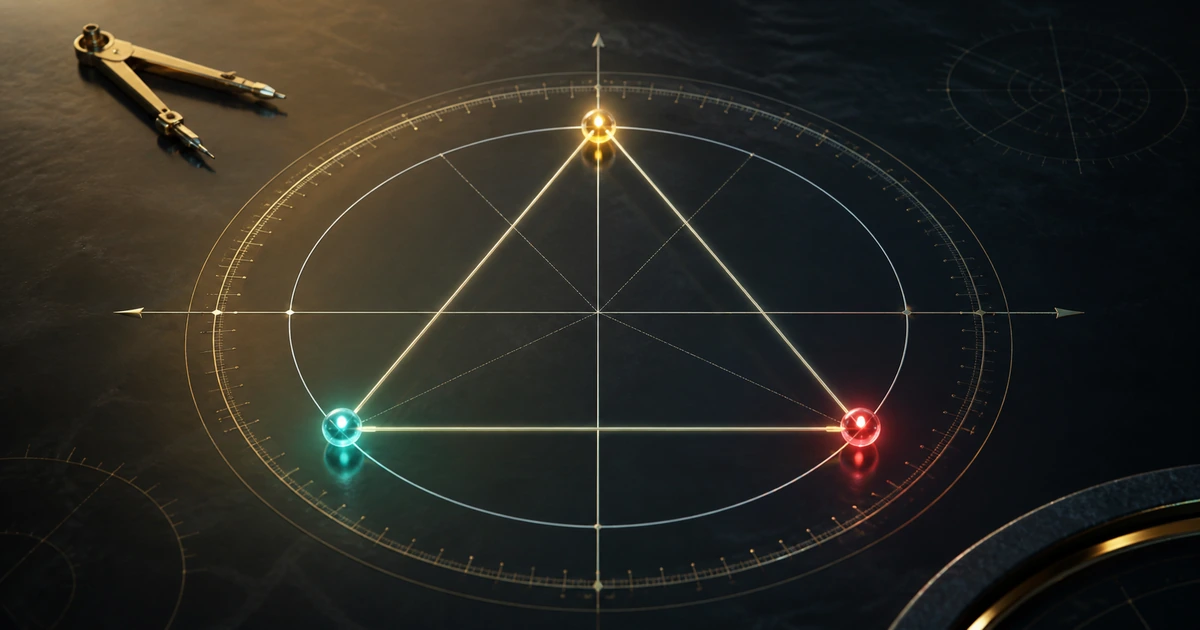
On the Argand plane, all three have modulus 1. That means all three lie on the unit circle.
Their arguments are separated by 120 degrees:
1        -> 0 degrees
omega    -> 120 degrees
omega^2  -> 240 degrees
This creates an equilateral triangle on the unit circle.
That picture explains the most important identity:
1 + omega + omega^2 = 0The three roots are balanced around the origin. When you add them as vectors, they cancel out.
The Core Identities You Must Know
Most questions on cube roots of unity use the same small identity set.
| Identity | Meaning |
|---|---|
omega^3 = 1 | Every third power returns to 1 |
1 + omega + omega^2 = 0 | The three roots balance to zero |
omega + omega^2 = -1 | Move 1 to the other side |
omega * omega^2 = omega^3 = 1 | The two complex roots multiply to 1 |
1 / omega = omega^2 | Since omega * omega^2 = 1 |
1 / omega^2 = omega | Since omega^2 * omega = 1 |
These identities are the heart of the topic.
Do not try to expand omega as (-1 + i sqrt(3)) / 2 every time. That is usually the slow path.
Use the identities first.
Why omega^3 = 1 Makes Powers Easy
Since:
omega^3 = 1the powers of omega repeat in a cycle of three:
omega^1 = omega
omega^2 = omega^2
omega^3 = 1
omega^4 = omega
omega^5 = omega^2
omega^6 = 1
So every power of omega can be reduced by dividing the exponent by 3 and looking at the remainder.
| Remainder when exponent is divided by 3 | Value |
|---|---|
0 | 1 |
1 | omega |
2 | omega^2 |
Example: Simplify omega^25
Divide 25 by 3.
25 = 3 x 8 + 1The remainder is 1, so:
omega^25 = omegaExample: Simplify omega^41
Divide 41 by 3.
41 = 3 x 13 + 2The remainder is 2, so:
omega^41 = omega^2Example: Simplify omega^96
Divide 96 by 3.
96 = 3 x 32 + 0The remainder is 0, so:
omega^96 = 1How to Handle Negative Powers
Negative powers become easy once you remember reciprocals.
Since:
1 / omega = omega^2we get:
omega^-1 = omega^2And since:
1 / omega^2 = omegawe get:
omega^-2 = omegaFor larger negative powers, use the same cycle idea.
Example: Simplify omega^-10
We can write:
omega^-10 = 1 / omega^10Now reduce omega^10.
10 = 3 x 3 + 1
omega^10 = omega
So:
omega^-10 = 1 / omega
omega^-10 = omega^2
Another quick way is to find a positive exponent with the same position in the cycle. Since powers repeat every 3, -10 and 2 have the same remainder pattern.
So:
omega^-10 = omega^2The Identity 1 + omega + omega^2 = 0
This is the identity that shortens many expressions.
From:
1 + omega + omega^2 = 0we get:
omega + omega^2 = -1
1 + omega = -omega^2
1 + omega^2 = -omega
These three forms are all useful.
For example:
1 + omega = -omega^2So instead of keeping 1 + omega as it is, you can replace it with -omega^2.
This is helpful when expressions are being multiplied, squared, or divided.
Simple Products That Appear Again and Again
Some products are so common that you should know how to simplify them quickly.
Product 1: (1 - omega)(1 - omega^2)
Expand:
(1 - omega)(1 - omega^2)
= 1 - omega - omega^2 + omega^3
Now use:
omega + omega^2 = -1
omega^3 = 1
So:
1 - (omega + omega^2) + omega^3
= 1 - (-1) + 1
= 3
Therefore:
(1 - omega)(1 - omega^2) = 3Product 2: (2 + omega)(2 + omega^2)
Expand:
(2 + omega)(2 + omega^2)
= 4 + 2omega + 2omega^2 + omega^3
Use:
omega + omega^2 = -1
omega^3 = 1
So:
4 + 2(omega + omega^2) + 1
= 4 + 2(-1) + 1
= 3
Therefore:
(2 + omega)(2 + omega^2) = 3Product 3: (1 + omega)^2
You can expand:
(1 + omega)^2
= 1 + 2omega + omega^2
Now split it:
1 + 2omega + omega^2
= (1 + omega + omega^2) + omega
Since:
1 + omega + omega^2 = 0we get:
(1 + omega)^2 = omegaYou can also use:
1 + omega = -omega^2Then:
(1 + omega)^2 = (-omega^2)^2 = omega^4 = omegaBoth methods give the same answer.
Fractions Become Shorter Too
Fractions with omega often look heavy, but they usually collapse after using the identities.
Example: Simplify
1 / (1 - omega) + 1 / (1 - omega^2)Take the common denominator:
(1 - omega)(1 - omega^2)We already know:
(1 - omega)(1 - omega^2) = 3Now add the numerators:
(1 - omega^2) + (1 - omega)
= 2 - (omega + omega^2)
Use:
omega + omega^2 = -1So:
2 - (omega + omega^2)
= 2 - (-1)
= 3
Therefore:
1 / (1 - omega) + 1 / (1 - omega^2)
= 3 / 3
= 1
This is a good example of why the identity set matters. Without it, the expression looks longer than it really is.
Factorisation With Cube Roots of Unity
Cube roots of unity also help in factorisation.
You already know:
x^3 - y^3 = (x - y)(x^2 + xy + y^2)Using cube roots of unity, the same factorisation can be written as:
x^3 - y^3 = (x - y)(x - omega y)(x - omega^2 y)Why?
Because the three values that make x^3 - y^3 = 0 are:
x = y
x = omega y
x = omega^2 y
So the three factors are:
(x - y), (x - omega y), (x - omega^2 y)This form is especially useful when a question already contains omega or complex factors.
Similarly:
x^3 + y^3 = (x + y)(x + omega y)(x + omega^2 y)This is because:
x^3 + y^3 = x^3 - (-y)^3A Fast Method for Simplification Questions
When a question contains omega, follow this order.
- Reduce all powers using
omega^3 = 1. - Replace
omega + omega^2with-1. - Replace
1 + omega + omega^2with0. - Use reciprocals:
1 / omega = omega^2and1 / omega^2 = omega. - Only expand fully when the expression does not simplify directly.
This order saves time because many expressions disappear before expansion is needed.
Let us solve that example.
17 = 3 x 5 + 2, so omega^17 = omega^2
31 = 3 x 10 + 1, so omega^31 = omega
44 = 3 x 14 + 2, so omega^44 = omega^2
So:
omega^17 + omega^31 + omega^44
= omega^2 + omega + omega^2
= (omega + omega^2) + omega^2
= -1 + omega^2
That is already a neat simplified form.
If the question asks for a + ib form, then substitute:
omega^2 = (-1 - i sqrt(3)) / 2So:
-1 + omega^2
= -1 + (-1 - i sqrt(3)) / 2
= (-3 - i sqrt(3)) / 2
When Should You Substitute the Value of omega?
Students often ask whether they should use the identities or substitute the full value of omega.
The answer is simple:
Use identities first.
Substitute the value only when the final answer must be in a + ib form, or when the question specifically asks for the real and imaginary parts.
For example, if the expression simplifies to:
2 + 3omegaand the answer must be written as a + ib, then use:
omega = (-1 + i sqrt(3)) / 2So:
2 + 3omega
= 2 + 3[(-1 + i sqrt(3)) / 2]
= 2 + (-3 + 3i sqrt(3)) / 2
= (4 - 3 + 3i sqrt(3)) / 2
= (1 + 3i sqrt(3)) / 2
Therefore:
2 + 3omega = 1/2 + (3 sqrt(3) / 2)iBut if the question only asks to simplify, 2 + 3omega may already be acceptable depending on the expression. Always read the final instruction carefully.
Common Mistakes to Avoid
Mistake 1: Forgetting the Root 1
The cube roots of unity are:
1, omega, omega^2Do not write only omega and omega^2.
The real root 1 is part of the set.
Mistake 2: Writing omega + omega^2 = 1
This is wrong.
The correct identity is:
omega + omega^2 = -1because:
1 + omega + omega^2 = 0Mistake 3: Treating omega^2 as a New Symbol
omega^2 is simply the square of omega.
It is also the other non-real cube root of unity.
Since:
omega^3 = 1we get:
omega^4 = omega
omega^5 = omega^2
omega^6 = 1
So omega^2 is not separate from the power cycle.
Mistake 4: Expanding Too Early
If you immediately write:
omega = (-1 + i sqrt(3)) / 2inside every expression, the work often becomes longer.
Try identities first. Substitute the full value near the end only if needed.
Mistake 5: Missing the Conjugate Pair
The two non-real cube roots are conjugates:
omega = (-1 + i sqrt(3)) / 2
omega^2 = (-1 - i sqrt(3)) / 2
Their sum is real:
omega + omega^2 = -1Their product is also real:
omega * omega^2 = 1This is why expressions containing both often simplify beautifully.
A Short Practice Set
Try these without substituting the full value of omega at the start.
Question 1
Simplify:
omega^14 + omega^22 + omega^33Solution:
omega^14 = omega^2
omega^22 = omega
omega^33 = 1
So:
omega^14 + omega^22 + omega^33
= omega^2 + omega + 1
= 0
Question 2
Simplify:
(3 + omega)(3 + omega^2)Solution:
(3 + omega)(3 + omega^2)
= 9 + 3omega + 3omega^2 + omega^3
= 9 + 3(omega + omega^2) + 1
= 9 + 3(-1) + 1
= 7
Question 3
Simplify:
omega / (1 - omega^2) + omega^2 / (1 - omega)Solution:
Use the common denominator:
(1 - omega)(1 - omega^2) = 3The numerator becomes:
omega(1 - omega) + omega^2(1 - omega^2)Expand:
omega - omega^2 + omega^2 - omega^4Since omega^4 = omega, this becomes:
omega - omega = 0Therefore:
omega / (1 - omega^2) + omega^2 / (1 - omega) = 0Question 4
Write 1 + 2omega in a + ib form.
Solution:
Use:
omega = (-1 + i sqrt(3)) / 2Then:
1 + 2omega
= 1 + 2[(-1 + i sqrt(3)) / 2]
= 1 + (-1 + i sqrt(3))
= i sqrt(3)
So:
1 + 2omega = i sqrt(3)The Main Takeaway
Cube roots of unity become simple when you stop seeing omega as a strange symbol and start seeing it as part of a cycle.
The cycle is:
omega, omega^2, 1, omega, omega^2, 1, ...The balance identity is:
1 + omega + omega^2 = 0Together, these two ideas solve most school-level cube-root-of-unity questions.
Frequently Asked Questions
1. What are the cube roots of unity?
The cube roots of unity are the three numbers that satisfy x^3 = 1. They are:
1, omega, omega^2In complex form:
1
(-1 + i sqrt(3)) / 2
(-1 - i sqrt(3)) / 2
2. What is the value of omega?
Usually:
omega = (-1 + i sqrt(3)) / 2Then:
omega^2 = (-1 - i sqrt(3)) / 2If a book chooses the other complex root as omega, the identities still work as long as the pairing is consistent.
3. Why is 1 + omega + omega^2 = 0?
The three cube roots of unity lie evenly around the unit circle. Their vector sum balances at the origin.
Algebraically, omega and omega^2 satisfy:
x^2 + x + 1 = 0So for x = omega:
omega^2 + omega + 1 = 0That is the same as:
1 + omega + omega^2 = 04. How do I simplify high powers of omega?
Use the cycle created by omega^3 = 1.
Divide the exponent by 3 and check the remainder.
Remainder 0 -> 1
Remainder 1 -> omega
Remainder 2 -> omega^2
For example:
omega^50 = omega^2because 50 leaves remainder 2 when divided by 3.
5. Is omega^2 the same as omega?
No. omega and omega^2 are different complex roots of unity.
But they are closely connected:
omega^3 = 1
omega * omega^2 = 1
omega + omega^2 = -1
6. When should I write the answer in a + ib form?
Write the answer in a + ib form when the question asks for the real and imaginary parts, or when it clearly wants the final answer as a complex number in standard form.
For simplification questions, it is usually better to use identities first and substitute the full value of omega only at the end.
Looking for commerce tuitions?
Prachi is a gold-medalist commerce teacher with experience at Deloitte and KPMG. She focuses on fundamentals to build a strong foundation.