
 Whatsapp
Depreciation by Written Down Value Method: Format and Formula
Understand the written down value method of depreciation with formula, yearly format, solved examples, part-year calculation, and practice questions.
- 11th
- Accounts
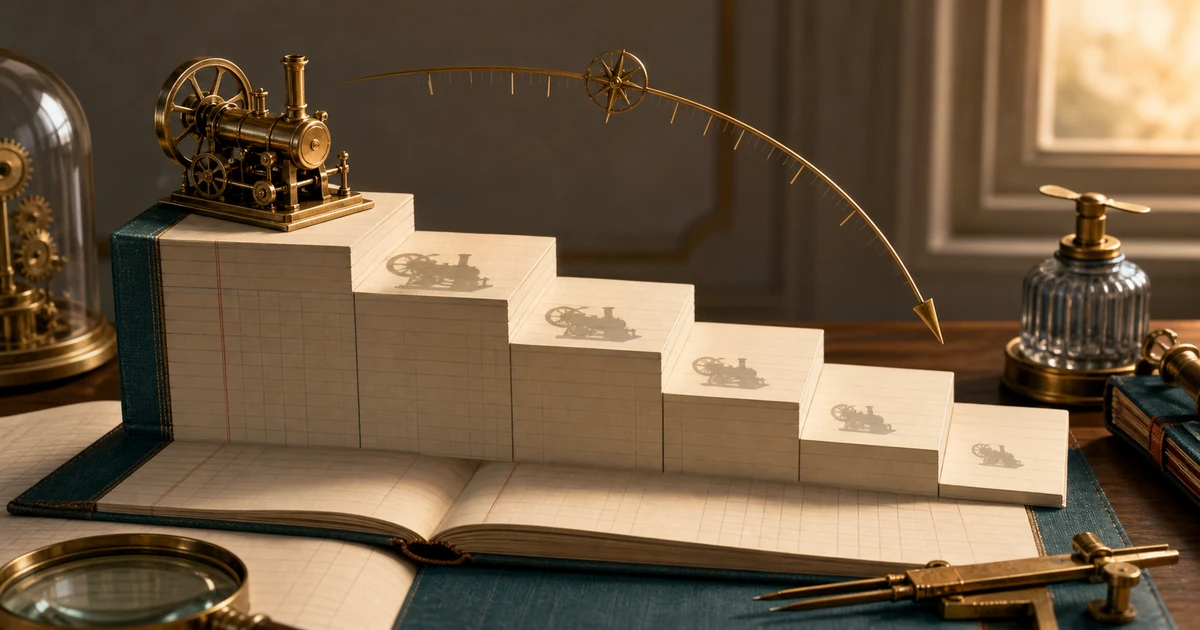
The written down value method looks confusing only until you notice one pattern.
The rate stays the same.
The value on which the rate is applied keeps reducing.
That is the whole idea.
Under this method, depreciation is not calculated on the original cost every year. It is calculated on the written down value, also called book value, at the beginning of the year.
So the first year’s depreciation is the highest. After that, the depreciation amount usually reduces year by year.
Once this is clear, the format becomes simple. You only need to carry the closing value of one year as the opening value of the next year.
What Written Down Value Means
Written down value means the value of the asset after deducting depreciation already charged.
In simple words:
Written down value = Cost of asset - Depreciation charged till dateExample:
A machine costs Rs. 1,00,000.
Depreciation for the first year is Rs. 10,000.
So the written down value at the end of the first year is:
Rs. 1,00,000 - Rs. 10,000 = Rs. 90,000For the second year, depreciation will be calculated on Rs. 90,000, not on Rs. 1,00,000.
This is why the method is also called the reducing balance method or diminishing balance method.
The Main Formula
The most important formula is:
Depreciation = Opening written down value x Rate of depreciation / 100After calculating depreciation:
Closing written down value = Opening written down value - DepreciationThen the closing written down value becomes next year’s opening written down value.
Why Depreciation Reduces Every Year
Let us say an asset costs Rs. 1,00,000 and depreciation is charged at 10 percent per year.
In the first year, 10 percent is charged on Rs. 1,00,000.
In the second year, 10 percent is charged on Rs. 90,000.
In the third year, 10 percent is charged on Rs. 81,000.
The percentage is always 10 percent, but the base amount keeps becoming smaller.
That is why depreciation reduces.
| Year | Opening written down value | Depreciation at 10 percent | Closing written down value |
|---|---|---|---|
| 1 | Rs. 1,00,000 | Rs. 10,000 | Rs. 90,000 |
| 2 | Rs. 90,000 | Rs. 9,000 | Rs. 81,000 |
| 3 | Rs. 81,000 | Rs. 8,100 | Rs. 72,900 |
Notice the rhythm:
1,00,000 -> 90,000 -> 81,000 -> 72,900Each year begins with last year’s closing value.
WDV Method vs Straight Line Method
Students often mix these two methods.
Here is the clean difference:
| Point | Straight line method | Written down value method |
|---|---|---|
| Depreciation is calculated on | Original cost | Opening book value |
| Depreciation amount | Same every year | Reduces every year |
| Rate | Applied to cost | Applied to written down value |
| Asset value at the end | Can reach scrap value in a planned way | Usually keeps reducing but does not become zero by normal percentage |
| Best memory line | Same amount each year | Same rate, reducing value |
The method is not difficult. The habit of applying the rate on original cost is what creates mistakes.
Why Businesses Use Written Down Value Method
Many fixed assets are more useful when they are new.
A new machine works faster. A new vehicle gives fewer repair problems. A new computer handles work better. As the asset gets older, repairs may increase and efficiency may reduce.
Written down value method charges more depreciation in the earlier years and less depreciation later.
This often matches the practical life of assets better.
The combined burden can also feel more balanced:
- earlier years: higher depreciation, lower repairs
- later years: lower depreciation, higher repairs
That is one reason this method is commonly used for assets like machinery, vehicles, and computers.
Basic Journal Entries
If depreciation is credited directly to the asset account, the entry is:
| Particulars | Debit (Rs.) | Credit (Rs.) |
|---|---|---|
| Depreciation A/c Dr. | Amount | |
| To Asset A/c | Amount |
Narration: Being depreciation charged on asset.
Then depreciation is transferred to Profit and Loss Account:
| Particulars | Debit (Rs.) | Credit (Rs.) |
|---|---|---|
| Profit and Loss A/c Dr. | Amount | |
| To Depreciation A/c | Amount |
Narration: Being depreciation transferred to Profit and Loss Account.
If Provision for Depreciation Account is maintained, the first entry changes to:
| Particulars | Debit (Rs.) | Credit (Rs.) |
|---|---|---|
| Depreciation A/c Dr. | Amount | |
| To Provision for Depreciation A/c | Amount |
The calculation of depreciation does not change only because the recording method changes.
Standard Schedule Format
When you are asked to calculate depreciation for a few years, use this format:
| Year | Opening WDV | Additions | Depreciation | Closing WDV |
|---|---|---|---|---|
| Year 1 | Cost or opening value | Additions during year | Calculated depreciation | Closing value |
| Year 2 | Previous closing value | Additions during year | Calculated depreciation | Closing value |
| Year 3 | Previous closing value | Additions during year | Calculated depreciation | Closing value |
For a simple question with no additions or sale, you can use a shorter version:
| Year | Opening WDV | Depreciation | Closing WDV |
|---|---|---|---|
| 1 | |||
| 2 | |||
| 3 |
This table is not just for presentation. It helps your working stay organised.
Solved Example 1: Full Year Depreciation
Question:
On April 1, 2026, a machine was purchased for Rs. 1,00,000. Depreciation is charged at 10 percent per annum under written down value method. Accounts are closed on March 31 every year. Calculate depreciation for three years.
Solution:
Since the machine was bought on April 1 and accounts close on March 31, each year is a full year.
| Year ended | Opening WDV | Depreciation at 10 percent | Closing WDV |
|---|---|---|---|
| March 31, 2027 | Rs. 1,00,000 | Rs. 10,000 | Rs. 90,000 |
| March 31, 2028 | Rs. 90,000 | Rs. 9,000 | Rs. 81,000 |
| March 31, 2029 | Rs. 81,000 | Rs. 8,100 | Rs. 72,900 |
Working:
Year 1 depreciation = 1,00,000 x 10 / 100 = Rs. 10,000
Year 2 depreciation = 90,000 x 10 / 100 = Rs. 9,000
Year 3 depreciation = 81,000 x 10 / 100 = Rs. 8,100
The important point is that the second year starts from Rs. 90,000, not Rs. 1,00,000.
Asset Account Format Under Direct Method
If depreciation is credited directly to the asset account, the Machine Account for the above example will look like this:
| Machine Account | |||
|---|---|---|---|
| Debit Side | Rs. | Credit Side | Rs. |
| Apr. 1, 2026 To Bank A/c | 1,00,000 | Mar. 31, 2027 By Depreciation A/c | 10,000 |
| Mar. 31, 2027 By Balance c/d | 90,000 | ||
| Total | 1,00,000 | Total | 1,00,000 |
Next year:
| Machine Account | |||
|---|---|---|---|
| Debit Side | Rs. | Credit Side | Rs. |
| Apr. 1, 2027 To Balance b/d | 90,000 | Mar. 31, 2028 By Depreciation A/c | 9,000 |
| Mar. 31, 2028 By Balance c/d | 81,000 | ||
| Total | 90,000 | Total | 90,000 |
This is the format students should understand:
- opening value appears on the debit side
- depreciation appears on the credit side
- closing value appears on the credit side as balance carried down
- next year, that closing value comes back as balance brought down
Solved Example 2: Asset Purchased During The Year
Question:
On July 1, 2026, furniture was purchased for Rs. 60,000. Depreciation is charged at 10 percent per annum under written down value method. Accounts are closed on March 31 every year. Calculate depreciation for the first two years.
Solution:
From July 1, 2026 to March 31, 2027, the furniture is used for 9 months.
First year depreciation:
60,000 x 10 / 100 x 9 / 12 = Rs. 4,500Closing WDV:
60,000 - 4,500 = Rs. 55,500Second year depreciation is for a full year on Rs. 55,500:
55,500 x 10 / 100 = Rs. 5,550| Year ended | Opening WDV | Period | Depreciation | Closing WDV |
|---|---|---|---|---|
| March 31, 2027 | Rs. 60,000 | 9 months | Rs. 4,500 | Rs. 55,500 |
| March 31, 2028 | Rs. 55,500 | 12 months | Rs. 5,550 | Rs. 49,950 |
The next year begins with the reduced value, not the original purchase price.
Solved Example 3: Addition During The Year
Question:
Opening written down value of machinery on April 1, 2026 was Rs. 80,000. A new machine was purchased on October 1, 2026 for Rs. 40,000. Depreciation is charged at 10 percent per annum under written down value method. Accounts close on March 31. Calculate depreciation and closing value.
Solution:
There are two parts:
- Old machinery: depreciation for full year.
- New machinery: depreciation for 6 months.
Old machinery depreciation:
80,000 x 10 / 100 = Rs. 8,000New machinery depreciation:
40,000 x 10 / 100 x 6 / 12 = Rs. 2,000Total depreciation:
8,000 + 2,000 = Rs. 10,000Closing WDV:
Opening WDV + Addition - Depreciation
80,000 + 40,000 - 10,000 = Rs. 1,10,000| Particular | Amount |
|---|---|
| Opening WDV of old machinery | Rs. 80,000 |
| Add: New machinery purchased | Rs. 40,000 |
| Less: Depreciation on old machinery | Rs. 8,000 |
| Less: Depreciation on new machinery | Rs. 2,000 |
| Closing WDV | Rs. 1,10,000 |
This is the correct way because each asset is depreciated only for the time it was used.
How To Calculate Rate If Rate Is Not Given
Most school questions give the rate.
Sometimes, the question gives cost, scrap value, and useful life, and asks you to find the rate under written down value method.
The formula is:
Rate = [1 - (Scrap value / Cost)^(1 / Useful life)] x 100This formula may look heavy, but the idea is simple. The rate should reduce the asset from cost to scrap value over the useful life.
Example:
Cost of asset = Rs. 1,00,000
Scrap value = Rs. 51,200
Useful life = 3 years
Rate = [1 - (51,200 / 1,00,000)^(1 / 3)] x 100
Rate = [1 - (0.512)^(1 / 3)] x 100
Rate = [1 - 0.8] x 100
Rate = 20 percent
Check:
| Year | Opening WDV | Depreciation at 20 percent | Closing WDV |
|---|---|---|---|
| 1 | Rs. 1,00,000 | Rs. 20,000 | Rs. 80,000 |
| 2 | Rs. 80,000 | Rs. 16,000 | Rs. 64,000 |
| 3 | Rs. 64,000 | Rs. 12,800 | Rs. 51,200 |
The closing value matches the scrap value.
Common Mistakes In WDV Questions
The first mistake is applying the rate on original cost every year.
That turns the answer into straight line style, even though the question asks for WDV.
The second mistake is forgetting the time period in the year of purchase.
If an asset is purchased on October 1 and accounts close on March 31, depreciation is for 6 months, not 12 months.
The third mistake is not carrying forward the closing written down value.
The closing value of one year becomes the opening value of the next year.
The fourth mistake is mixing up depreciation and closing value.
Depreciation is the amount charged for the year. Closing WDV is the value left after deducting depreciation.
The fifth mistake is ignoring additions.
If a new asset is purchased during the year, calculate depreciation on the old asset and the new asset separately.
A Simple Answer-Writing Format
When you solve WDV questions, write your answer like this:
- State the method and rate.
- Make the depreciation table.
- Show workings for part-year amounts.
- Write journal entries if asked.
- Prepare the asset account if asked.
This keeps your answer clean and easy to check.
Here is a compact template:
| Year | Opening WDV | Additions | Depreciation | Closing WDV |
|---|---|---|---|---|
Use the additions column only when the question has new purchases during the year.
Practice Questions
Try these without looking back.
Question 1
Machinery was purchased for Rs. 2,00,000 on April 1, 2026. Depreciation is charged at 15 percent per annum under written down value method. Accounts close on March 31. Calculate depreciation for three years.
Question 2
Furniture was purchased for Rs. 90,000 on October 1, 2026. Depreciation is charged at 10 percent per annum under written down value method. Accounts close on March 31. Calculate depreciation for two years.
Question 3
Opening written down value of machinery on April 1, 2026 was Rs. 1,50,000. A new machine was purchased on January 1, 2027 for Rs. 60,000. Depreciation is charged at 20 percent per annum. Accounts close on March 31. Calculate total depreciation and closing WDV.
Question 4
An asset costing Rs. 1,00,000 is expected to have a scrap value of Rs. 64,000 after two years. Find the depreciation rate under written down value method.
Practice Answers
Answer 1
| Year ended | Opening WDV | Depreciation at 15 percent | Closing WDV |
|---|---|---|---|
| March 31, 2027 | Rs. 2,00,000 | Rs. 30,000 | Rs. 1,70,000 |
| March 31, 2028 | Rs. 1,70,000 | Rs. 25,500 | Rs. 1,44,500 |
| March 31, 2029 | Rs. 1,44,500 | Rs. 21,675 | Rs. 1,22,825 |
Answer 2
First year depreciation is for 6 months.
90,000 x 10 / 100 x 6 / 12 = Rs. 4,500Second year depreciation is on Rs. 85,500 for a full year.
85,500 x 10 / 100 = Rs. 8,550| Year ended | Opening WDV | Period | Depreciation | Closing WDV |
|---|---|---|---|---|
| March 31, 2027 | Rs. 90,000 | 6 months | Rs. 4,500 | Rs. 85,500 |
| March 31, 2028 | Rs. 85,500 | 12 months | Rs. 8,550 | Rs. 76,950 |
Answer 3
Old machinery depreciation:
1,50,000 x 20 / 100 = Rs. 30,000New machinery depreciation for 3 months:
60,000 x 20 / 100 x 3 / 12 = Rs. 3,000Total depreciation:
30,000 + 3,000 = Rs. 33,000Closing WDV:
1,50,000 + 60,000 - 33,000 = Rs. 1,77,000Answer 4
Rate = [1 - (64,000 / 1,00,000)^(1 / 2)] x 100
Rate = [1 - (0.64)^(1 / 2)] x 100
Rate = [1 - 0.8] x 100
Rate = 20 percent
So the depreciation rate is 20 percent per annum.
Check:
Year 1 closing value = 1,00,000 - 20,000 = Rs. 80,000
Year 2 closing value = 80,000 - 16,000 = Rs. 64,000
Final Summary
Written down value method is simple when you follow the value from year to year.
The rate remains fixed.
The opening written down value changes.
That changing value is the base for depreciation.
Remember this flow:
Opening WDV
- Depreciation for the year
= Closing WDV

Next year's opening WDV = Previous year's closing WDV
If you keep this flow clear, WDV questions become organised and predictable.
Frequently Asked Questions
What is written down value method of depreciation?
Written down value method is a method in which depreciation is charged at a fixed percentage on the opening book value of the asset. Since the book value reduces every year, the depreciation amount also usually reduces every year.
What is the formula for depreciation under written down value method?
The formula is Depreciation = Opening written down value x Rate / 100. If the asset is used for only part of the year, multiply the result by the number of months used divided by 12.
Why does depreciation reduce every year in WDV method?
Depreciation reduces because the same rate is applied on a smaller book value each year. The rate is constant, but the base amount keeps reducing after every year’s depreciation.
Is WDV calculated on cost or book value?
WDV depreciation is calculated on book value, also called written down value, at the beginning of the year. Only in the first year is this usually the original cost, if the asset was purchased at the beginning of the year.
What is the difference between WDV and straight line method?
In straight line method, depreciation is usually the same every year because it is based on original cost. In WDV method, depreciation usually decreases every year because it is based on the reduced book value.
How do we calculate depreciation if an asset is purchased during the year?
Calculate depreciation only for the period the asset was used. For example, if an asset is bought on October 1 and accounts close on March 31, depreciation is usually calculated for 6 months.
Does written down value become zero?
Under a fixed percentage WDV method, the asset value usually keeps reducing but does not become zero by normal percentage calculation. It may reach a planned scrap value if the rate has been calculated using cost, scrap value, and useful life.
Which assets are suitable for written down value method?
WDV method is often suitable for machinery, vehicles, computers, and similar assets that may give higher benefit in earlier years and need more repairs as they become older.
What is the journal entry for depreciation under WDV method?
If depreciation is credited directly to the asset, the entry is Depreciation A/c Dr. To Asset A/c. Then Profit and Loss A/c Dr. To Depreciation A/c is passed to transfer depreciation to Profit and Loss Account.
Looking for commerce tuitions?
Prachi is a gold-medalist commerce teacher with experience at Deloitte and KPMG. She focuses on fundamentals to build a strong foundation.