
 Whatsapp
Determinant Properties: How to Create Zeros Before Expanding
Learn how to choose row or column operations that create zeros, protect the determinant's value, and shorten difficult calculations.
- 12th
- Study Advice

A three by three determinant can look like nine numbers demanding a long calculation.
Usually, that is not the real problem.
The real problem is deciding what to do before you expand.
If you expand a crowded row immediately, you create three minor determinants. Each one brings multiplication, subtraction, and a chance of a sign error. If you first create two zeros in a row or column, the same question may collapse into one small calculation.
That is the central idea of this guide:
We will build a decision method for choosing that operation, track how every move affects the determinant, and work through numerical, symbolic, and parameter-based examples.
Why Zeros Make Expansion Easier
Suppose a determinant has the form:
| a  b  c |
| d  e  f |
| g  h  i |
If you expand along the first row, you must calculate three terms:
a(ei - fh) - b(di - fg) + c(dh - eg)Now imagine that valid operations turn the first row into:
| a 0 0 |The expansion becomes:
a(ei - fh)Two complete cofactor terms disappear.
A zero is therefore not just a convenient number. It removes an entire branch of work.
The Six Properties You Need at Your Fingertips
The following table is the safety net for every operation.
| Operation or pattern | Effect on the determinant |
|---|---|
| Interchange two rows or two columns | The sign changes |
Multiply one row or one column by k | The value is multiplied by k |
Add k times one row to another row | The value does not change |
Add k times one column to another column | The value does not change |
| Two rows or columns are equal or proportional | The determinant is zero |
| Interchange rows and columns together, which forms the transpose | The value does not change |
The third and fourth properties are your main zero-making tools.
For example:
R2 -> R2 - 3R1means that three times row 1 is subtracted from row 2. The determinant’s value does not change.
Similarly:
C3 -> C3 + 2C1means that twice column 1 is added to column 3. Again, the value does not change.
But these two moves are different:
R2 -> 3R2
R2 -> R2 + 3R1
The first multiplies the determinant by 3. The second leaves it unchanged.
That distinction causes many avoidable errors.
Keep an Operation Ledger
Before solving harder questions, form this small habit: write the effect beside the operation.
R2 -> R2 - 3R1      value unchanged
R1 <-> R3           sign changes
take 4 common from C2   factor 4 outside
This is an operation ledger. It prevents you from reaching a neat final number after quietly losing a sign or factor in the middle.
The Zero-Making Decision Map
Use this scan before touching the determinant.
- Look for a row or column that already contains two zeros. Expand immediately.
- Look for equal or proportional rows or columns. The determinant may already be zero.
- Look for a row or column that is almost a multiple of another one. One subtraction may create two zeros.
- Look for an entry equal to
1or-1. It can often be used to clear the other entries in its row or column. - Look for repeated patterns such as
a, b, cor powers such as1, a, a^2. Subtracting one row or column from another may reveal factors. - Compare the row route and the column route. Choose the one that creates more zeros with fewer moves.
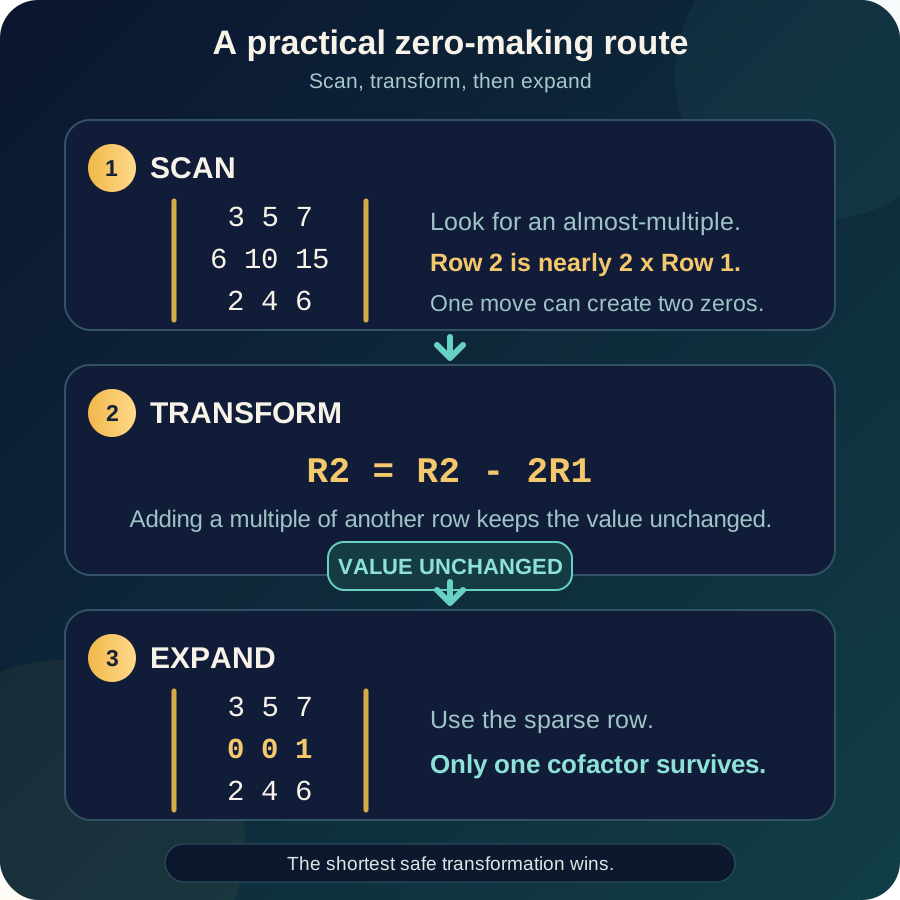
The point is not to perform the maximum number of operations. It is to find the smallest useful transformation.
Strategy 1: Use One Row as an Anchor
Consider:
D = | 2   3   1 |
    | 4   7   2 |
    | 6  11   5 |
The first entries are 2, 4, 6. Row 1 is a natural anchor because its first entry can clear both entries below it.
Apply:
R2 -> R2 - 2R1
R3 -> R3 - 3R1
Both are value-preserving operations.
D = | 2  3  1 |
    | 0  1  0 |
    | 0  2  2 |
Now the first column has two zeros. Expand along it:
D = 2 | 1  0 |
      | 2  2 |

D = 2(2 - 0)
D = 4
Notice the decision that made this easy. We did not start by expanding row 1. We used row 1 to clean column 1.
Strategy 2: Use a 1 to Clear Across Columns
Now consider:
D = | 1   3   5 |
    | 2   7  11 |
    | 4  13  20 |
The top-left entry is 1. That makes column 1 a useful anchor for clearing the rest of the first row.
Apply:
C2 -> C2 - 3C1
C3 -> C3 - 5C1
The determinant becomes:
D = | 1   0   0 |
    | 2   1   1 |
    | 4   1   0 |
Expand along row 1:
D = 1 | 1  1 |
      | 1  0 |

D = 0 - 1
D = -1
This example gives a useful rule:
It is not a compulsory rule, but it is an excellent first scan.
Strategy 3: Search for the One-Move Win
Consider:
D = | 3   5   7 |
    | 6  10  15 |
    | 2   4   6 |
The second row is almost twice the first row. Only its last entry breaks the pattern.
Apply one operation:
R2 -> R2 - 2R1Then:
D = | 3  5  7 |
    | 0  0  1 |
    | 2  4  6 |
Row 2 now contains two zeros. Expand along row 2.
The entry 1 is in position (2, 3), whose cofactor sign is negative:
D = -1 | 3  5 |
         | 2  4 |

D = -(12 - 10)
D = -2
One move removed two-thirds of the expansion.
This is why scanning for an almost-multiple is often more valuable than beginning with a memorised formula.
Strategy 4: Recognise When the Answer Is Already Zero
Suppose:
D = | 3   6   9 |
    | 1   4   7 |
    | 2   5   8 |
Look at the columns:
C1 + C3 = 2C2So one column is a linear combination of the other two. To make that dependence visible, apply:
C3 -> C3 + C1 - 2C2The new third column is all zeros. Therefore:
D = 0You do not need a cofactor expansion at all.
An even faster case occurs when two rows are already proportional. If R3 = 4R1, the determinant is immediately zero.
Strategy 5: Use Differences to Reveal Factors
Symbolic determinants often look harder because the entries are letters. In reality, repeated structure can make the correct operation easier to see.
Consider the Vandermonde-style determinant:
D = | 1    1    1  |
    | a    b    c  |
    | a^2  b^2  c^2|
The first row suggests column subtraction:
C2 -> C2 - C1
C3 -> C3 - C1
So:
D = | 1      0          0      |
    | a    b - a      c - a    |
    | a^2  b^2 - a^2  c^2 - a^2|
Expand along row 1:
D = | b - a      c - a     |
    | b^2 - a^2  c^2 - a^2 |
Use the difference of squares:
b^2 - a^2 = (b - a)(b + a)
c^2 - a^2 = (c - a)(c + a)
Take the factors from the two columns:
D = (b - a)(c - a) | 1  1 |
                         | b + a  c + a |
Now evaluate the small determinant:
D = (b - a)(c - a)((c + a) - (b + a))
D = (b - a)(c - a)(c - b)
The zeros opened the door, and factorisation finished the job.
Strategy 6: Handle a Parameter Without Expanding Everything
Suppose:
D = | 1  2  3 |
    | 2  5  8 |
    | 3  8  x |
We want to express D in terms of x.
Use row 1 as the anchor:
R2 -> R2 - 2R1
R3 -> R3 - 3R1
Then:
D = | 1  2    3   |
    | 0  1    2   |
    | 0  2  x - 9 |
Expand along column 1:
D = | 1    2   |
    | 2  x - 9 |

D = x - 9 - 4
D = x - 13
If the question says D = 5, then:
x - 13 = 5
x = 18
The parameter stayed under control because we avoided a full three-term expansion.
When Should You Use Rows, and When Should You Use Columns?
There is no permanent preference. Compare the patterns.
| What you notice | Usually try |
|---|---|
| Entries in one column are easy multiples of an anchor entry | Row operations |
| Entries in one row are easy multiples of an anchor entry | Column operations |
| Two rows are almost proportional | Subtract one row from a multiple of the other |
| Two columns have a repeated difference | Subtract one column from the other |
A row or column contains 1 or -1 | Use it to clear across the opposite direction |
| A symbolic row contains repeated powers or common terms | Use differences, then factor |
Here is a quick way to remember the direction:
Change a column with row operations.
Change a row with column operations.
Do Not Mix Row and Column Thinking Mid-Move
This notation is valid:
R2 -> R2 - 2R1This notation is not meaningful:
R2 -> R2 - 2C1A row has entries arranged horizontally. A column has entries arranged vertically. They cannot be combined as if they were the same kind of object.
You may use row operations at one stage and column operations at another stage. Just finish and record each operation clearly.
The Three Effects You Must Never Confuse
Every elementary move belongs to one of three boxes.
1. Replacement by adding a multiple
R3 -> R3 - 4R1Effect: value unchanged.
2. Interchange
R1 <-> R2Effect: sign changes.
If the old value is D, the new value is -D.
3. Scaling or factor extraction
R2 -> 5R2Effect: value is multiplied by 5.
If every entry of a row has a common factor 5 and you take it outside, write:
| ... |
= 5 | determinant with the row divided by 5 |A Reliable Written Method
For a clean solution, use this order:
- Copy the determinant accurately.
- Write the planned operation before applying it.
- State or remember its effect on the value.
- Rewrite the complete determinant after the operation.
- Expand along the row or column with the most zeros.
- Show the cofactor sign if the surviving entry is not in a positive position.
- Simplify the remaining two by two determinant.
- Restore any outside factor or sign change.
This is slightly more writing than a rushed solution, but much less work than correcting a hidden error.
Common Mistakes and Their Fixes
| Mistake | Why it fails | Better habit |
|---|---|---|
| Expanding the first row automatically | It may have no zeros | Scan every row and column first |
| Multiplying a row and treating the value as unchanged | Scaling changes the determinant | Record the factor outside |
| Swapping rows without changing the sign | A row interchange reverses the sign | Write a minus sign immediately |
| Performing two operations mentally | An entry is easily copied incorrectly | Rewrite after each important step |
| Ignoring the cofactor sign | Positions such as (2, 3) are negative | Use the checkerboard sign pattern |
| Creating one zero with three messy operations | The route is longer than expansion | Compare the cost before starting |
| Using fractions too early | Fractions increase arithmetic risk | Prefer an integer anchor when possible |
| Stopping after creating zeros | The determinant still needs evaluation | Expand along the new sparse line |
The cofactor sign pattern is:
+  -  +
-  +  -
+  -  +
A Five-Second Choice Test
Before solving, ask:
Do I already have two zeros?
Are two rows or columns proportional?
Can one subtraction create two zeros?
Is there a 1 or -1 that can clear a line?
Which route avoids fractions?
If one move creates two zeros, it is usually the winning move.
If no clean pattern appears, direct expansion is perfectly valid. Properties are tools, not a ritual. The goal is a shorter and safer solution.
Practice Questions
Try to choose the operation before calculating.
- Evaluate:
| 2  1   3 |
| 4  3   6 |
| 6 5 10 |- Show that the following determinant is zero:
| 1  2   4 |
| 3  7  13 |
| 2 5 9 |- Without a full expansion, evaluate:
| 3  6  9 |
| 1  4  7 |
| 2 5 8 |- If
| 1  2  3 |
| 2  5  8 | = 7,
| 3  8  k |
find k.
- Evaluate:
| 1  1   1 |
| 1  2   4 |
| 1 4 16 |-
A determinant has value
-12. What is its value after two rows are interchanged once? -
A determinant has value
-3. One row is multiplied by 5, and then twice another row is added to it. What is the final value? -
Find a one-move route and evaluate:
| 4   7   9 |
| 8  14  19 |
| 2   5   6 |
Practice Answers
2. UseR2 -> R2 - 2R1andR3 -> R3 - 3R1, then expand along column 1.0. The last two rows become equal after subtracting suitable multiples of row 1.0. The columns satisfyC1 + C3 = 2C2.k = 20, because the determinant simplifies tok - 13.6. UseC2 -> C2 - C1andC3 -> C3 - C1, then factor.12. One interchange changes the sign.-15. Scaling the row multiplies the value by 5; the later row replacement does not change it.-6. UseR2 -> R2 - 2R1, which turns row 2 into[0, 0, 1].
The Big Picture
Determinant properties are not a list to recite after memorising a formula. They are a way to redesign the calculation before the arithmetic begins.
First, scan for structure.
Then choose one row or column as an anchor.
Use a value-preserving replacement to create zeros. Keep a visible record of every swap and factor. Finally, expand along the line that has become simple.
The calmest determinant solutions usually come from one strong decision made at the start.
If you want to connect this skill to inverse questions, revise our guide to matrix invertibility next.
Sources and Further Reading
- NIOS Senior Secondary Mathematics, Lesson 21: Determinants
- MIT OpenCourseWare: Determinants
- MIT Mathematics: Properties of Determinants
- MIT Mathematics: Determinants Galore Worksheet
Frequently Asked Questions
Why should I create zeros before expanding a determinant?
Every zero removes a cofactor term from the expansion. A row with two zeros reduces a three by three determinant to one small two by two calculation.
Which operation keeps the determinant unchanged?
Adding or subtracting a multiple of one row to another row keeps the value unchanged. The same is true for columns.
Does multiplying a row by a number keep the value unchanged?
No. Multiplying one row or column by k multiplies the determinant by k.
What happens when I interchange two rows?
The determinant changes sign. A value of 7 becomes -7, and a value of -7 becomes 7.
How do I decide between row and column operations?
Compare the visible patterns. Use row operations when entries down a column are easy to clear. Use column operations when entries across a row are easy to clear.
Is a row containing 1 always the best anchor?
Not always, but it is often useful because it can clear other entries without introducing fractions.
Can I use row operations and column operations in the same question?
Yes. Record each operation separately and track its effect. Never combine a row directly with a column.
When is a determinant immediately zero?
It is zero if a row or column is all zeros, if two rows or columns are equal or proportional, or if one row or column depends on the others.
Should I always use determinant properties instead of direct expansion?
No. If a row already has small entries or zeros, direct expansion may be shortest. Use properties only when they simplify the work.
Why is R2 -> R2 - 3R1 safer than doing the subtraction mentally?
Written notation shows exactly which row changes and which row stays fixed. It also reminds you that the determinant’s value is unchanged.
What is the most common sign mistake after creating zeros?
Students often forget the cofactor sign of the surviving entry. Check its position against the + - +, - + -, + - + pattern.
What is the fastest way to improve at choosing operations?
Before calculating each practice determinant, spend five seconds predicting the best anchor and the line you want to make sparse. Then compare your route with direct expansion.
Looking for commerce tuitions?
Prachi is a gold-medalist commerce teacher with experience at Deloitte and KPMG. She focuses on fundamentals to build a strong foundation.