
 Whatsapp
Probability With and Without Replacement: When the Denominator Changes
Understand when probability denominators stay the same or shrink, with simple rules, tree thinking, and solved examples for exam questions.
- 12th
- Study Advice
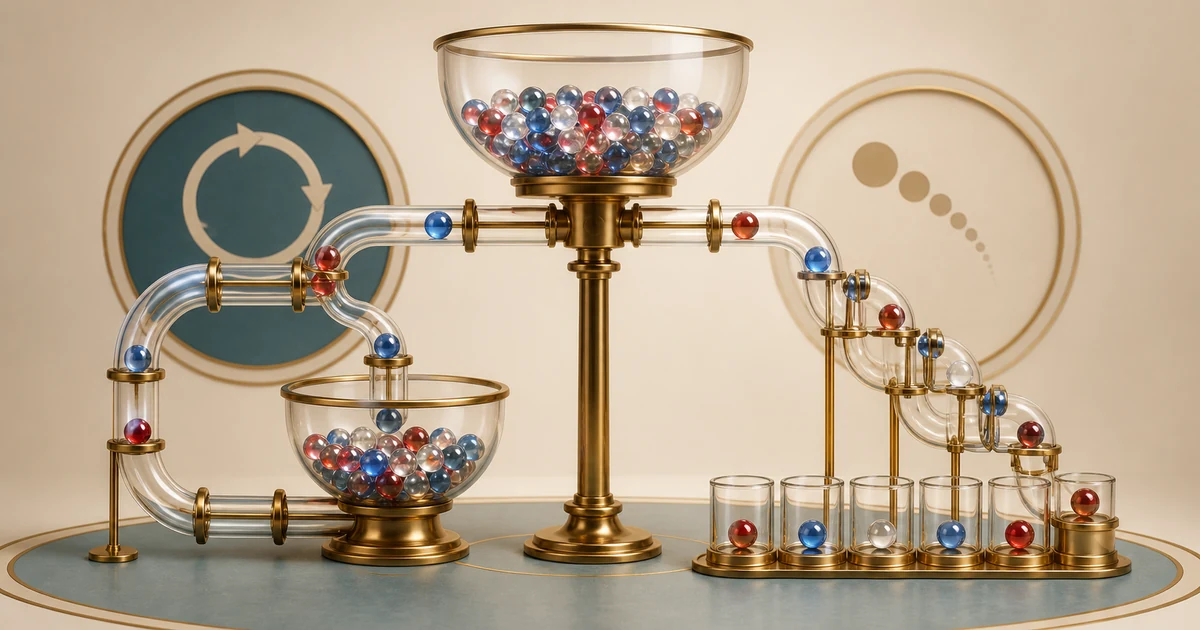
Probability becomes much easier when you stop treating every fraction as a formula and start asking one simple question:
What is left before the next selection happens?
That question is the difference between probability with replacement and probability without replacement.
If the item is put back, the total number of possible outcomes is restored. The denominator usually stays the same.
If the item is not put back, the total number of possible outcomes becomes smaller. The denominator changes.
Once this idea is clear, questions on balls, cards, slips, tickets, defective items, and committees stop feeling random. You can build every answer step by step.
The Whole Topic in One Table
Here is the basic difference.
| Situation | What happens after the first selection? | Effect on the next denominator | Type of event |
|---|---|---|---|
| With replacement | The item is put back before the next selection | Denominator is restored | Usually independent |
| Without replacement | The item is kept aside | Denominator decreases | Usually dependent |
| Simultaneous selection | Items are selected together | Repetition is not possible | Treat like without replacement |
For example, suppose a bag has 5 red balls and 4 blue balls.
Total balls:
5 + 4 = 9If one ball is drawn and then replaced, the bag again has 9 balls before the second draw.
If one ball is drawn and not replaced, the bag has only 8 balls before the second draw.
That is the entire denominator story.
What the Denominator Really Means
In probability, the denominator answers this question:
Out of how many equally likely possibilities is this draw happening?On the first draw from a bag of 9 balls, the denominator is 9.
On the second draw, the denominator depends on what happened after the first draw.
If the first ball was put back:
Second draw denominator = 9If the first ball was not put back:
Second draw denominator = 8If two balls were already removed:
Third draw denominator = 7This is why students often get stuck. They remember the original total, but probability is asking about the current total.
With Replacement: The Denominator Comes Back
“With replacement” means the selected item is returned before the next selection.
Suppose a bag contains:
5 red balls
4 blue balls
Total = 9 balls
A ball is drawn, its colour is noted, and the ball is put back. Then another ball is drawn.
If the question asks for the probability of getting two red balls, write:
P(red on first draw) = 5/9Since the first red ball is put back, the bag again has 5 red balls and 4 blue balls.
So:
P(red on second draw) = 5/9Therefore:
P(two red balls with replacement)
= 5/9 x 5/9
= 25/81
The denominator stayed 9 because the bag was restored before the second draw.
For example:
P(red, then blue with replacement)
= 5/9 x 4/9
= 20/81
The denominator stayed 9, but the numerator changed because the required colour changed.
Without Replacement: The Denominator Shrinks
“Without replacement” means the selected item is not returned before the next selection.
Use the same bag:
5 red balls
4 blue balls
Total = 9 balls
If two balls are drawn one after another without replacement, and both must be red:
First draw:
P(red on first draw) = 5/9After one red ball is removed, the bag now has:
4 red balls
4 blue balls
Total = 8 balls
Second draw:
P(red on second draw after red first) = 4/8Therefore:
P(two red balls without replacement)
= 5/9 x 4/8
= 20/72
= 5/18
The denominator changed from 9 to 8 because one ball had already left the bag.
The numerator also changed from 5 to 4 because one red ball had already been used.
The Numerator Can Change Too
Many students focus only on the denominator, but the numerator also needs attention.
Ask two questions at every stage:
1. How many total items are left?
2. How many favourable items are left?
Suppose the bag has 5 red and 4 blue balls.
Case 1: Red, Then Red Without Replacement
P(red, then red)
= 5/9 x 4/8
= 5/18
Why does the numerator become 4?
Because one red ball has already been removed.
Case 2: Red, Then Blue Without Replacement
P(red, then blue)
= 5/9 x 4/8
= 5/18
Why does the numerator for the second draw stay 4?
Because the first ball removed was red, not blue. All 4 blue balls are still in the bag.
Case 3: Blue, Then Red Without Replacement
P(blue, then red)
= 4/9 x 5/8
= 5/18
Here the second numerator is 5 because all 5 red balls are still available after a blue ball is removed.
So the rule is not “subtract 1 from the numerator every time.”
The better rule is:
Subtract only from the group that was actually removed.A Quick Decision Test
Before solving, mark the question using this test:
Was the selected item returned before the next selection?If yes:
Use with replacement.
Denominator is restored.
If no:
Use without replacement.
Denominator decreases.
If items are drawn together:
Use without replacement thinking.
The same item cannot be selected twice in the same draw.
If the question uses separate objects, such as two dice or two coins, replacement is not the issue. Each die or coin already has its own full set of outcomes.
For example:
Rolling two dice:
First die denominator = 6
Second die denominator = 6
The second die does not lose a face just because the first die showed 4.
Wording Clues That Matter
Question language often tells you exactly what to do.
| Wording in the question | How to think |
|---|---|
| ”with replacement” | Put it back before the next draw |
| ”replaced” | Total is restored |
| ”without replacement” | Keep it aside |
| ”not replaced” | Total decreases |
| ”drawn successively” | Draws happen one after another |
| ”drawn simultaneously” | Treat as no replacement between selected items |
| ”one after another and kept aside” | Denominator decreases each time |
Do not rush through these words. In probability, small wording changes often create completely different fractions.
Example 1: Same Bag, Different Answers
A bag contains 6 black balls and 3 white balls. Two balls are drawn.
Find the probability that both are black.
If the Draw Is With Replacement
Total balls:
6 + 3 = 9First black:
6/9The black ball is put back, so the bag is restored.
Second black:
6/9Answer:
6/9 x 6/9
= 36/81
= 4/9
If the Draw Is Without Replacement
First black:
6/9Now one black ball is gone. The bag has 5 black balls and 3 white balls.
Second black:
5/8Answer:
6/9 x 5/8
= 30/72
= 5/12
Same bag. Same required outcome. Different answer.
Why?
Because the second denominator changed in the second case.
Example 2: One Red and One Blue in Any Order
A bag has 5 red balls and 4 blue balls. Two balls are drawn without replacement.
Find the probability of getting one red and one blue.
This can happen in two orders:
Red first, blue second
Blue first, red second
Now calculate both paths.
Path 1: Red, Then Blue
P(red, then blue)
= 5/9 x 4/8
= 20/72
Path 2: Blue, Then Red
P(blue, then red)
= 4/9 x 5/8
= 20/72
Add the two paths because either order is acceptable.
P(one red and one blue)
= 20/72 + 20/72
= 40/72
= 5/9
This is a common exam trap. If the question says “one red and one blue”, it usually does not care about order unless it specifically says “red first and blue second.”
Example 3: Cards Without Replacement
A standard deck has 52 cards, including 4 aces.
Two cards are drawn one after another without replacement. Find the probability that both cards are aces.
First ace:
4/52After one ace is removed, the deck has:
3 aces left
51 cards left
Second ace:
3/51Answer:
4/52 x 3/51
= 12/2652
= 1/221
The denominator changed from 52 to 51 because the first card was not returned.
The numerator changed from 4 to 3 because the first selected card was an ace.
Example 4: At Least One Success
A box contains 3 defective bulbs and 7 good bulbs. Two bulbs are selected without replacement.
Find the probability of getting at least one defective bulb.
“At least one defective” means:
one defective or two defectiveYou can solve it directly, but the complement is faster.
The opposite of “at least one defective” is:
no defective bulbsThat means both bulbs are good.
Probability of first good bulb:
7/10Probability of second good bulb after one good is removed:
6/9So:
P(no defective)
= 7/10 x 6/9
= 42/90
= 7/15
Therefore:
P(at least one defective)
= 1 - 7/15
= 8/15
This method works beautifully when “at least one” would otherwise create too many cases.
Successive Draw vs Simultaneous Draw
Students sometimes worry that “drawn one after another” and “drawn together” require completely different ideas.
They do not, if you understand what is happening.
When two balls are drawn together, no ball is returned between them. So the situation behaves like without replacement.
For example, from 5 red and 4 blue balls, if two balls are drawn together and both must be red:
Using combinations:
Favourable pairs = C(5,2)
Total pairs = C(9,2)
So:
P(two red)
= C(5,2) / C(9,2)
= 10/36
= 5/18
Using successive without-replacement thinking:
P(red, then red)
= 5/9 x 4/8
= 20/72
= 5/18
Both methods give the same answer.
The combination method hides the changing denominator inside the total number of pairs. The successive method shows the denominator changing step by step.
Conditional Probability Connection
Without replacement is closely connected to conditional probability.
When you write:
P(red on second draw after red on first draw)you are asking a conditional question. The second probability depends on what happened first.
That is why:
P(red second after red first) = 4/8not:
5/9The condition “red first” has changed the bag.
In short:
With replacement:
P(second event after first event) often stays like the original probability.

Without replacement:
P(second event after first event) must be recalculated from what remains.
This is also why without-replacement events are usually called dependent. The second event depends on the first event.
A Simple Working Format for Answers
Use this format in rough work until the habit becomes natural.
Original contents:

First draw:
Favourable =
Total =
Probability =

After first draw:
Remaining favourable =
Remaining total =

Second draw:
Probability =

Final probability =
Here is how it looks for two red balls without replacement from 5 red and 4 blue balls:
Original contents:
5 red, 4 blue, total 9

First draw:
Favourable = 5 red
Total = 9
Probability = 5/9

After first draw:
Remaining red = 4
Remaining total = 8

Second draw:
Probability = 4/8

Final probability:
5/9 x 4/8 = 5/18
It may feel slow at first, but it builds the exact thinking that prevents wrong denominators.
Common Mistakes to Avoid
Mistake 1: Keeping the Denominator Same Without Checking
Wrong:
P(two red without replacement) = 5/9 x 5/9Correct:
P(two red without replacement) = 5/9 x 4/8The first ball was not returned, so both numerator and denominator changed.
Mistake 2: Subtracting From the Wrong Colour
For red then blue without replacement:
Wrong:
5/9 x 3/8Correct:
5/9 x 4/8Why?
Because a red ball was removed first. The number of blue balls did not decrease.
Mistake 3: Forgetting the Second Order
For one red and one blue:
Incomplete:
5/9 x 4/8Complete:
(5/9 x 4/8) + (4/9 x 5/8)Unless the question fixes the order, include both possible orders.
Mistake 4: Treating Two Dice Like Without Replacement
Rolling two dice is not like drawing two balls from one bag.
Each die has 6 faces.
So:
Total outcomes = 6 x 6 = 36The first die does not reduce the second die’s possibilities.
Mistake 5: Ignoring the Word “At Least”
“At least one” often becomes easier through the complement.
Instead of listing every successful case, use:
P(at least one success) = 1 - P(no success)This is especially useful when there are several draws.
The Final Rule to Remember
Whenever you see a probability question with repeated selection, do not begin with multiplication.
Begin with the story.
Ask:
Is the selected item returned?
What remains before the next draw?
How many favourable items are left now?
How many total items are left now?
If the item is returned, the denominator is restored.
If the item is not returned, the denominator shrinks.
That is the cleanest way to know when the denominator must change.
Frequently Asked Questions
1. What does “with replacement” mean in probability?
With replacement means the selected item is put back before the next selection. Because the original set is restored, the next draw usually has the same denominator as the first draw.
2. What does “without replacement” mean in probability?
Without replacement means the selected item is not put back. The next selection happens from fewer items, so the denominator changes.
3. Why does the denominator change without replacement?
The denominator changes because the total number of available items becomes smaller after each selection. If you start with 9 balls and remove one, the next draw is from 8 balls.
4. Does the numerator always decrease without replacement?
No. The numerator decreases only if a favourable item has been removed. If you draw a red ball first and then want a blue ball, the number of blue balls has not decreased.
5. Is with replacement always independent?
In usual school-level drawing questions, yes, because replacing the item restores the original situation. The result of the first draw does not change the probabilities for the next draw.
6. Is without replacement always dependent?
In usual drawing questions, yes. The first selection changes what remains, so the probability of the second selection depends on the first result.
7. How do I know whether to add or multiply probabilities?
Multiply along one fixed path, such as red then blue. Add different acceptable paths, such as red then blue or blue then red.
8. Are simultaneous draws the same as without replacement?
Yes, for counting purposes. If two items are drawn together, the same item cannot appear twice, so the situation behaves like selection without replacement.
9. Why do two dice not have changing denominators?
Two dice are separate objects. The result on the first die does not remove any face from the second die, so each die still has 6 possible outcomes.
10. What is the fastest way to avoid denominator mistakes?
Before every new fraction, ask: “What is available right now?” Then write the favourable count over the total count at that stage.
Looking for commerce tuitions?
Prachi is a gold-medalist commerce teacher with experience at Deloitte and KPMG. She focuses on fundamentals to build a strong foundation.