
 Whatsapp
Class 11 Sets: Intervals, Power Sets, and Venn Diagrams
Master interval brackets, subsets, power sets, and two- and three-set Venn diagrams with solved examples, counting checks, and practice answers.
- 11th

One student can belong to the music club and the enterprise club. She has two memberships, but she is still one person. That small distinction explains why adding two club totals can give the wrong answer.
Sets help us describe belonging precisely. A bracket decides whether a boundary value belongs. A pair of braces decides whether we mean an object or a set containing that object. An overlap decides whether someone has already been counted.
This lesson connects interval notation, subsets, power sets, and Venn diagrams through worked examples. Keep a pencil nearby: checking one endpoint or filling one small region yourself is often more useful than reading a formula twice.
Start with the objects, then choose the notation
A set is a well-defined collection of objects. For any proposed object, its membership should be unambiguous. “Students enrolled in the enterprise club on Monday” works; “students with brilliant business ideas” needs a clearer criterion.
We can list members in roster form, such as A = {3, 6, 9}, or describe a membership rule in set-builder form:
A = {x : x is a positive multiple of 3 less than 12}
The colon means “such that”. Some books use a vertical bar instead. Order does not change a set, and repeated entries do not create extra members. Thus {9, 3, 6, 3} is the same set as A, with three elements. These conventions are introduced in NCERT’s Sets chapter, sections 1.1 to 1.5.
Here is the notation we will use throughout:
| Symbol | Read it as |
|---|---|
x ∈ A | x is an element of A |
x ∉ A | x is not an element of A |
A ⊆ B | A is a subset of B; equality is allowed |
A ∪ B | A union B |
A ∩ B | A intersection B |
A − B | A minus B, a set difference |
A' | The complement of A in the stated universe |
∅ or {} | The empty set |
n(A) | The number of elements in a finite set A |
P(A) | The power set of A |
We use R for real numbers and Z for integers. Read these restrictions before doing anything else. The condition 1 < x < 5 gives infinitely many real numbers if x ∈ R, but only {2, 3, 4} if x ∈ Z.
Interval notation: decide each endpoint separately
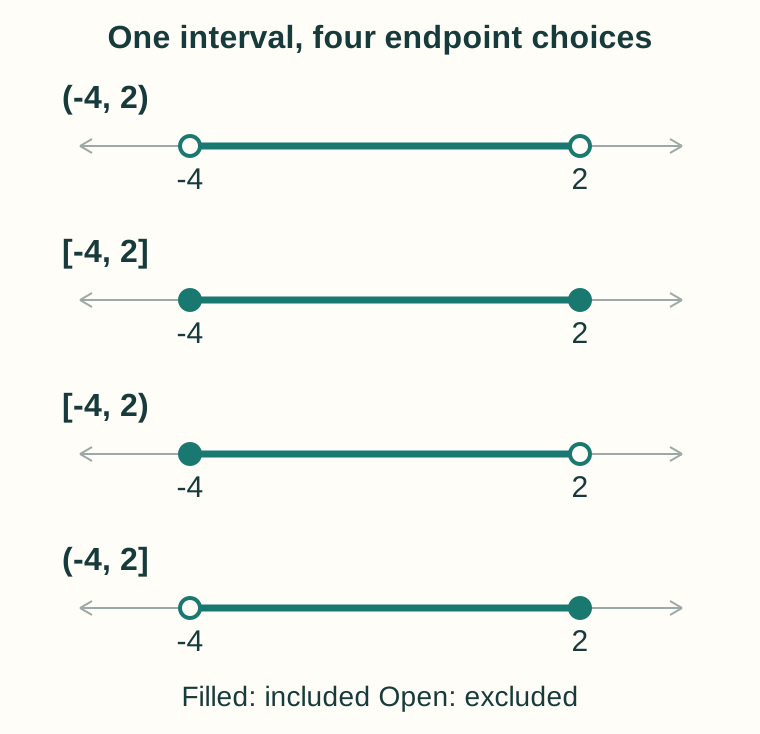
An interval describes a continuous stretch of real numbers. Round brackets exclude a finite endpoint; square brackets include it. OpenStax’s explanation of interval notation connects this directly to open and filled dots on a number line.
For the same two boundaries, -4 and 2:
| Condition on a real number x | Interval |
|---|---|
-4 < x < 2 | (-4, 2) |
-4 ≤ x ≤ 2 | [-4, 2] |
-4 ≤ x < 2 | [-4, 2) |
-4 < x ≤ 2 | (-4, 2] |
Read the left bracket and right bracket independently. A closed left end does not force a closed right end.
On a number line, an open circle excludes the marked value and a filled dot includes it. Everything on the highlighted stretch between the endpoints belongs, including fractions and irrational numbers.
Infinity always takes a round bracket
x ≥ 7 becomes [7, ∞), and x < -3 becomes (-∞, -3).
Infinity describes an unbounded direction, rather than a real endpoint you can include. This is why neither ∞ nor -∞ gets a square bracket. See OpenStax’s interval and inequality guide.
Also keep these three objects separate:
{2, 5}contains exactly two numbers.[2, 5]contains every real number from 2 through 5.{x ∈ Z : 2 ≤ x ≤ 5}is{2, 3, 4, 5}.
The interval [2, 5] contains 2.8; the other two sets do not. That single test exposes the difference immediately.
Worked example: solve before choosing brackets
Write the real solution set of -7 ≤ 3 - 2x < 9 in interval notation.
Subtract 3 from all three parts:
-10 ≤ -2x < 6
Divide by -2, reversing both inequality signs:
5 ≥ x > -3
Now put the smaller boundary first:
-3 < x ≤ 5, so the interval is (-3, 5].
Check the endpoints in the original question. At x = -3, the middle expression equals 9, which fails the strict upper bound. At x = 5, it equals -7, which is allowed.
Union and intersection of intervals
Let A = [-4, 2) and B = (0, 6].
The union keeps any value accepted by at least one set. The intersection keeps a value only when both sets accept it:
A ∪ B = [-4, 6]
A ∩ B = (0, 2)
A − B = [-4, 0]
B − A = [2, 6]
Why is zero included in A − B? A contains it, while B excludes it. Why is 2 included in B − A? B contains it, while A excludes it.
Shared boundary values deserve their own check. The sets [-2, 1] and [1, 4] intersect in {1}. But [-2, 1) and (1, 4] have an empty intersection, and their union still has a hole at 1. Writing that union as [-2, 4] would silently put 1 back in.
Element or subset: look inside the outer braces
For A = {2, 7, 11}, the statement 2 ∈ A is true. The statement {2} ⊆ A is also true. They answer different questions:
- Membership: is this whole object one of A’s listed elements?
- Subset: is every element of this proposed set also in A?
Here, {2} ∈ A is false: the three listed objects are numbers, not the set {2}.
A proper subset is a subset that is unequal to the original set. For example, {2, 7} is a proper subset of A, while A is a subset of itself but is not a proper subset of itself. The empty set is a subset of every set. These definitions are developed in Monroe Community College’s Subsets and Power Sets lesson.
A set can contain another set as one element
Consider B = {5, {8, 10}, ∅}. There are three elements: the number 5, the set {8, 10}, and the empty set.
| Statement | Result and reason |
|---|---|
{8, 10} ∈ B | True: that whole set is listed |
8 ∈ B | False: 8 is inside a listed set |
{8, 10} ⊆ B | False: 8 and 10 are not individual members of B |
{{8, 10}} ⊆ B | True: its only element is listed in B |
∅ ∈ B | True: the empty set is explicitly listed |
∅ ⊆ B | True: the empty set is always a subset |
Imagine placing each outer-level element on a separate card. You would need three cards, not four. Do not open a card containing a set and count its contents as extra outer-level elements.
The empty set has zero elements, but {∅} has one. An empty box and a box holding an empty box do not contain the same number of objects.
Power sets: collect every possible subset
The power set P(A) is the set whose elements are all the subsets of A. For A = {p, q, r}, list subsets by size:
| Size | Subsets |
|---|---|
| Zero | ∅ |
| One | {p}, {q}, {r} |
| Two | {p, q}, {p, r}, {q, r} |
| Three | {p, q, r} |
Enclose those eight subsets in one outer pair of braces to form P(A). The empty set and A itself both belong in the answer.
For a finite set with n distinct elements:
n(P(A)) = 2^n
Each element has two choices: include it in a subset, or leave it out. Three elements therefore give 2 × 2 × 2 = 8 choices. This also explains why duplicate roster entries must be removed before counting.
For example, {m, n, m, t} has three distinct elements, so it has eight subsets, rather than sixteen.
Total, proper, and non-empty subsets
For a non-empty finite set with n elements:
| What is requested? | Number |
|---|---|
| All subsets | 2^n |
| Proper subsets | 2^n - 1 |
| Non-empty subsets | 2^n - 1 |
| Non-empty proper subsets | 2^n - 2 |
For a four-element set, these counts are 16, 15, 15, and 14. Proper subsets exclude the whole set; non-empty subsets exclude the empty set. The two exclusions are different even though their individual counts match.
The empty set needs a separate check. Its only subset is itself, so P(∅) = {∅}. It has one subset, zero proper subsets, and zero non-empty proper subsets. Do not substitute n = 0 into the last row and accept a negative answer.
Worked example: a nested power set
Let C = {0, {4}}. Its two elements are 0 and {4}. Therefore:
P(C) = {∅, {0}, {{4}}, {0, {4}}}
The one-element subset containing {4} is {{4}}. Removing one pair of braces changes the element you selected.
Also distinguish P(C) from n(P(C)). The first is the collection above; the second is the number 4. If the question asks you to write a power set, giving only its size leaves the main work unfinished.
If a power set has 32 elements, its original set has five elements because 2^5 = 32. You cannot recover the actual five members from that count alone.
Set operations: translate the words before calculating
Take U = {1, 2, 3, 4, 5, 6, 7, 8}, A = {1, 3, 5, 7}, and B = {3, 4, 5, 6}.
A ∪ B = {1, 3, 4, 5, 6, 7}
A ∩ B = {3, 5}
A − B = {1, 7}
B − A = {4, 6}
A' = {2, 4, 6, 8}
Union corresponds to inclusive or, intersection to and, and difference to in the first set but not the second. A complement keeps everything in U that the named set leaves out. Sekhon and Bloom’s Sets and Counting chapter explains these operations and the role of U.
Notice that A − B and B − A are different. Set difference is not ordinary subtraction, and order matters.
The universal set matters too. If U were {1, 2, 3, 4, 5, 6, 7}, then A’s complement would be {2, 4, 6}. You cannot decide a complement without knowing what counts as the full collection.
Two sets are disjoint when their intersection is empty. A and A’ are disjoint, but two disjoint sets need not be complements: they might leave some elements of U outside both.
Two-set Venn questions: count each person once
At a school fair, 72 students are surveyed. Of these, 39 joined the enterprise activity, 31 joined the design activity, and 14 joined both.
Let E and D represent the two groups. The 14 students in the overlap are already included in both given totals.
Enterprise only = 39 - 14 = 25
Design only = 31 - 14 = 17
At least one = 25 + 14 + 17 = 56
Neither = 72 - 56 = 16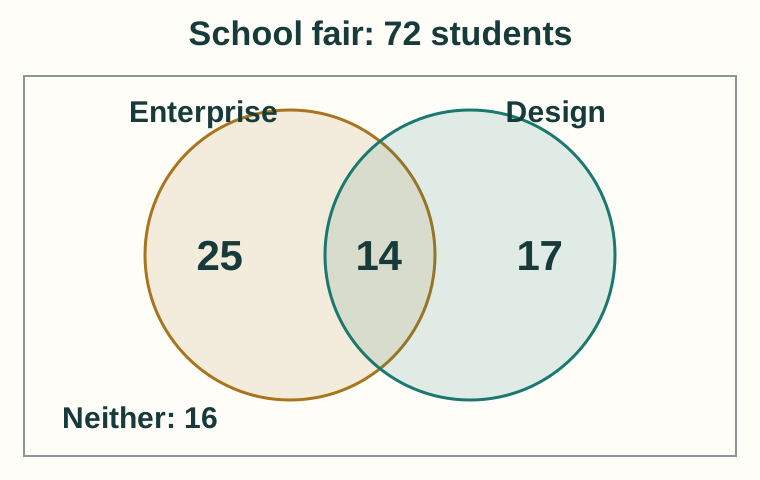
The familiar formula is a compact way to correct the repeated overlap:
n(E ∪ D) = n(E) + n(D) - n(E ∩ D)
Here, 39 + 31 - 14 = 56. The general two-set counting rule is explained in OpenStax’s Set Operations with Two Sets.
Different wording now gives different answers:
| Question | Answer |
|---|---|
| Enterprise or design, including both | 56 |
| Both | 14 |
| Exactly one activity | 25 + 17 = 42 |
| Neither | 16 |
| Not enterprise | 17 + 16 = 33 |
“Not enterprise” includes students outside both circles. It does not mean “design only”.
Recovering a missing intersection
In a separate group of 90 students, 48 choose accounting practice, 37 choose economics practice, and 20 choose neither.
First find the union: 90 - 20 = 70. Then the overlap is 48 + 37 - 70 = 15.
The two exclusive regions are 33 and 22. Check the whole group: 33 + 15 + 22 + 20 = 90.
If your overlap exceeds either of the original group totals, recheck the data or your working. An intersection cannot contain more people than a set containing it.
Three-set Venn questions: fill the centre first
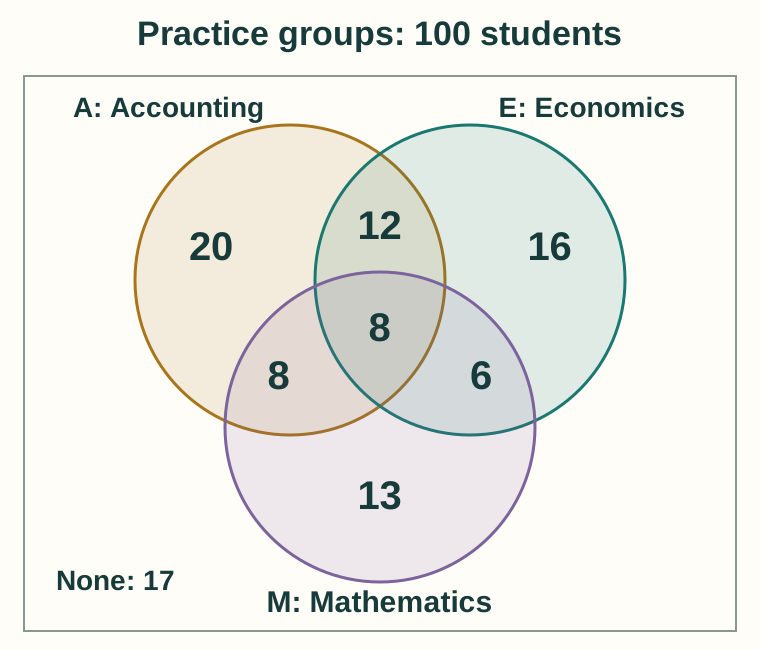
A three-set Venn diagram showing every possible overlap has seven separate regions inside the circles, plus the outside region. OpenStax’s three-set lesson recommends working from the greatest overlap outward.
Try this original survey. Among 100 students:
- 48 attend accounting practice, A.
- 42 attend economics practice, E.
- 35 attend mathematics practice, M.
- 20 attend A and E, 16 attend A and M, and 14 attend E and M.
- 8 attend all three.
The pairwise totals include the students in all three. A student attending A, E, and M certainly attends A and E.
Step 1: enter 8 in the centre
This is the intersection of all three sets. Keep it separate from the regions belonging to exactly two sets.
Step 2: remove the centre from each pairwise total
A and E only = 20 - 8 = 12
A and M only = 16 - 8 = 8
E and M only = 14 - 8 = 6
Step 3: complete each single-set region
A only = 48 - 12 - 8 - 8 = 20
E only = 42 - 12 - 6 - 8 = 16
M only = 35 - 8 - 6 - 8 = 13
Each subtraction removes the three regions already inside that circle. The two 8s in the A calculation represent different groups: A and M only, and all three.
Step 4: find the union and the outside region
Add the seven separate inside regions:
20 + 16 + 13 + 12 + 8 + 6 + 8 = 83
Therefore 17 students attend none, since 100 - 83 = 17.
Now we can answer more questions without starting again:
| Wording | Count |
|---|---|
| Exactly one subject | 20 + 16 + 13 = 49 |
| Exactly two subjects | 12 + 8 + 6 = 26 |
| At least two subjects | 26 + 8 = 34 |
| At most one subject | 17 + 49 = 66 |
| A and E, but not M | 12 |
| A and E, whether or not M | 20 |
Why the three-set formula adds the centre back
Let S be the sum of the three set sizes and T the sum of the three pairwise intersection sizes. Then:
S = n(A) + n(E) + n(M)
T = n(A ∩ E) + n(A ∩ M) + n(E ∩ M)
n(A ∪ E ∪ M) = S - T + n(A ∩ E ∩ M)
For our survey, S is 125 and T is 50, so the union is 125 - 50 + 8 = 83.
Follow one student who attends all three. Adding the set totals counts her three times. Subtracting the three pairwise totals removes her three times. She is now counted zero times, so the last addition restores her once.
If the question gives pair-only counts instead, those are already separate regions. Do not subtract the centre from them again or substitute them as inclusive intersections in this formula.
De Morgan’s laws: “neither” is different from “not both”
With complements taken in the same U:
(A ∪ B)' = A' ∩ B'
(A ∩ B)' = A' ∪ B'
These identities appear in Choo and Taylor’s Introduction to Discrete Mathematics, chapter 2.
To be outside the union, someone must be outside A and outside B. That is “neither”. To be outside the intersection, someone only needs to fail one of the two memberships. That is “not both”.
In the 72-student fair survey, neither activity means 16 students. Not both activities means everyone except the overlap: 72 - 14 = 58. That includes the 25 in enterprise only, the 17 in design only, and the 16 in neither.
When shading a complicated expression, work through the innermost parentheses first. For A − (B ∪ C), remove from A every part shared with B or C. For (A − B) ∩ C, keep the part shared by A and C that is outside B. The bracket position changes the region.
A short practice set
Try these before looking at the answers. Write a reason beside each answer, even if the reason is just “endpoint excluded” or “centre already counted”.
- Write
{x ∈ R : -6 < 2x + 4 ≤ 10}as an interval. - If
A = [-5, 1]andB = [1, 4), find their union, intersection, andA − B. - List
{x ∈ Z : -2 < x ≤ 3}. Explain why(-2, 3]alone does not describe the same set. - For
T = {6, {9}, ∅}, decide whether{9} ∈ T,9 ∈ T, and{∅} ⊆ Tare true. - Write
P({a, b}). How many non-empty proper subsets does{a, b, c, d, e}have? - Of 80 students, 44 join debate, 33 join design, and 18 join both. Find neither, exactly one, and not debate.
- In the 100-student three-subject survey above, find the number who attend M but not A, and the number who attend neither A nor E.
- A report about 50 students says 35 chose activity A, 30 chose B, and 10 chose both. Can these figures all be correct?
Answers with checks
1. Subtract 4, then divide by 2: -5 < x ≤ 3. Answer: (-5, 3]. The value -5 fails the original strict lower bound.
2. Union: [-5, 4); intersection: {1}; difference: [-5, 1). Both sets contain 1, so removing B from A removes 1.
3. {-1, 0, 1, 2, 3}. The interval would also include non-integers such as 0.5. An equivalent description is (-2, 3] ∩ Z.
4. True, false, true. The set {9} is one listed element; 9 is not. The only element of {∅} is ∅, which is listed in T.
5. P({a, b}) = {∅, {a}, {b}, {a, b}}. A five-element set has 2^5 - 2 = 30 non-empty proper subsets.
6. The union is 44 + 33 - 18 = 59, so neither is 21. Exactly one is (44 - 18) + (33 - 18) = 41. Not debate is 80 - 44 = 36, comprising design only and neither.
7. M but not A is 13 + 6 = 19. Neither A nor E includes M only and none: 13 + 17 = 30.
8. No. The implied union is 35 + 30 - 10 = 55, larger than the surveyed group. For those set totals, the overlap must be at least 15. Do not change a number silently; identify the inconsistency.
A final check before you submit
For intervals, test every finite boundary. For power sets, check the number of distinct original elements, then the number of subsets and the braces. For a Venn question, add every separate region, including the outside, and recover the stated total.
If you can explain why a boundary is included or why an overlap is subtracted, you are doing more than recalling a rule. You have a way to catch your own mistakes.
These ideas return when you study domains, graph endpoints, and probability. Our guide to modulus, signum, and greatest integer graphs shows how the same open and filled endpoints control whether a point belongs to a graph.
Sources and further reading
- NCERT, Mathematics, Chapter 1: Sets, 2026-27 reprint: school-level notation, subsets, intervals, and operations.
- OpenStax, Precalculus 2e, section 1.2: reading intervals and set-builder notation.
- OpenStax, College Algebra, section 2.7: inequality solutions and unbounded intervals.
- Monroe Community College, MTH 220, section 4.2: subsets, empty sets, and power sets.
- Rupinder Sekhon and Roberta Bloom, Applied Finite Mathematics, section 7.1: union, intersection, and complements.
- OpenStax, Contemporary Mathematics, section 1.4 and section 1.5: two- and three-set Venn diagrams.
- Koo-Guan Choo and Donald E. Taylor, Introduction to Discrete Mathematics, chapter 2: set algebra and De Morgan’s laws.
Frequently asked questions
1. How do I choose round or square brackets in an interval?
Test the endpoint against the condition. Use a square bracket if the finite endpoint is allowed and a round bracket if it is excluded. Check each side separately.
2. Can I use a square bracket next to infinity?
No. Infinity expresses an unbounded direction, so write forms such as [4, ∞) or (-∞, 4]. It is not a real value included at the end.
3. Is an interval the same as a list of integers?
No. An interval contains all real values along its stretch. To restrict it to integers, state x ∈ Z or intersect the interval with Z.
4. What is the difference between an element and a subset?
An element is one whole member of a set. A subset is a set whose members all belong to the original set. For {4, 8}, 4 is an element and {4} is a subset.
5. Is the empty set a subset of every set?
Yes. It has no element that could violate the subset condition. However, the empty set is an element of another set only when it is included there as a member.
6. Why are the empty set and the set containing it different?
The empty set has no elements. {∅} has one element, namely the empty set. Their cardinalities are zero and one respectively.
7. How many subsets does a set with n elements have?
A finite n-element set has 2^n subsets. Count distinct elements first. Repeating a member in the roster does not increase n.
8. Does a power set include the original set?
Yes, as an element. Every set is a subset of itself, and the power set collects all subsets. It also includes the empty set.
9. Why do we subtract the overlap in a two-set question?
Adding the two set totals counts each shared member twice. Subtracting the intersection once leaves each member of the union counted once.
10. Does “both A and B” include members of a third set?
Yes. Membership of a third set does not undo membership of A and B. Exclude the third set only when the wording says “A and B only” or “A and B but not C”.
11. Are “exactly two” and “at least two” the same?
No. With three sets, exactly two includes the three pair-only regions. At least two also includes the central region belonging to all three.
12. What does a negative number in a Venn region mean?
It means the working or supplied data is inconsistent for a count of people or objects. Check whether pairwise totals include the centre, whether “only” was stated, and whether every group fits within the universe.
Looking for commerce tuitions?
Prachi is a gold-medalist commerce teacher with experience at Deloitte and KPMG. She focuses on fundamentals to build a strong foundation.