
 Whatsapp
Complex Numbers on the Argand Plane: Modulus and Argument
Learn to plot complex numbers, find modulus and principal argument, choose the correct quadrant, use polar form, and avoid common sign mistakes.
- 11th
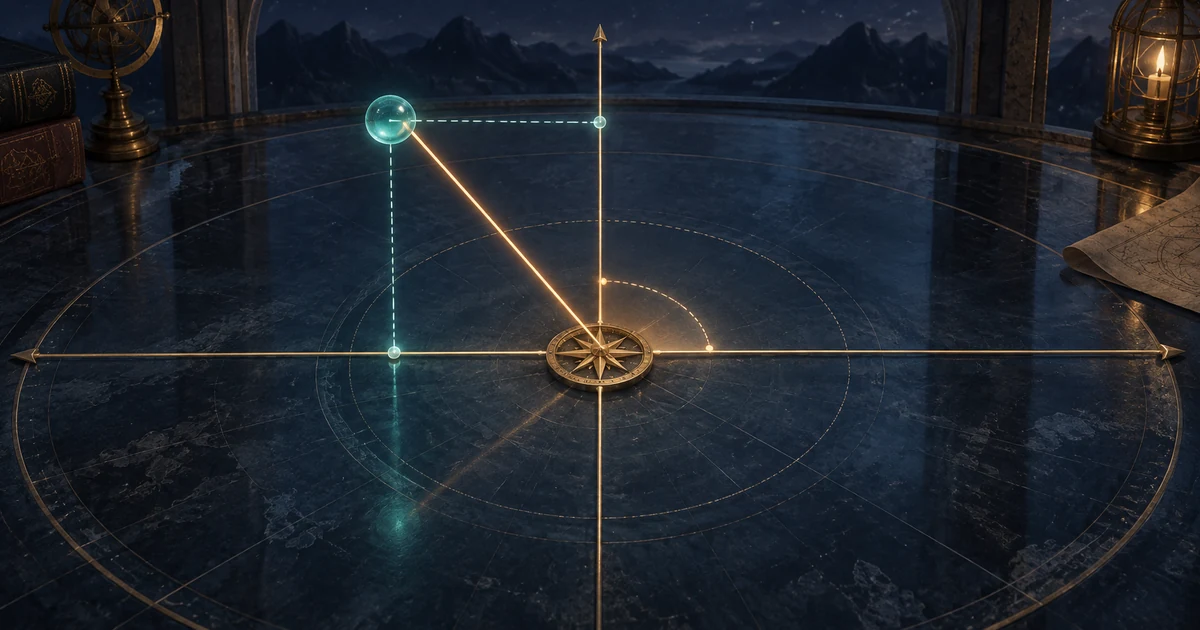
A complex number can look like a short algebraic expression and a point on a plane at the same time.
Take z = -3 + 4i. In algebra, it has a real part and an imaginary part. On the Argand plane, it is the point (-3, 4). From the origin, that point is 5 units away and lies in a particular direction.
Those two geometric facts are its modulus and argument.
Most mistakes in this topic do not come from the modulus formula. They come from finding a reference angle and forgetting to place it in the quadrant where the point actually lies. Once you learn to read the signs before touching the inverse-tangent key, the whole topic becomes much calmer.
The Argand Plane Turns a Number Into a Point
Write a complex number as:
z = x + iyHere:
x = Re(z)is the real part.y = Im(z)is the imaginary part.- The corresponding point is
P(x, y).
The horizontal axis is the real axis. The vertical axis is the imaginary axis.
Be careful with one small notation detail. In x + iy, the imaginary part is y, not iy. For example, if z = 6 - 5i, then:
Re(z) = 6
Im(z) = -5
So the point is (6, -5), which lies below the real axis.
| Signs of x and y | Position |
|---|---|
x > 0, y > 0 | Quadrant I |
x < 0, y > 0 | Quadrant II |
x < 0, y < 0 | Quadrant III |
x > 0, y < 0 | Quadrant IV |
y = 0, x != 0 | On the real axis |
x = 0, y != 0 | On the imaginary axis |
x = 0, y = 0 | At the origin |
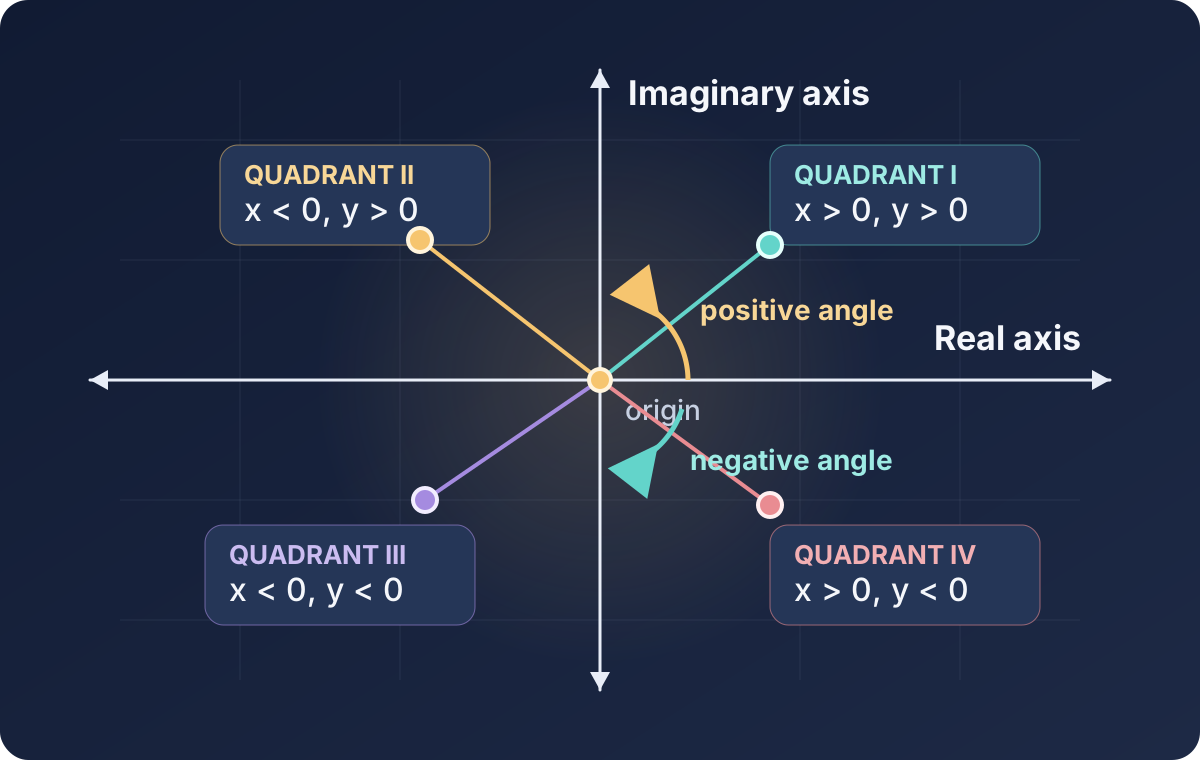
The point -3 + 4i has a negative real part and a positive imaginary part, so it lies in Quadrant II. We already know its direction must be between pi/2 and pi. Any calculator answer outside that range needs to be adjusted.
Modulus Means Distance From the Origin
For z = x + iy, the modulus is:
|z| = sqrt(x^2 + y^2)This is simply the Pythagorean distance from (0, 0) to (x, y). That is why the modulus is always non-negative.
For z = -3 + 4i:
|z| = sqrt((-3)^2 + 4^2)
    = sqrt(9 + 16)
    = 5
The negative real part is squared. It does not make the modulus negative.
Three facts are worth remembering:
|z| >= 0
|z| = 0 only when z = 0
|z|^2 = z times conjugate(z)
If z = x + iy, its conjugate is x - iy. Therefore:
z times conjugate(z)
= (x + iy)(x - iy)
= x^2 + y^2
= |z|^2
This identity connects the geometry to the algebra. It also explains why multiplying by the conjugate clears a complex denominator.
Argument Means Direction From the Positive Real Axis
For a non-zero complex number, an argument is an angle from the positive real axis to the line joining the origin to the point.
Counterclockwise rotation is positive. Clockwise rotation is negative.
If z = x + iy and theta is one of its arguments, then:
x = |z| cos(theta)
y = |z| sin(theta)
Dividing the second relation by the first gives:
tan(theta) = y/xThis is useful, but it is also the source of the most common error. The tangent function has the same value in two opposite quadrants. A calculator evaluating tan^-1(y/x) normally returns an angle between -pi/2 and pi/2. It cannot decide by itself whether your point lies on the right or the left half of the plane.
For example:
tan^-1(1) = pi/4But both 1 + i and -1 - i have y/x = 1. Their directions are not the same:
1 + ilies in Quadrant I, with principal argumentpi/4.-1 - ilies in Quadrant III, with principal argument-3pi/4under the convention used in this guide.
The ratio gives a line’s slope. The signs tell you which direction along that line the point occupies.
Reference Angle First, Quadrant Second
A safe method is to find the positive acute reference angle:
alpha = tan^-1(|y/x|)Then place that angle in the correct quadrant.
In this guide, the principal argument Arg(z) is chosen in:
-pi < Arg(z) <= pi| Position | Principal argument using reference angle alpha |
|---|---|
| Quadrant I | alpha |
| Quadrant II | pi - alpha |
| Quadrant III | -pi + alpha |
| Quadrant IV | -alpha |
| Positive real axis | 0 |
| Positive imaginary axis | pi/2 |
| Negative real axis | pi |
| Negative imaginary axis | -pi/2 |
Some questions instead choose the interval 0 <= theta < 2pi. The point does not change. Only the chosen name for its direction changes. Under that convention:
- Quadrant III uses
pi + alpha. - Quadrant IV uses
2pi - alpha. - The negative imaginary axis uses
3pi/2.
A Four-Quadrant Pattern You Can Reuse
Consider four numbers built from the same reference triangle:
sqrt(3) + i
-sqrt(3) + i
-sqrt(3) - i
sqrt(3) - i
Every one has modulus 2:
r = sqrt((sqrt(3))^2 + 1^2)
  = sqrt(3 + 1)
  = 2
Every one also has the same reference angle:
alpha = tan^-1(1/sqrt(3))
      = pi/6
Only the signs change the final direction.
| Complex number | Quadrant | Principal argument in (-pi, pi] |
|---|---|---|
sqrt(3) + i | I | pi/6 |
-sqrt(3) + i | II | 5pi/6 |
-sqrt(3) - i | III | -5pi/6 |
sqrt(3) - i | IV | -pi/6 |
This table is more useful than memorising four unrelated rules. The reference triangle stays fixed while the point travels around the plane.
Worked Example: Rectangular Form to Polar Form
Convert:
z = -3 + 3sqrt(3)ito polar form.
Step 1: Locate the quadrant
The real part is negative and the imaginary part is positive. Therefore, z lies in Quadrant II.
Step 2: Find the modulus
r = sqrt((-3)^2 + (3sqrt(3))^2)
  = sqrt(9 + 27)
  = 6
Step 3: Find the reference angle
tan(alpha) = |3sqrt(3)/(-3)|
           = sqrt(3)

alpha = pi/3
Step 4: Adjust for Quadrant II
theta = pi - alpha
      = pi - pi/3
      = 2pi/3
Step 5: Write the polar form
z = 6(cos(2pi/3) + i sin(2pi/3))Check by returning to rectangular coordinates:
6 cos(2pi/3) = 6(-1/2) = -3
6 sin(2pi/3) = 6(sqrt(3)/2) = 3sqrt(3)
The check reproduces the original number.
Polar Form Back to Rectangular Form
Now reverse the process. Convert:
z = 8(cos(7pi/6) + i sin(7pi/6))Since:
cos(7pi/6) = -sqrt(3)/2
sin(7pi/6) = -1/2
we get:
z = 8(-sqrt(3)/2) + 8i(-1/2)
  = -4sqrt(3) - 4i
The angle 7pi/6 is a valid argument. If the question asks for the principal argument in (-pi, pi], subtract 2pi:
7pi/6 - 2pi = -5pi/6So the same point can be written using 7pi/6 or -5pi/6. One full turn separates the angles.
Argument, General Argument and Principal Argument
An angle does not become a new direction after one full revolution. Therefore, a non-zero complex number has infinitely many arguments.
If theta is one argument of z, then all its arguments are:
theta + 2kpi, where k is any integerFor z = -4, one argument is pi. The complete family is:
arg(-4) = pi + 2kpi, k in ZUnder the interval (-pi, pi], the single principal value is:
Arg(-4) = piIt is useful to keep the notation separate:
arg(z)may refer to all possible arguments.Arg(z)commonly means one principal value selected from a stated interval.
Not every textbook uses the capital letter consistently, so the interval printed in the question is more important than the typography.
Why zero has no argument
The number 0 + 0i is at the origin. Its modulus is zero, but there is no line from the origin to a different point and therefore no direction to measure.
|0| = 0
arg(0) is undefined
Writing arg(0) = 0 is not a harmless shortcut. Zero is not pointing along the positive real axis. It is not pointing anywhere.
Conjugates Are Reflections Across the Real Axis
If:
z = x + iythen:
conjugate(z) = x - iyOn the Argand plane, the x-coordinate stays fixed and the y-coordinate changes sign. The point reflects across the real axis.
For example:
z = -2 + 5i
conjugate(z) = -2 - 5i
Both points have the same distance from the origin:
|z| = |conjugate(z)| = sqrt(29)Away from the negative real axis, reflection changes a principal argument theta to -theta under the convention (-pi, pi].
There is one boundary detail. A negative real number is its own conjugate, and its principal argument is pi. We do not write -pi because that endpoint is excluded from our chosen interval.
Multiplication Scales and Rotates
Polar form reveals what multiplication does geometrically. Suppose:
z1 = r1(cos(theta1) + i sin(theta1))
z2 = r2(cos(theta2) + i sin(theta2))
Then:
z1z2 = r1r2[
  cos(theta1 + theta2)
  + i sin(theta1 + theta2)
]
The moduli multiply and the arguments add. Multiplication combines a scaling with a rotation.
Let:
z1 = 2(cos(5pi/6) + i sin(5pi/6))
z2 = 3(cos(2pi/3) + i sin(2pi/3))
Then:
|z1z2| = 2 times 3 = 6
argument = 5pi/6 + 2pi/3
         = 5pi/6 + 4pi/6
         = 3pi/2
So:
z1z2 = 6(cos(3pi/2) + i sin(3pi/2))
     = -6i
The angle 3pi/2 is correct, but its principal representative in (-pi, pi] is -pi/2.
This leads to an important distinction:
arg(z1z2)
= arg(z1) + arg(z2)
  allowing full turns
but the sum of two principal arguments may fall outside the principal interval. Reduce it by adding or subtracting 2pi before calling it the principal argument.
Division Divides Lengths and Subtracts Angles
For non-zero z2:
|z1/z2| = |z1|/|z2|

arg(z1/z2)
= arg(z1) - arg(z2)
Consider:
z1 = 4(cos(-3pi/4) + i sin(-3pi/4))
z2 = 2(cos(pi/2) + i sin(pi/2))
Then:
z1/z2 = 2[cos(-5pi/4) + i sin(-5pi/4)]Add 2pi to place the angle in our principal interval:
-5pi/4 + 2pi = 3pi/4Therefore:
z1/z2 = 2(cos(3pi/4) + i sin(3pi/4))
= -sqrt(2) + sqrt(2)iDo Not Add Moduli or Arguments Across a Sum
The elegant polar rules belong to multiplication and division, not ordinary addition.
Take:
z1 = 1 + i
z2 = 1 - i
Both have modulus sqrt(2), but:
z1 + z2 = 2
|z1 + z2| = 2
This is not sqrt(2) + sqrt(2).
Their principal arguments are pi/4 and -pi/4, while the sum has argument 0. That happens to equal the sum of these two angles, but it is not a general addition rule. Change one point and the shortcut fails.
For a sum or difference, first combine real parts and imaginary parts. Then find the modulus and argument of the resulting complex number.
A Mixed Example With a Principal-Angle Wrap
Evaluate the modulus and principal argument of:
w = [(-sqrt(3) + i)(1 + i)]/(1 - i)Use polar information for each factor:
| Number | Modulus | Principal argument |
|---|---|---|
-sqrt(3) + i | 2 | 5pi/6 |
1 + i | sqrt(2) | pi/4 |
1 - i | sqrt(2) | -pi/4 |
The modulus is:
|w| = (2 times sqrt(2))/sqrt(2)
    = 2
An argument is:
5pi/6 + pi/4 - (-pi/4)
= 5pi/6 + pi/2
= 4pi/3
That angle is outside (-pi, pi]. Subtract 2pi:
Arg(w) = 4pi/3 - 2pi
       = -2pi/3
Therefore:
w = 2[cos(-2pi/3) + i sin(-2pi/3)]
  = -1 - sqrt(3)i
The signs in this rectangular form confirm Quadrant III, exactly where the principal angle -2pi/3 should point.
Distance and Simple Loci on the Argand Plane
The modulus can measure more than distance from the origin. If z and a are complex numbers, then:
|z - a|is the distance between their two points.
Distance between two points
Let:
z1 = -1 + 2i
z2 = 3 - i
Then:
z1 - z2 = (-1 - 3) + (2 - (-1))i
        = -4 + 3i

distance = |z1 - z2|
         = sqrt((-4)^2 + 3^2)
         = 5
Circle
The condition:
|z - (2 + i)| = 3describes every point whose distance from 2 + i is 3. It is a circle with centre (2, 1) and radius 3.
Ray
The condition:
Arg(z) = pi/3describes a ray beginning just beyond the origin and making an angle pi/3 with the positive real axis. The origin itself is excluded because its argument is undefined.
Perpendicular bisector
The condition:
|z| = |z - 4|says that the point z is equally distant from 0 and 4 on the real axis. Therefore, the locus is the perpendicular bisector of the segment joining them:
Re(z) = 2These interpretations let you see many locus questions before expanding a single square.
The Mistakes That Cost the Most Marks
1. Reading the point as (x, iy)
The coordinates of x + iy are (x, y). The imaginary coordinate is a real number.
2. Losing the sign of the imaginary part
For 5 - 2i, the y-coordinate is -2, not 2. The point is in Quadrant IV.
3. Writing a negative modulus
Modulus is a distance. It can be zero, but never negative.
4. Treating tan^-1(y/x) as the final answer
It is final only when the point is on the right half-plane and the chosen branch agrees. In Quadrants II and III, a pi adjustment is necessary.
5. Dividing by zero on an axis
If x = 0, do not calculate y/x. Read the direction directly as pi/2 or -pi/2.
6. Giving an argument to zero
The modulus of zero exists. Its argument does not.
7. Mixing degrees and radians
60 degrees and pi/3 describe the same angle. Choose one system and keep it consistent throughout the calculation.
8. Forgetting the requested principal interval
5pi/3 and -pi/3 point in the same direction, but only one may lie in the interval specified by the question.
9. Adding arguments for a sum
Argument addition belongs to products. Add complex numbers in rectangular form first.
10. Forgetting to verify the quadrant
After finding an angle, check whether its cosine and sine have the same signs as the original real and imaginary parts.
A Reliable Six-Step Method
When asked for the modulus and argument of z = x + iy, use this order:
- Write x and y with their signs.
- Place the point in a quadrant or on an axis.
- Find the modulus using
sqrt(x^2 + y^2). - Find the positive reference angle using
tan^-1(|y/x|)when both coordinates are non-zero. - Convert the reference angle to the correct quadrant.
- Check the requested interval and verify the signs of cosine and sine.
This order makes the geometry supervise the algebra. Even if a calculator gives a surprising angle, the quadrant check catches it.
Practice Questions With Answers
Work through these before checking the answers. Use the principal interval (-pi, pi] unless another interval is stated.
- Find the quadrant and modulus of
4 - 3i. - Find the principal argument of
-1 + sqrt(3)i. - Find the modulus and principal argument of
-5. - Find the modulus and principal argument of
6i. - State the modulus and argument of zero.
- Convert
4(cos(5pi/3) + i sin(5pi/3))to rectangular form. - If
z = -7 + 2i, write its conjugate and compare their moduli. - Find the principal argument of a product whose factor arguments are
3pi/4and2pi/3. - Find the distance between
-1 + 2iand3 - i. - Describe the locus
|z + 2i| = 4.
Answers
- Quadrant IV and modulus 5.
2pi/3.- Modulus 5 and principal argument
pi. - Modulus 6 and principal argument
pi/2. - Modulus 0; argument undefined.
2 - 2sqrt(3)i.- The conjugate is
-7 - 2i; both moduli aresqrt(53). - The angle sum is
17pi/12; subtract2pito get the principal argument-7pi/12. - The distance is 5.
- A circle with centre
(0, -2)and radius 4.
If you want to continue from polar form into a powerful special pattern, read our guide to cube roots of unity.
Sources Used for This Guide
- NCERT, Complex Numbers and Quadratic Equations, for the real and imaginary parts, conjugate, modulus and Argand-plane representation.
- NIOS, Complex Numbers, for worked modulus and Argand-plane examples.
- OpenStax, Polar Form of Complex Numbers, for rectangular-to-polar conversion and polar operations.
- MIT OpenCourseWare, Complex Numbers and Exponentials, for the geometric meaning of magnitude, argument, conjugation, multiplication and division.
- MIT Mathematics, Complex Numbers Notes, for principal-angle conventions and the warning about the one-variable inverse tangent.
Frequently Asked Questions
What is an Argand plane?
It is a coordinate plane for complex numbers. The horizontal axis represents real parts and the vertical axis represents imaginary parts. The number x + iy is plotted at (x, y).
Is the imaginary part of x + iy equal to iy?
No. The imaginary part is the real coefficient y. For 3 - 7i, the imaginary part is -7.
Can the modulus of a complex number be negative?
No. Modulus is a distance, so it is always non-negative. Only the zero complex number has modulus 0.
Why is tan^-1(y/x) sometimes wrong?
It returns an angle in a limited range and cannot distinguish opposite directions with the same tangent. Use the signs of x and y to choose the correct quadrant.
What is the difference between arg(z) and Arg(z)?
arg(z) may represent the infinite family of angles differing by 2pi. Arg(z) usually represents one principal value from a chosen interval. Check the notation and interval given in the question.
Which principal-argument interval should I use?
Use the interval specified in the question or textbook. Two common choices are (-pi, pi] and [0, 2pi). This guide uses (-pi, pi].
What is the principal argument of a negative real number?
Under (-pi, pi], it is pi. Under [0, 2pi), it is also pi.
What is the argument of zero?
It is undefined because the origin has no direction from itself. Its modulus is 0.
What does conjugation do on the Argand plane?
It reflects the point across the real axis. The modulus stays the same, while the sign of the imaginary part changes.
Can I add the arguments when I add two complex numbers?
No. The argument-addition rule applies to multiplication. For a sum, first add the real and imaginary parts, then find the argument of the result.
Are degrees allowed instead of radians?
They describe the same directions, but you must follow the form requested by the question and stay consistent. Polar-form calculations are usually cleaner in radians.
Is the polar form of a complex number unique?
Its modulus is unique, but its angle is not. Adding any integer multiple of 2pi gives another valid argument for the same non-zero complex number.
Looking for commerce tuitions?
Prachi is a gold-medalist commerce teacher with experience at Deloitte and KPMG. She focuses on fundamentals to build a strong foundation.