
 Whatsapp
Increasing vs Strictly Increasing Functions: Derivatives and Intervals
Understand increasing and strictly increasing functions with derivative sign charts, zero-slope examples, interval endpoints, parameter questions, and practice.
- 12th

You differentiate a function, find that its derivative is zero at one point, and pause. Does that single zero mean the function has stopped increasing?
It might feel that way, but a horizontal tangent is not the same thing as a horizontal stretch. A curve can have a level tangent for an instant and still give a larger output whenever you choose a larger input.
That distinction is the heart of increasing vs strictly increasing functions. Once it makes sense, derivative sign charts, interval endpoints, and those awkward parameter questions become much easier to handle.
We will start with the meaning of the words, then work through examples where the tempting shortcut gives the wrong answer.
Increasing vs strictly increasing: start with two inputs
Choose any two different inputs in the interval, with x1 < x2. Now compare their outputs.
| Description | Required comparison | Can different inputs have equal outputs? |
|---|---|---|
| Nondecreasing, also called increasing in the weak sense | f(x1) <= f(x2) | Yes |
| Strictly increasing | f(x1) < f(x2) | No |
| Nonincreasing, also called decreasing in the weak sense | f(x1) >= f(x2) | Yes |
| Strictly decreasing | f(x1) > f(x2) | No |
Here, <= means less than or equal to, and >= means greater than or equal to. The comparison must work for every pair of ordered inputs in the interval. A few rising values in a table are useful clues, but they do not prove a claim about all real inputs.
There is a small vocabulary trap: some textbooks use “increasing” for the weak comparison, while others use it for the strict comparison. APEX Calculus explicitly separates the two; OpenStax uses increasing for the strict comparison.
In this guide, nondecreasing will always allow equality, and strictly increasing will always require a larger output. In your answer, follow the definition stated in the question or your textbook, and write the inequality when the wording could be unclear.
For example, f(x) = 4x + 7 is strictly increasing on the real line: raising x by any positive amount raises the output by four times that amount. By contrast, g(x) = 7 is nondecreasing and nonincreasing, because every output is equal. On an interval containing two different points, it is neither strictly increasing nor strictly decreasing.
What the derivative can prove
For the following tests, assume the function is differentiable throughout the open interval being studied. If you include finite endpoints, also check that the function is continuous there.
| Derivative throughout the interval’s interior | Conclusion |
|---|---|
f'(x) > 0 everywhere | Strictly increasing |
f'(x) >= 0 everywhere | Nondecreasing; check further for strictness |
f'(x) < 0 everywhere | Strictly decreasing |
f'(x) <= 0 everywhere | Nonincreasing; check further for strictness |
f'(x) = 0 everywhere | Constant |
The continuity and differentiability assumptions belong to the test. NCERT’s Applications of Derivatives, section 6.3, states them before applying the derivative-sign theorem.
To see why the positive-derivative test works, choose a < b within your interval. The Mean Value Theorem gives a point c between them such that:
f(b) - f(a) = f'(c)(b - a)Since b - a is positive, a positive f'(c) makes the output difference positive too. A nonnegative derivative guarantees only a nonnegative difference. This is the reasoning behind the Mean Value Theorem’s monotonicity consequence.
The arrow matters. “Positive derivative everywhere implies strict increase” is true. Reversing it to “strict increase implies positive derivative everywhere” is false.
If a strictly increasing function is differentiable at an interior point, its derivative cannot be negative there. But it can be zero. Let’s make that possibility visible.
Example 1: a zero derivative without losing strict increase
Consider:
f(x) = (x - 2)^3 + 5
f'(x) = 3(x - 2)^2
The derivative is positive whenever x != 2, and it equals zero at x = 2. The symbol != means not equal to.
Here are five points on the curve:
| x | f(x) |
|---|---|
| 0 | -3 |
| 1 | 4 |
| 2 | 5 |
| 3 | 6 |
| 4 | 13 |
The values keep rising through x = 2. To prove that this holds for every pair, take a < b and write u = a - 2, v = b - 2. Then:
f(b) - f(a) = v^3 - u^3
  = (v - u)(v^2 + uv + u^2)

v^2 + uv + u^2
  = (v + u/2)^2 + 3u^2/4
The first factor is positive. The second is also positive when u and v are different: it could be zero only if both were zero. Therefore, f(b) > f(a).
The function is strictly increasing on the entire real line, including across x = 2. Its tangent there is horizontal, but its graph has no level stretch.
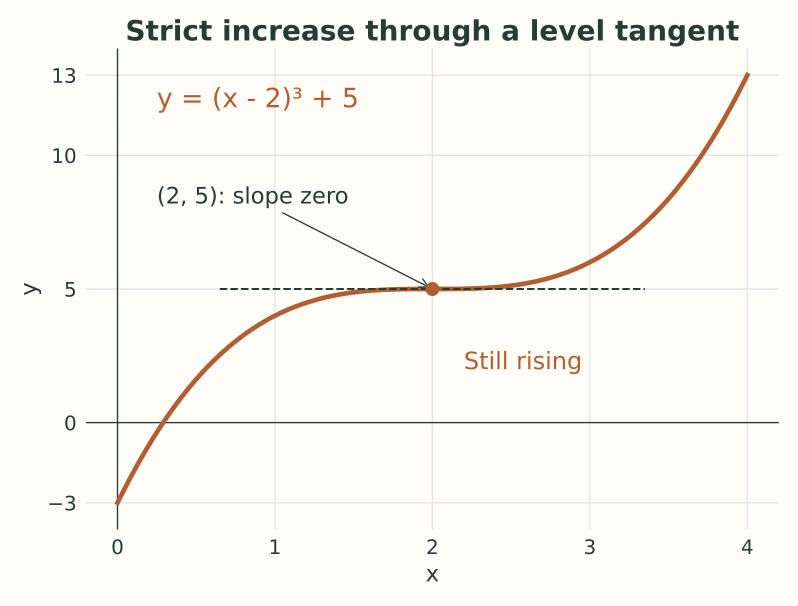
The familiar unshifted example is x^3. The University of Nebraska-Lincoln’s calculus lesson uses it to show why an increasing function need not have a strictly positive derivative everywhere.
Example 2: nonnegative derivative with a real plateau
Now compare the previous curve with this function:
x < -1:        g(x) = (x + 1)^3
-1 <= x <= 1:  g(x) = 0
x > 1:         g(x) = (x - 1)^3
The left piece rises towards zero. The middle stays at zero. The right piece rises away from zero. These pieces meet continuously, and their derivatives also fit together at x = -1 and x = 1.
Its derivative is:
x < -1:
  g'(x) = 3(x + 1)^2
-1 <= x <= 1:
  g'(x) = 0
x > 1:
  g'(x) = 3(x - 1)^2
So g'(x) >= 0 for every real x. Yet g(-0.5) = g(0.5) = 0, despite -0.5 < 0.5.
The function is nondecreasing on the real line but not strictly increasing there. It is strictly increasing on each outer interval (-infinity, -1] and [1, infinity), and constant on [-1, 1].
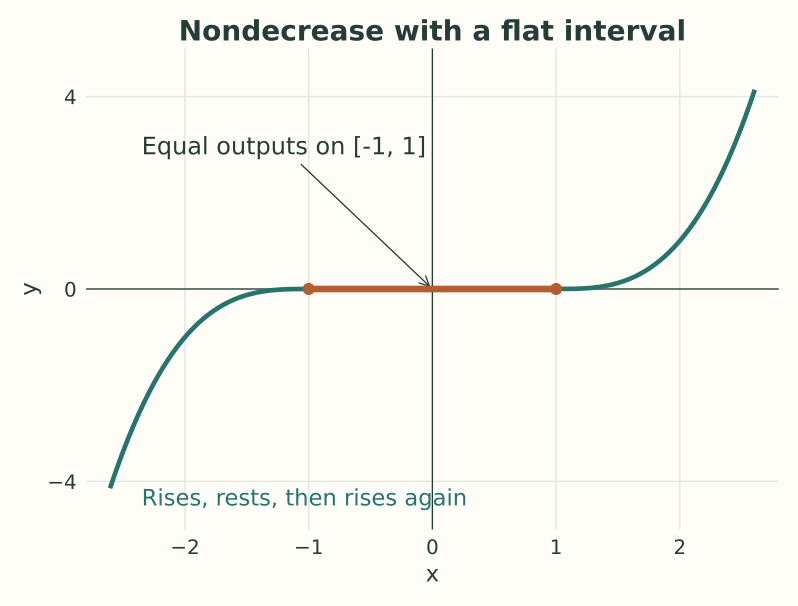
Notice the difference between the two examples. In the first, the zero derivative belongs to one input. In the second, it belongs to every input in a stretch with positive length.
A useful way to finish the strictness check
Suppose a differentiable function has a nonnegative derivative throughout an interval. It is already nondecreasing. If two different inputs a < b had the same output, then every intermediate input t would satisfy:
f(a) <= f(t) <= f(b)Because the two outside values are equal, every middle value must equal them. The function would be constant on [a, b].
This gives a practical conclusion: a nondecreasing function with no constant subinterval of positive length is strictly increasing. For a differentiable function, such a constant subinterval would have derivative zero throughout its interior.
If your derivative is positive except at finitely many isolated zeros, no whole subinterval can have zero derivative everywhere. Strict increase survives those isolated zeros. APEX Calculus also records the finite-zero extension to the derivative test.
How to build a derivative sign chart
Use this order when a question asks for increasing and decreasing intervals:
- Write the domain. Mark excluded inputs before doing any cancellation.
- Differentiate and factor. A factored derivative makes signs easier to track.
- Mark every possible boundary. Include derivative zeros, points where the derivative does not exist, and breaks in the domain.
- Check the derivative’s sign between boundaries. Use factor signs or a convenient test input in each interval.
- Translate signs into behavior. Positive means strict increase; negative means strict decrease.
- Check joining points and endpoints. Decide whether neighboring pieces can form a larger monotonic interval.
For the polynomial and rational functions below, the derivative is continuous between the marked boundaries. Once all its zeros and undefined points are accounted for, its sign cannot change inside one of those pieces. That is why a test input works. One positive derivative value at an arbitrary input does not prove increase over an unchecked interval.
A point where the function exists but its derivative is zero or undefined is a critical point. A hole where the function itself is undefined is a domain break, not a critical point of that function. Both deserve a mark on your working number line.
Example 3: a cubic with two direction changes
Find the intervals for:
f(x) = x^3 - 6x^2 + 9x + 2
f'(x) = 3x^2 - 12x + 9
      = 3(x - 1)(x - 3)
The domain is the real line. The derivative vanishes at x = 1 and x = 3.
| Interval | Sign of x - 1 | Sign of x - 3 | Sign of f’ | Behavior |
|---|---|---|---|---|
(-infinity, 1) | Negative | Negative | Positive | Strictly increasing |
(1, 3) | Positive | Negative | Negative | Strictly decreasing |
(3, infinity) | Positive | Positive | Positive | Strictly increasing |
These are the open intervals where the derivative has a strict sign. Since the polynomial is continuous at both boundary points, the corresponding maximal intervals of strict monotonicity are:
- Strictly increasing on
(-infinity, 1]and, separately, on[3, infinity). - Strictly decreasing on
[1, 3].
Here “maximal” means that you cannot extend the interval any further while retaining that behavior. At x = 1, the curve reaches f(1) = 6, then falls. At x = 3, it reaches f(3) = 2, then rises.
The shared endpoints do not create a contradiction. The statement “increasing up to x = 1” concerns pairs on its left, while “decreasing from x = 1” concerns pairs on its right. Neither statement says that the curve increases through a whole neighborhood of x = 1.
If an exercise asks specifically where f'(x) > 0, give the open intervals and exclude the zeros. If it asks for maximal intervals on which f is strictly increasing, the included endpoints above are mathematically justified. Writing the sign intervals first and then explaining endpoint inclusion makes your reasoning clear.
Example 4: a repeated root need not change the direction
Suppose a function has derivative:
f'(x) = (x + 2)^2(x - 1)The derivative is zero at x = -2 and x = 1. Away from -2, the squared factor is positive, so the sign comes from x - 1.
| Interval | Derivative sign | What f does |
|---|---|---|
(-infinity, -2) | Negative | Strictly decreases |
(-2, 1) | Negative | Strictly decreases |
(1, infinity) | Positive | Strictly increases |
There is no sign change at -2. Assuming f is differentiable on the real line as stated, the two decreasing pieces join through that stationary point. The maximal intervals are strict decrease on (-infinity, 1] and strict increase on [1, infinity).
At x = 1, the derivative changes from negative to positive, producing a local minimum. At x = -2, the curve keeps falling through a horizontal tangent. It is not a local maximum or minimum there.
For a factored polynomial derivative, a root of even multiplicity preserves the sign, while a root of odd multiplicity reverses it. Still inspect all the factors. The important evidence is the sign on each side, not simply the equation f'(x) = 0. This is the distinction developed in OpenStax’s first derivative test.
Domain gaps: why separate intervals must stay separate
Consider h(x) = 1/x. Its derivative is:
h'(x) = -1/x^2 < 0, for x != 0Therefore h is strictly decreasing on (-infinity, 0) and strictly decreasing on (0, infinity).
It is tempting to shorten that to “strictly decreasing on its whole domain.” Test that claim with two inputs on opposite sides of the gap:
-2 < 2
h(-2) = -1/2
h(2)  = 1/2
The later input gives a larger output, contradicting strict decrease. The separate interval statements remain correct; the whole-domain claim does not.
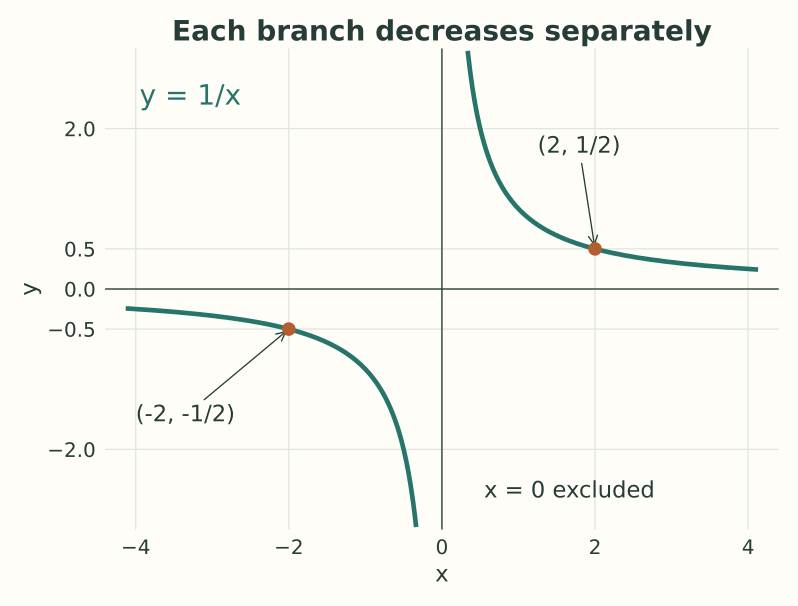
The derivative test works on intervals contained in the domain. It cannot bridge a missing input. A union such as (-infinity, 0) U (0, infinity) describes both pieces as a set, but it does not prove the pairwise monotonicity condition across the pieces. In prose, write “on each interval separately.”
Cancellation does not restore a missing input either. If an original fraction excludes x = 4, that restriction remains after simplifying, unless a new function value at 4 is explicitly supplied.
Endpoints and corners: check the function itself
The function s(x) = sqrt(x) is strictly increasing on [0, infinity). Its derivative 1/(2sqrt(x)) is positive for x > 0 and is not defined as a finite derivative at zero. That does not prevent including zero: the function is continuous there and its output comparison still works.
Similarly, |x| is strictly decreasing on (-infinity, 0] and strictly increasing on [0, infinity). There is a corner at zero. A missing derivative does not automatically mean a missing function value or a broken graph.
However, you cannot attach an endpoint blindly. Define a different function on [0, 2] by:
p(0) = 9
p(x) = x, for 0 < x <= 2
Its derivative is 1 throughout (0, 2), but it is not nondecreasing on [0, 2]: 0 < 1 while p(0) = 9 > p(1) = 1. The endpoint value breaks continuity and reverses the required comparison.
This is why the assumptions in the theorem matter. If you include an endpoint, check the value and continuity rather than looking only at the interior derivative. For a piecewise join, check the two sides and the joining value before merging intervals.
For a refresher on brackets, excluded points, and the real number line, see our guide to interval notation and sets.
Example 5: a parameter question where equality belongs
Find every real k for which the following function is strictly increasing on the real line:
F(x) = x^3 - 6x^2 + kx + 1
F'(x) = 3x^2 - 12x + k
      = 3(x - 2)^2 + k - 12
The square is smallest at x = 2, where the derivative equals k - 12. Now separate three cases.
If k > 12: the derivative is positive everywhere, so F is strictly increasing.
If k = 12: the derivative is 3(x - 2)^2. It vanishes only at x = 2. In fact:
F(x) = (x - 2)^3 + 9This is a shifted cubic of the kind already proved strictly increasing. Therefore, the equality case is allowed.
If k < 12: the derivative is negative at x = 2. More explicitly, it is negative whenever:
|x - 2| < sqrt((12 - k)/3)The function decreases on that neighborhood, so it cannot be strictly increasing on the real line.
The answer is k >= 12. Solving only for a derivative that is positive everywhere would give k > 12 and wrongly discard the boundary value.
A commerce example: rising revenue with a falling marginal revenue
Suppose a simplified continuous model gives a shop’s total revenue as:
R(q) = 100q - q^2
0 <= q <= 100
Here q represents output and the model treats it as continuous for differentiation. The associated price per unit is 100 - q, so the stated range keeps that price nonnegative. Revenue is measured in rupees.
Differentiate:
R'(q) = 100 - 2qMarginal revenue is positive below q = 50 and negative above it. Thus total revenue is strictly increasing on [0, 50] and strictly decreasing on [50, 100].
At q = 50, marginal revenue is zero. Revenue still increases all the way up to that endpoint:
R(49) = 2,499
R(50) = 2,500
R(51) = 2,499
Also notice that marginal revenue itself falls as q increases. Between q = 10 and q = 20, marginal revenue falls from 80 to 60, while total revenue rises from 900 to 1,600.
A function can rise while its derivative falls. The sign of R' tells you whether revenue rises or falls; the change in R' tells you how that rate changes. Similarly, a positive revenue figure says nothing by itself about whether revenue is increasing. At q = 60, revenue is positive at 2,400, but marginal revenue is negative at -20.
Eight practice questions with answers
Try writing the domain and one line of reasoning before checking each answer. Unless a question says otherwise, find the largest intervals on which the stated behavior holds.
1. Classify a constant
For f(x) = -6 on [1, 5], is f nondecreasing, nonincreasing, strictly increasing, or strictly decreasing?
Answer: Nondecreasing and nonincreasing. Neither strict description holds, since any two different inputs give equal outputs.
2. Handle one stationary point
Is f(x) = (x + 3)^3 - 4 strictly increasing on the real line?
Answer: Yes. The derivative is 3(x + 3)^2, positive except at x = -3. This isolated zero creates no constant interval.
3. Include the turning point correctly
Find the monotonicity intervals of f(x) = x^2 + 6x + 11.
Answer: Since f'(x) = 2(x + 3), f is strictly decreasing on (-infinity, -3] and strictly increasing on [-3, infinity). The intervals where the derivative is strictly negative or positive exclude -3.
4. Track an even power
A differentiable function on the real line has f'(x) = (x - 4)^2(x + 1). Find its strict monotonicity intervals.
Answer: Strictly decreasing on (-infinity, -1] and strictly increasing on [-1, infinity). The derivative touches zero at 4 without changing its positive sign on either side.
5. Keep a rational function’s domain break
Find the intervals for f(x) = x + 4/x.
Answer: The domain excludes zero, and f'(x) = (x^2 - 4)/x^2. Strict increase occurs on (-infinity, -2] and [2, infinity), separately. Strict decrease occurs on [-2, 0) and (0, 2], separately. Zero remains excluded.
6. Test a boundary parameter
For which real a is f(x) = x^3 + ax strictly increasing on the real line?
Answer: a >= 0. Positive a gives a positive derivative everywhere. At a = 0, the function is x^3 and remains strictly increasing. Negative a makes the derivative negative near zero.
7. Read the derivative rather than its trend
For f(x) = 20x - x^2 on [0, 8], the derivative decreases throughout the interval. Does f decrease?
Answer: No. f'(x) = 20 - 2x stays positive, so f is strictly increasing on [0, 8]. Its slope decreases, but the outputs rise.
8. Check a piecewise join
Define f(x) = x for x < 0 and f(x) = x - 5 for x >= 0. Each piece has derivative 1 away from zero. Is f strictly increasing on the real line?
Answer: No. For example, -1 < 0, but f(-1) = -1 > -5 = f(0). The downward jump prevents joining the two increasing pieces into a whole-line claim.
A quick check before you finish
Read your final answer as a statement about pairs of inputs. A larger input must produce a larger output for strict increase, and it must never produce a smaller output for nondecrease.
Then check the three places where shortcuts tend to fail: a derivative zero, an interval endpoint, and a gap or join in the domain. Give each one a reason. Once those checks are in place, your interval answer says exactly what you have proved.
Sources for further reading
- NCERT, Mathematics Part I, 2026-27 reprint: Applications of Derivatives, section 6.3, for the school-level derivative test and its assumptions.
- OpenStax, Calculus Volume 1: The Mean Value Theorem, section 4.4, for the link between derivative signs and output comparisons.
- Gregory Hartman and collaborators, APEX Calculus 3e: Increasing and Decreasing Functions, section 3.3, for weak and strict terminology, isolated derivative zeros, and domain restrictions.
- University of Nebraska-Lincoln, Contemporary Calculus: First Derivative Test, for why a strictly increasing function can have a zero derivative.
- OpenStax, Calculus Volume 1: Derivatives and the Shape of a Graph, section 4.5, for sign changes, stationary points, and the distinction between a function and its derivative.
Frequently asked questions
What is the difference between increasing and strictly increasing?
When increasing is used in the weak sense, larger inputs may give equal outputs. Strictly increasing means every larger input gives a larger output. Since terminology varies, check the stated inequality; nondecreasing always makes the weak meaning clear.
Can a strictly increasing function have a zero derivative?
Yes. For example, (x - 2)^3 + 5 is strictly increasing on the real line, although its derivative is zero at x = 2. A horizontal tangent at one point does not create a flat interval.
Does a nonnegative derivative prove strict increase?
It proves nondecrease under the derivative test’s assumptions. To establish strict increase, also rule out constant subintervals of positive length. A derivative that is positive except at finitely many isolated points passes that additional check.
Does a positive derivative at one point prove increase on an interval?
No. A claim about an interval needs control throughout that interval. In a sign chart, a test input is useful only after you have located all possible sign boundaries and justified why the sign stays unchanged between them.
Is a constant function increasing?
It is nondecreasing and nonincreasing. If increasing means strictly increasing in your question, a constant function does not qualify on an interval containing two different points.
Should I include a point where the derivative is zero?
Exclude it when listing where the derivative is strictly positive or negative. It may be included in an interval of strict monotonicity of the function. Check the function’s continuity, output comparisons, and behavior around the point.
Can an interval be both increasing and decreasing at the same endpoint?
A point can be the end of an increasing interval and the start of a decreasing interval, as at a local maximum. These statements concern different intervals; they do not claim both behaviors through the same neighborhood.
Can I join intervals across a point outside the domain?
You cannot apply the interval derivative test across that gap. Analyze each domain interval separately. A claim about their union would require additional comparisons across the gap and can fail, as it does for 1/x.
Does every derivative zero give a maximum or minimum?
No. Inspect the derivative’s signs on either side. A change from positive to negative gives a local maximum under the usual continuity assumptions; negative to positive gives a local minimum. The same sign on both sides can give a stationary point without an extremum.
Can a function increase while its derivative decreases?
Yes. If the derivative remains positive, the function rises even as its slope gets smaller. In the revenue model R(q) = 100q - q^2, this happens for output between 0 and 50.
Does an undefined derivative mean the function is not monotonic?
No. A corner or vertical tangent requires a separate check, not automatic rejection. For instance, sqrt(x) is strictly increasing on [0, infinity) even though it has no finite derivative at zero.
Why should I check equality in a parameter answer?
The boundary parameter may leave only an isolated derivative zero, which is compatible with strict increase. It may instead make the function constant. Substitute the boundary value and examine the resulting function before choosing a strict or inclusive inequality.
Looking for commerce tuitions?
Prachi is a gold-medalist commerce teacher with experience at Deloitte and KPMG. She focuses on fundamentals to build a strong foundation.